
Vir Biotechnology Confronts Commercial Challenges and Advances Pipeline Amid Collaboration Obligations
Vir Biotechnology's latest quarter reflects ongoing R&D investment, limited commercialization, and strategic reliance on collaborations with inherent risks.
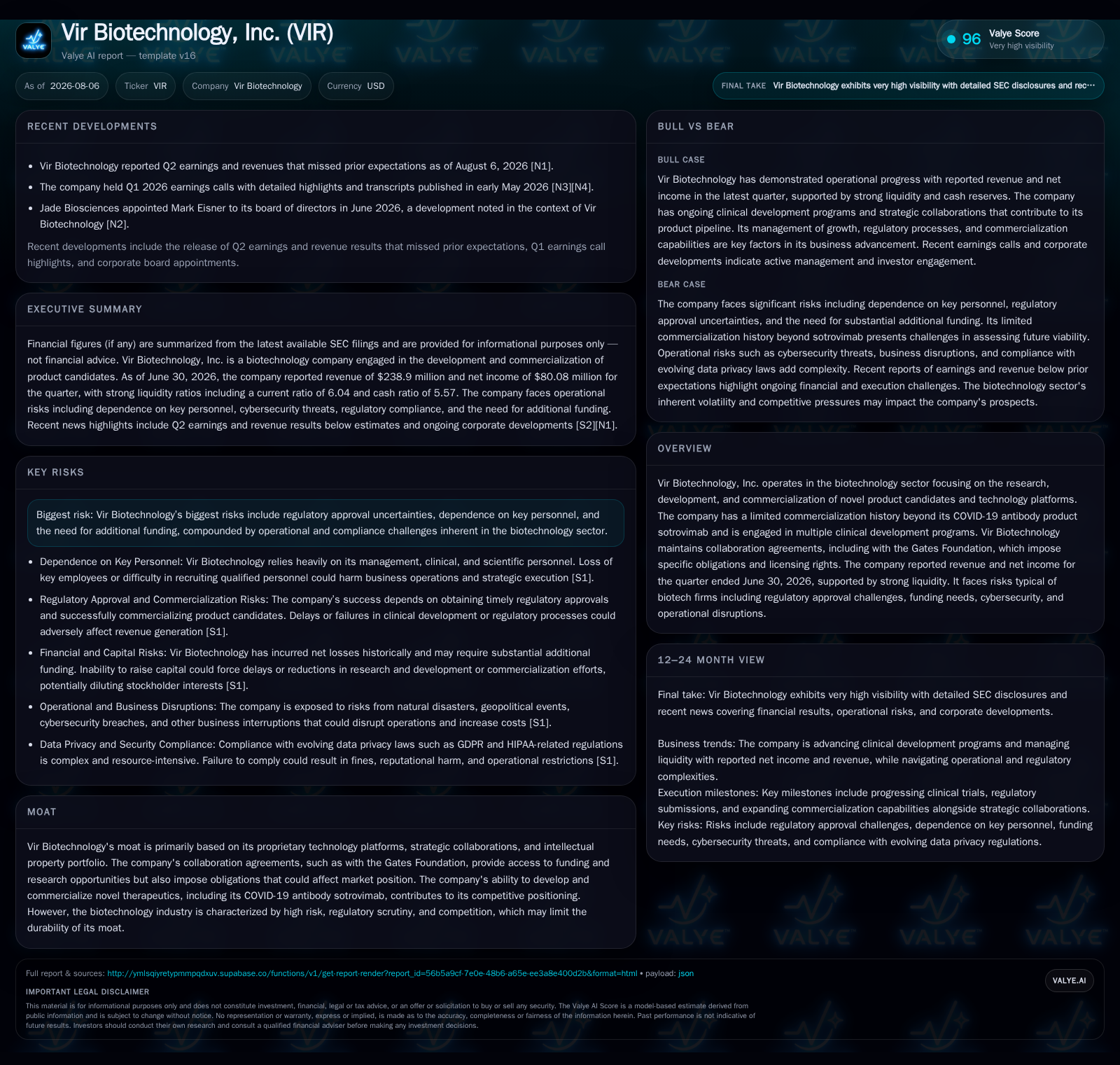
Vir Biotechnology's Q2 2026 results indicate continued net losses despite revenue from COVID-19 antibody sales and collaboration agreements. The company’s primary commercial product sotrovimab faces market pressures typical for early-stage biotech commercialization, while its pipeline advancement is supported by collaborations, notably with the Gates Foundation. Key risks include regulatory hurdles, funding needs, and potential contractual obligations that may affect competitive positioning. Financially, Vir maintains strong liquidity and a healthy current ratio but anticipates ongoing R&D spending consistent with pipeline development. Monitoring clinical milestones and regulatory approvals will be critical to assessing its progress.
Recent Operating Update: Q2 2026 Reflects Revenue Generation from COVID-19 Therapeutic during Continuing Losses
Vir Biotechnology's second quarter ending June 30, 2026 showed ongoing top-line receipt primarily arising from limited sales of its COVID-19 antibody product sotrovimab alongside revenue from licensing and collaboration agreements [S2]. Despite these inflows, the company recorded persistent net losses fueled by high research and development (R&D) expenses aimed at advancing multiple clinical programs plus selling, general and administrative (SG&A) costs linked to building commercial capabilities [S2]. This operating loss pattern is typical for biotechnology developers progressing novel biologics through costly clinical trials prior to securing broad regulatory approvals or meaningful market penetration.
The filing emphasized that while sotrovimab remains the sole commercialized product contributing to revenue streams, broader commercialization efforts are nascent [S2]. The company continues to invest heavily in clinical development infrastructure – encompassing patient enrollment in studies across various disease areas – reflecting considerable cash burn consistent with early-stage biotech models [S2].
Business Model: Revenue From Product Sales Limited; Collaboration Agreements Are Strategic Pillars
Vir’s business model centers on leveraging proprietary biologic therapeutics technology platforms to develop a diversified pipeline of infectious disease treatments. Revenue generation hinges on eventual commercialization of approved products like sotrovimab combined with milestone payments, licensing fees, and grants obtained via collaborations [S1]. The monetization mechanics involve upfront and milestone-based payments embedded in partnership contracts combined with direct sales where regulatory approvals have been attained.
Crucially, Vir maintains a significant strategic collaboration with the Gates Foundation which provides both financial support and access to specific targeted disease programs such as HIV and tuberculosis [S1]. Under this arrangement, Vir commits to using proceeds for defined purposes and adhering to global access obligations. Failure to meet these terms triggers redemption rights for the Gates Foundation and potential license-back provisions permitting non-exclusive use of intellectual property to benefit low- and middle-income countries [S1]. These legal commitments shape Vir’s development priorities but also expose it to competitive risks should the foundation exercise licensing rights in overlapping therapeutic areas.
This interplay between capital infusion benefits and contractual tradeoffs exemplifies how collaboration agreements serve as dual-edged swords influencing both R&D strategy direction and downstream market dynamics.
Industry Structure and Competitive Position: Early-Stage Biotech With Proprietary Therapeutics Platform
Operating within the highly regulated biotechnology sector characterized by long timelines from discovery through clinical validation to commercialization, Vir Biotechnology sits at the drug discovery through early commercialization end of the value chain. Like peers such as Regeneron Pharmaceuticals or Gilead Sciences in their earlier growth phases, Vir exhibits a pipeline-progress-driven profile where success depends on achieving clinical trial milestones, securing regulatory approvals across multiple jurisdictions, and subsequently scaling manufacturing plus commercialization capabilities.
Within this ecosystem, competition stems not only from other biotechs developing novel infectious disease therapies but also larger pharmaceutical companies engaging in similar pipeline areas or collaborating/partnering with academia or contract research organizations (CROs). Vir differentiates itself primarily through its proprietary technology platform targeting immune modulation against pathogens plus deep scientific expertise fostered by its partnerships including those with philanthropic institutions.
The company’s ability to perform on trial enrollment rates, reduce development cycle times without compromising safety/efficacy data integrity, navigate complex regulatory pathways timely, and expand collaborative deal count under favorable terms constitute key operational benchmarks reflective of its competitive standing.
Growth Drivers: Clinical Advancement Milestones and Strategic Collaborations Bolster Prospects
Vir’s growth trajectory depends significantly on accelerating clinical trial progression across its pipeline candidates beyond sotrovimab. Active management of trial enrollment speed and patient retention directly supports operational efficiency while successful interim data readouts facilitate regulatory submission milestones crucial for product approvals [S1],[S2].
Strategic collaborations like those with the Gates Foundation offer not only non-dilutive grant funding but also partnership leverage aiding broader geographic reach including emerging markets—an increasing priority in infectious disease therapeutics. Such partnerships additionally underpin milestone payment inflows enhancing capital runway.
Advancements in manufacturing scale-up techniques also contribute to readiness for commercial launch upon product approval. In parallel, maintaining robust intellectual property protections around proprietary biologics provides a defensible moat against generic competition.
Increasing global demand for innovative biologic treatments addressing unmet infectious diseases amid public health concerns supports further market opportunity expansion if products gain final regulatory endorsement.
Risks and Constraints: Regulatory Uncertainties, Personnel Dependence, Funding Needs,
and Compliance Challenges
Vir continues to face notable risks characteristic of biotechnology firms. Chief among them are delays or failures in obtaining necessary regulatory approvals caused by unpredictable trial outcomes or heightened agency requirements that could impede time-to-market or even bar commercialization altogether [S7],[S11].
Dependence on key scientific leadership presents organizational continuity risks that could disrupt ongoing research initiatives if talent retention falters. Additionally, persistent operating losses necessitate recurrent capital raises potentially dilutive to existing shareholders—a dynamic requiring prudent financial stewardship.
Regulatory compliance extends beyond approvals; Vir must navigate complex healthcare laws encompassing anti-bribery statutes internationally due to cross-border operations. Violations or enforcement actions could materially harm reputation or operational capacity [S7],[S11].
Furthermore, coverage limitations by third-party payors or insufficient reimbursement levels pose constraints on commercial viability post-approval given variability in payer policies [S6],[S9]. Technical challenges scaling manufacturing processes without quality lapses introduce additional operational risk layers.
What to Watch Next: Clinical Trial Data Releases, Regulatory Submissions,
and Partnership Developments
Key forward-looking indicators include announcements regarding enrollment progress or final results from pivotal trials across Vir’s pipeline candidates. Timely submission of biologic license applications (BLAs) or equivalent filings in major markets will serve as confirmation of developmental momentum.
Updates concerning expansions or modifications in collaboration agreements—particularly adjustments involving global access clauses tied to the Gates Foundation partnership—will be pivotal given their influence on capability financing versus competitive limitations.
Management commentary around commercial strategies for sotrovimab amid evolving COVID-19 therapeutic landscapes will also signal ability to scale product sales beyond limited initial deployments.
Finally, continued maintenance of strong balance sheet liquidity supporting R&D investment without immediate equity dependency will be an important execution metric closely monitored in forthcoming earnings releases.
Financial Profile Discussion
As of June 30, 2026, Vir Biotechnology held $279 million in cash and equivalents alongside $574 million in total current assets against $95 million in current liabilities yielding a robust current ratio exceeding 6.0—indicative of comfortable short-term liquidity [F1]. This financial position equips the company well to sustain ongoing research expenditures leveraging non-dilutive collaboration revenues while organically progressing toward commercialization milestones.
In summary, Vir’s fiscal standing supports medium-term operational continuity but highlights inherent capital intensity intrinsic to advancing multiple early-to-mid stage biologic candidates through clinical validation.
Disclaimer: This analysis is based on publicly available SEC filings and company disclosures as of August 2026. It does not constitute investment advice or research views. Investors should conduct their own due diligence considering all risks associated with biotechnology sector businesses.
Disclaimer: This is research-only, informational analysis and not investment advice. It may include AI-generated interpretation and general industry context. Always verify important details using primary sources.

Comments