
Griffon’s Strategic Rebound Through Brand Strength and Channel Expansion
Griffon's Q3 2026 results show resilience amid housing market cyclicality, driven by its diversified brand portfolio and robust retail partnerships.
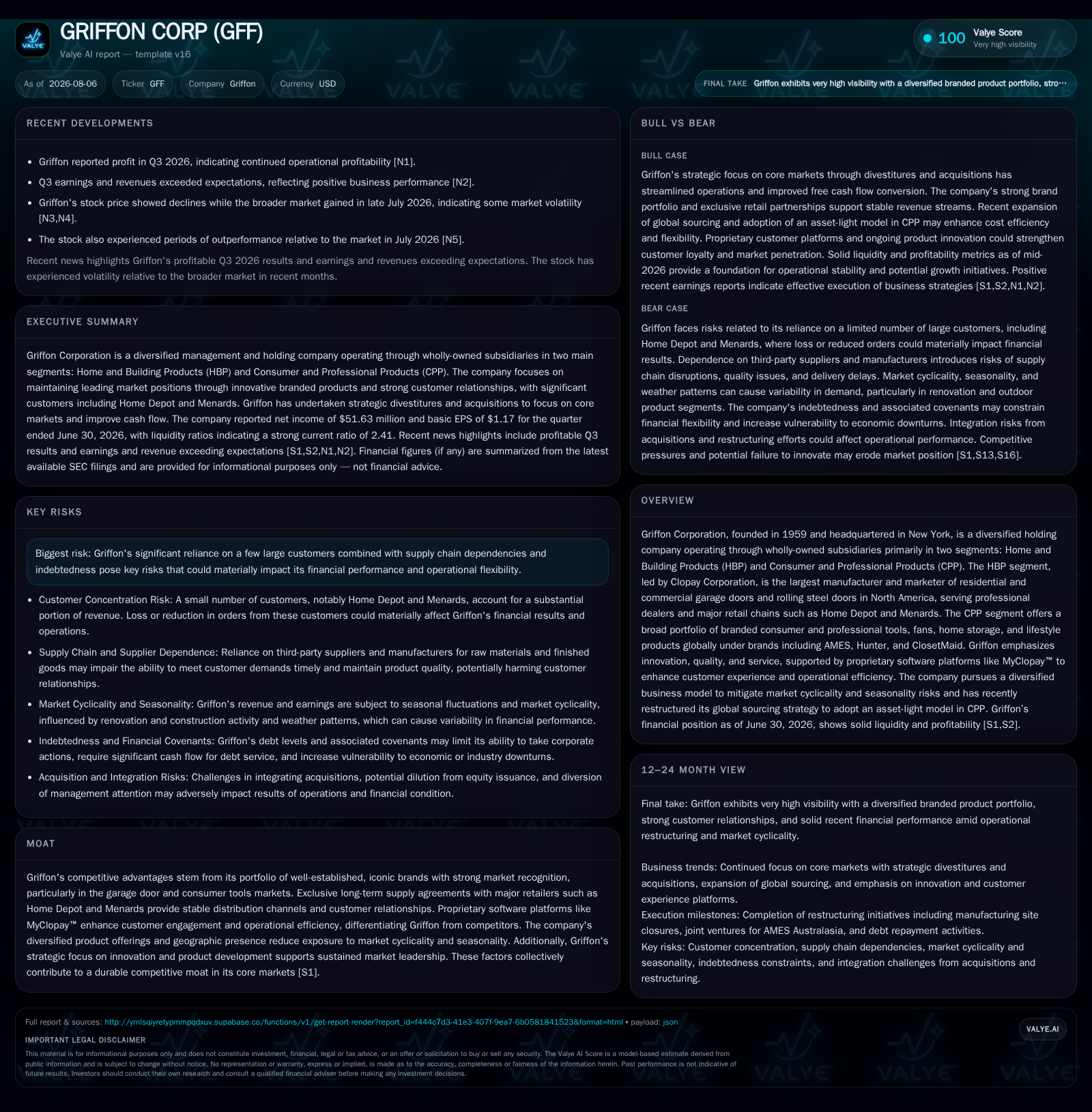
In Q3 2026, Griffon Corporation demonstrated operational resilience with segment revenue growth and improving margin trends despite ongoing volatility in the housing sector. Its Home and Building Products (HBP) segment benefited from stable professional dealer and major retail chain demand, while the Consumer and Professional Products (CPP) segment showed the positive impact of recent global sourcing initiatives and geographic expansion. Griffon's competitive moat is reinforced by strong brands like Clopay and AMES, enhanced by proprietary software platforms such as MyClopay™, supporting customer retention and pricing power. Key risks remain high customer concentration and supply chain cost pressures, but strategic divestitures and capital structure management maintain flexibility going forward.
Q3 Operational Update Signals Resilient Demand Amid Sector Cyclicality
Griffon's latest quarterly filing for Q3 2026 reveals encouraging momentum despite general market headwinds impacting the building products industry related to residential construction fluctuations [S2]. Both core segments—Home and Building Products (HBP) and Consumer and Professional Products (CPP)—delivered revenue growth signaling sustained end-market demand resilience. The HBP segment, led by Clopay-branded residential garage doors and rolling steel doors, capitalized on stable order patterns from professional dealers and major retail chains such as Home Depot and Menards. Meanwhile, CPP's broad offering of tools, fans, home storage products benefited from completions in global sourcing restructuring implemented by late 2024, which has started to enhance gross margins amid rising input costs [S1][S2].
Margins showed improvement driven by pricing power supported by proprietary software platforms like MyClopay™, which streamline ordering and installation processes while reinforcing customer loyalty. This is a key differentiation point compared with broader manufacturing peers who may compete more heavily on price alone [S2]. Nonetheless, inflationary pressures on raw materials such as steel remain a constraint on margin expansion. Griffon’s ability to partially pass through these costs to customers reflects moderate pricing power yet requires ongoing vigilance given the cyclical nature of housing markets [S1][S2].
Griffon's Business Model: Branding Power Coupled with Channel Depth
Griffon operates primarily through wholly owned subsidiaries that manufacture branded physical products sold via multiple distribution channels: predominantly professional dealers for building products alongside major retail chains including Home Depot for broader consumer goods [S1]. The HBP segment accounted for approximately 63% of consolidated revenues for the year ending September 30, 2025, with CPP contributing about 37% [S1]. Revenue mechanics revolve around product sales volume influenced by construction activity levels, pricing strategies reflecting input cost changes, plus aftermarket services that create recurring revenue streams.
A significant strength lies in long-standing supply agreements with dominant retailers which enable consistent volume throughput but also generate notable customer concentration risk: Home Depot alone represented roughly 10% of total revenue in fiscal 2025 across segments [S13][S27]. These retailers influence purchasing decisions heavily via category management teams that weigh brand strength, innovation introductions, logistic costs, and reliability in delivery times.
The company's emphasis on innovation extends beyond product design to include digital engagement tools; MyClopay™ exemplifies this approach by enhancing user experience through online configuration options and streamlined repair service scheduling. Such investments bolster switching costs among end-customers while providing operational efficiencies internally [S1].
Competitive Position Rooted in Iconic Brands and Strategic Retail Partnerships
Griffon's competitive moat derives substantially from its portfolio of iconic brands like Clopay in the garage door space and AMES in consumer tools. These brands carry considerable recognition which is leveraged through tightly managed retailer relationships. Competitors such as Masco Corporation tend to rely more heavily on distributor networks or broader residential plumbing fixtures offerings; Stanley Black & Decker focuses predominantly on tools with diverse go-to-market channels including specialty stores.
Griffon's proprietary software platform adoption enhances differentiation relative to peers who may not have equivalent customer-facing digital tools integrated into their sales process [N14]. This tech layer supports premium pricing capability through added value perceived by professional dealers.
Geographic diversification remains opportunistic rather than extensive; however, strategic moves into Australia via AMES have expanded footprint successfully before recent restructurings channel that business into joint ventures formed with local financial investors to unlock value while retaining upside exposure [S20][N14].
Growth Engines: Innovation, Portfolio Expansion, and Geographic Penetration
Recent acquisitions under the CPP umbrella—including Hunter Fan (2022) and ClosetMaid (2018)—have broadened Griffon's product breadth into lifestyle-oriented categories complementing traditional building goods lines [S1]. The August 2024 completion of global sourcing expansion in handles/tools lines for U.S. markets exemplifies deliberate efforts toward cost competitiveness critical in consumer discretionary arenas increasingly challenged by import competition [S1].
Geographic penetration via AMES Australasia grew steadily prior to its July 31, 2026 divestiture into a joint venture structure with Australian financial backing representing a partial monetization while preserving participation through equity stakes—this balances capital recycling advantages against maintaining strategic presence in growth markets [S20][N14]
Innovation cadence across existing brands aims at premium product introductions targeting renovation-driven replacement cycles typical in mature home markets. Integration of software platforms support aftermarket service revenues—another recurring revenue lever to buffer cyclicality inherent to new construction sales spikes.
Risks & Watchpoints: Customer Concentration, Supply Chain Costs, Cyclical Demand
Griffon’s dependence on a few large retailers constitutes a material risk vector given potential order volume fluctuations driven by shifts in end-customer demand or retailer strategy adjustments [S13][S27]. Home Depot alone accounted for around one-tenth of total consolidated revenues though geographic diversification partially mitigates region-specific downturns
Supply chain fragilities remain relevant in light of recent inflationary headwinds adversely impacting labor costs as well as raw materials such as steel used heavily across residential garage doors and rolling steel products. While Griffon has leveraged pricing adjustments successfully so far, persistent input cost volatility could compress operating margins if customers resist further price increases or consumer confidence wanes significantly due to macroeconomic conditions [S2][S1]
More broadly, Griffon's exposure to construction activity variability introduces cyclicality—adverse trends in new housing starts or remodeling activities directly curtail volume shipments for both core segments given the discretionary nature of many products sold.
"Next Steps": Milestones to Monitor Against Housing Cycle Recovery and Cost Controls
Management commentary around incremental productivity gains or successful acquisition integrations may also provide leading insights into margin trajectory improvements or capital allocation discipline influencing long-term shareholder value creation prospects.
Financial Profile Insight: Current Leverage Posture Supports Strategic Flexibility
As of June 30, 2026, Griffon maintained a liquidity position highlighted by a current ratio of approximately 2.41 based on $723 million in current assets versus $300 million in current liabilities—a level indicating comfortable short-term obligations coverage [F1]. Cash & equivalents totaled roughly $110 million providing immediate liquidity buffers. Total debt stood near $1.27 billion with net debt after cash subtraction approximating $1.16 billion—demonstrating material leverage balanced against operational cash flow generating capacity [F1].
Debt servicing demands are mitigated by disciplined covenant management within senior credit facilities expiring beyond 2028 allowing for refinancing optionality absent immediate maturity pressures [F1][S24]. This structure underpins acquisition-fueled growth strategies alongside necessary investments into product innovation platforms without imminent capital constraints
This analysis synthesizes Griffon Corporation's Q3 operating update alongside strategic context drawn from latest annual disclosures emphasizing its positioning within the building products manufacturing sector.
Disclaimer: This is research-only, informational analysis and not investment advice. It may include AI-generated interpretation and general industry context. Always verify important details using primary sources.

Comments