
Nine Energy Service’s Post-Bankruptcy Reset Limits Near-Term Growth and Market Access
Emerging from Chapter 11 in early 2026, Nine Energy Service faces operational and financial hurdles amid competitive industry dynamics and NYSE compliance challenges.
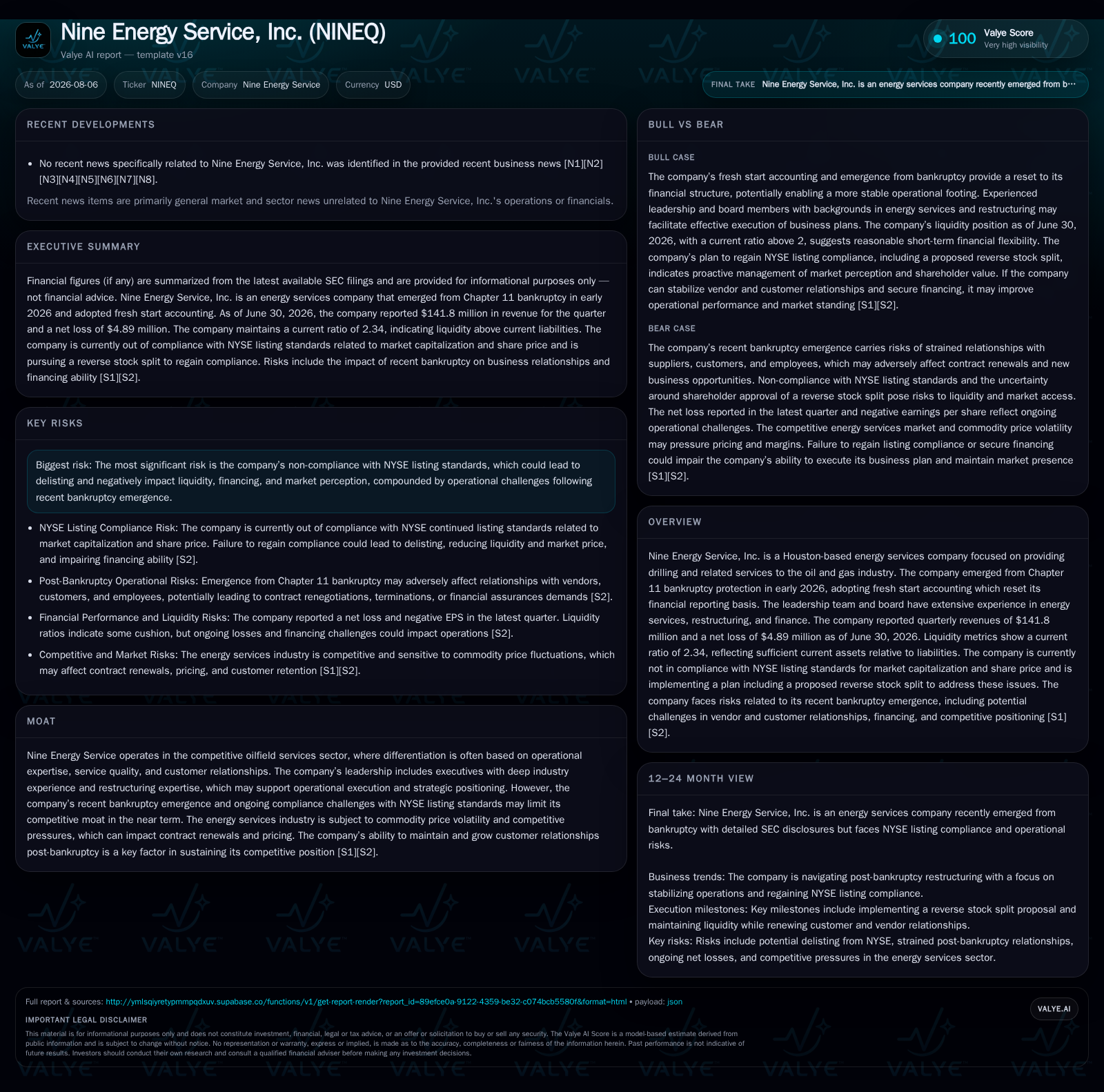
Nine Energy Service exited bankruptcy in March 2026 with a fresh start accounting basis, resetting its financials but also burdening it with legacy operational challenges. Its Q2 2026 results reflect modest revenue but a net loss, signaling early-stage recovery in a highly cyclical oilfield services sector. Liquidity remains adequate with a current ratio of 2.34, yet substantial net debt persists. The company is under pressure to comply with NYSE listing standards and is pursuing a reverse stock split to avoid delisting risks. In an industry dominated by large integrated peers, Nine’s competitive moat is constrained by recent restructuring and market perception.
Recent Operating Update
Nine Energy Service made its public market reappearance after emerging from Chapter 11 bankruptcy on March 5, 2026 [S1]. This reorganization introduced fresh start accounting under ASC 852 which resets all prior retained earnings and value metrics to fair value as of the emergence date [S7]. As a result, financial statements for periods post-March 2026 are not comparable with any historical data before the restructuring. The most recent quarterly disclosure for Q2 ended June 30, 2026 reveals revenues of approximately $141.8 million alongside a net loss of $4.89 million [S2][S3]. These figures signal that the company is still navigating early recovery phases after significant deleveraging and operational reset.
Liquidity metrics appear stable enough for near-term operations, supported by a current ratio of 2.34 as of quarter-end [F1]. This is underpinned by $17 million in cash against total debt close to $99 million (net debt estimated around $82 million), reflecting residual leverage from the prepackaged restructuring [F1]. Operating in an asset- and capital-intensive sector means managing balance sheet flexibility is essential; the asset-based revolving credit facility (Exit ABL Facility) provides a borrowing base up to $135 million secured by its equipment fleet [S9][S17].
A notable governance challenge surrounds Nine Energy’s non-compliance with NYSE listing standards relating to minimum market capitalization thresholds and share price levels [S1][S20]. The company has disclosed its plans for corrective actions including a reverse stock split to meet continued listing requirements within mandated cure periods. Failure to regain compliance could raise delisting risks that would diminish liquidity access and investor confidence.
Business Model Overview
Nine Energy Service operates within the oilfield services segment delivering specialized drilling support services primarily focused on upstream exploration and production companies. Its product offerings encompass drilling services along with associated technical support like well completion assistance — essential activities for hydrocarbon extraction but highly dependent on producer capital allocation decisions.
Revenue generation follows traditional industry mechanics: contracted service agreements or day-rate arrangements based on rig utilization. Volumes fluctuate directly with producer activity levels influenced by commodity prices driving upstream capital expenditure cycles. Pricing power is susceptible to intense competition from large-scale integrated service providers such as Halliburton or Schlumberger that benefit from scale economies and broader service portfolios.
The company does not own subsurface assets but acts as an intermediary supplying labor expertise, specialized technology tools, and operational crews vital for field operations. Its ability to maintain customer relationships post-bankruptcy will materially affect contract renewals and pricing negotiations, given that trust and service reliability are crucial switching cost dimensions in this sector.
Industry Structure and Competitive Position
The oilfield services industry features several dominant integrated providers alongside smaller specialized players focused on specific niches such as drilling or completion technologies. Demand is heavily cyclical due to commodity price swings dictating producer drilling budgets.
Peer firms like Halliburton or Baker Hughes command differentiated positions through extensive global footprints, deeper technology integration (e.g., digital drilling analytics), and diverse service lines that buffer against localized demand shocks. In contrast, Nine Energy currently occupies more of a mid-sized specialist role constrained geographically mainly within North American shale basins.
After emerging from bankruptcy with adjusted governance structures—including board refreshment with experienced restructuring professionals—Nine's management must demonstrate operational efficiency gains while stabilizing customer retention against peers who continue investing in innovation amid rising pricing pressure [S1][S7]
Risks specific to this structural context include intense pricing competition during commodity downturns leading to margin compression; equipment fleet underutilization due to cyclicality; potential supply chain disruptions delaying critical parts or equipment deployment; labor market tightness impacting skilled crew availability; and regulatory compliance costs increasing operational complexity.
Growth Drivers
Key growth opportunities align with cyclical upstream spending trends often catalyzed during sustained commodity price recoveries. Increased rig count adoption fuels demand for drilling-related services which are time- and resource-intensive.
Technological advances improving drilling efficiency—such as automation or real-time monitoring—can differentiate service providers by enabling faster well completions or reducing non-productive time. Expanding application into unconventional plays (horizontal shale hydraulic fracturing campaigns) offers incremental volume growth potential where intensive stage-by-stage support is required.
Geographic diversification into emerging basins could reduce dependency on any single basin’s capital cycle. Additionally, renewing or expanding service contracts based on proven reliability contributes to backlog stability—a key KPI underpinning revenue visibility.
Strategic partnerships directly linking Nine's service capabilities with exploration/production companies can translate into more predictable revenue streams amid volatile spot-market conditions.
Risks and Growth Constraints
Beyond cyclical commodity price volatility impacting customer capital expenditure timing—which creates inherent demand uncertainty—the biggest immediate risk is the company’s NYSE non-compliance circumstance that threatens liquidity if delisting occurs [S20]. Stock price weakness can limit equity financing avenues needed for future growth capex commitments or working capital needs.
Operational execution risk looms given the fresh start accounting reset indicative of significant prior distress; sustaining quality execution while rebuilding reputation among producers will be tested by external competitors actively courting business during any transitional instability.
Furthermore, global supply chain constraints potentially hamper timely equipment repairs or upgrades necessary for maintaining high equipment uptime—a direct influencer of operating margin.
Labor shortages particularly among skilled drill crews may increase wage costs or reduce operating consistency affecting customer retention rates.
Lastly, any new regulatory tightening concerning environmental standards or safety protocols relevant to oilfield activities introduces potential added costs or limits capacity expansion plans.
What To Watch Next
Key milestones include quarterly earnings releases quantifying progress toward profitability improvements beyond Q2’s net loss performance; evidence of improved service utilization metrics such as rig days booked relative to installed fleet capacity would signal operational scaling.
Market indicators involving commodity prices—and consequent upstream E&P capital budget guidance—would provide directional insight into customer activity levels impacting Nine’s revenue funnel.
Progress updates on NYSE listing compliance measures including successful implementation of the planned reverse stock split represent critical corporate governance developments influencing investor sentiment.
Contract renewal announcements or expansions from major producers would confirm regained customer trust post-bankruptcy emergence.
Finally, watching any shifts in leverage ratios or liquidity positions across subsequent filings will reveal the company’s ability to manage financial obligations while investing prudently in technology or geographic expansion necessary for sustained competitiveness.
Financial Profile Discussion
As of June 30, 2026, Nine Energy reported cash and equivalents of approximately $17 million against total debts nearing $99 million resulting in a net debt position near $82 million [F1]. The current ratio stands at a healthy 2.34 suggesting sufficient liquid assets relative to short-term liabilities [F1], an important signpost given working capital demands typical in oilfield services requiring inventory management and payroll funding across field operations.
Nonetheless, the net loss incurred ($4.89 million in Q2) evidences that free cash flow generation remains constrained during this early restructuring phase [S2][S3]. Longer-term financial health depends heavily on returning to sustained positive operating margins in line with peer benchmarks seen among integrated operators typically ranging higher due to scale advantages.
Debt under the revolving credit facility bears floating interest rates tied to SOFR plus margins secured against machinery/equipment assets providing some flexibility but also exposure to interest rate fluctuations [S9][S17]. Efficient CapEx management balancing reinvestment needs against deleveraging targets will be critical going forward.
In summary, while liquidity ratios reflect operational continuity capability near term, long-term financial sustainability necessitates growth-driven margin improvement coupled with balance sheet strengthening as market conditions stabilize.
This report examines Nine Energy Service’s situation grounded strictly on public SEC filings up through August 5, 2026 [S1][S2][S3] augmented by company facts data as available [F1]. It aims to provide an informed industry analyst perspective without extending beyond documented evidence or offering investment research views.
Disclaimer: This is research-only, informational analysis and not investment advice. It may include AI-generated interpretation and general industry context. Always verify important details using primary sources.

Comments