
Coherus Oncology Advances Commercial Stage with LOQTORZI Amid Pipeline Development Challenges
Coherus Oncology's near-term focus centers on commercializing its FDA-approved PD-1 inhibitor LOQTORZI while advancing combination therapies in a competitive immuno-oncology market.
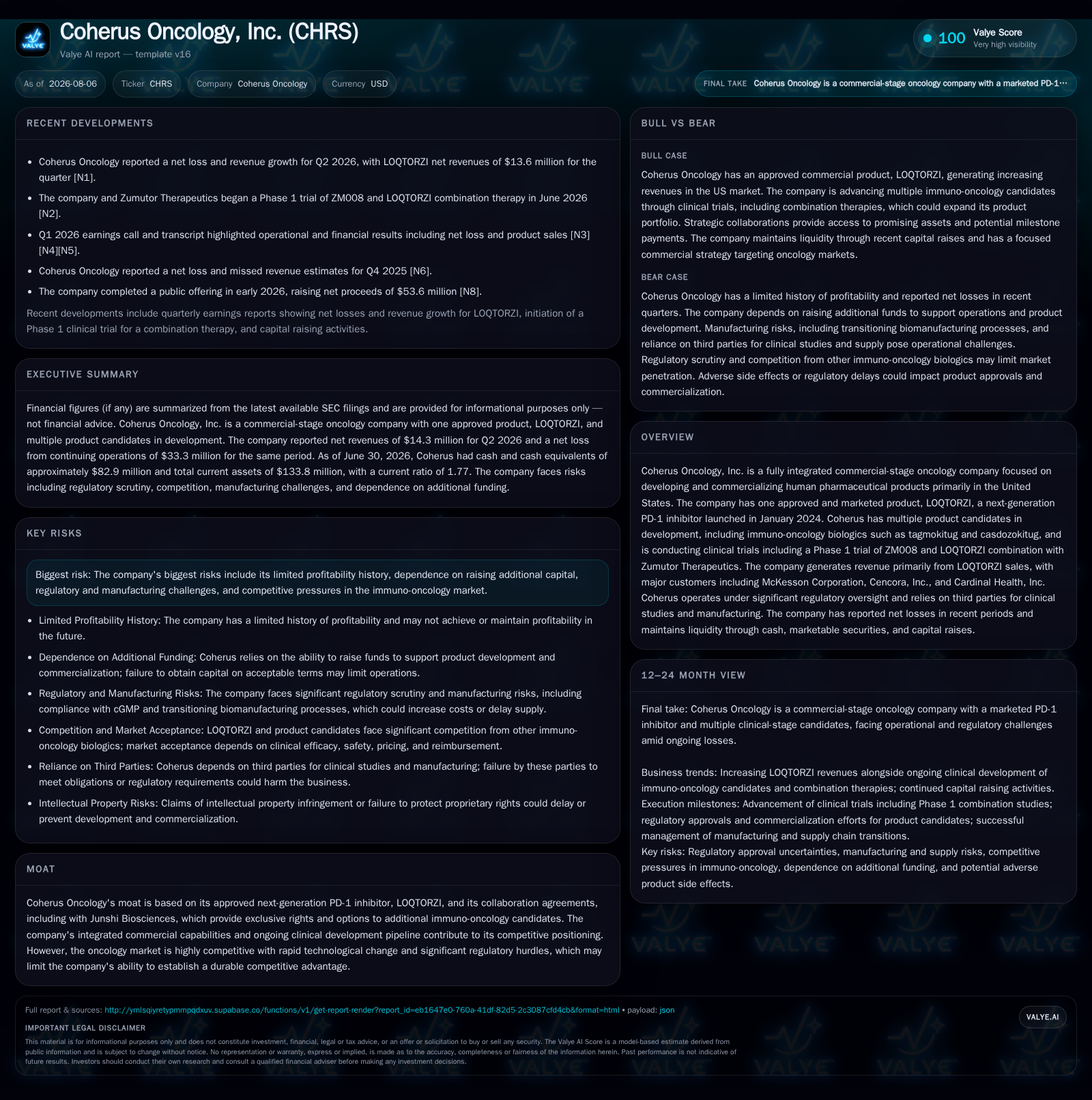
Coherus Oncology reported Q2 2026 results showing continuing investment in commercial launch and clinical pipeline expansion, centered around LOQTORZI, its sole approved product. Despite growing revenues from LOQTORZI, the company continues to run net losses amidst significant R&D spending on mid-stage candidates and combination trials. Coherus operates in a highly competitive oncology biologics environment that demands effective market access execution and clinical progress. Its financial profile reflects ongoing capital needs supported by recent equity raises and a balanced cash runway over the next year.
Recent Operating Update
In its Q2 2026 filing dated August 5, Coherus Oncology disclosed continued commercial activity centered around its sole approved product, LOQTORZI (toripalimab-tpzi), a next-generation programmed death receptor-1 (PD-1) inhibitor launched in January 2024 [S2][S3]. The company reported LOQTORZI generated $13.6 million in net revenues for the quarter ended June 30, 2026. However, Coherus recorded a net loss driven by ongoing investment in research and development (R&D) as well as selling, general and administrative (SG&A) expenses [N1][S2].
Alongside commercial sales growth efforts, Coherus has initiated a Phase 1 clinical trial combining LOQTORZI with ZM008 in collaboration with Zumutor Therapeutics to explore enhanced immuno-oncology efficacy [N2]. This trial represents part of Coherus's broader strategy to expand indications through combination therapies leveraging its immuno-oncology biologics stable. Pipeline candidates include tagmokitug and casdozokitug targeting other cancer types such as liver, head and neck, and colorectal cancers [S1].
Despite recent capital raises via equity offerings yielding $53.6 million in net proceeds earlier this year [S15][S16], Coherus remains dependent on external funding sources due to persistent operating losses. The company holds approximately $105 million in cash, cash equivalents, and marketable securities as of June 30, 2026 [S15], sufficient to fund planned expenditures for at least the next twelve months according to management assumptions.
Business Model Analysis
Coherus Oncology operates as a fully integrated commercial-stage oncology biotechnology company primarily focused on developing and marketing biologic therapies targeting cancer through immuno-oncology mechanisms such as checkpoint inhibition. Its primary revenue stream derives from sales of LOQTORZI, an anti-PD-1 monoclonal antibody developed in collaboration with Junshi Biosciences [S1]. The drug is approved by the FDA for treatment of metastatic or recurrent locally advanced nasopharyngeal carcinoma (NPC), both first-line in combination with chemotherapy agents cisplatin and gemcitabine and as monotherapy post-platinum chemotherapy progression.
Revenue mechanics involve selling finished inventories through wholesale pharmaceutical distributors including McKesson Corporation, Cencora Inc., and Cardinal Health Inc., who act as key intermediaries responsible for distribution logistics and access to hospital formularies [S1]. These relationships are critical: they influence product reach into treatment centers and impact overall market penetration rates crucial for driving sustained topline growth.
Margins face pressure typical for biotech commercialization including manufacturing scale-up costs aligned with biologics production complexities managed via contract manufacturing organizations (CMOs). Additionally, SG&A expenses balloon notably during the early commercial launch phase due to marketing investments aimed at achieving formulary placement across various payors—a determining factor for physician prescribing habits—and addressing payer reimbursement negotiations.
On the pipeline side, the business model leverages clinical development programs designed both to broaden authorized indications for LOQTORZI through combination regimens as well as bring novel immuno-oncology biologics forward. Success in clinical trial phases—from enrollment efficiency through endpoint achievement—directly impacts regulatory approval prospects; these milestones unlock potential additional revenue streams via new product launches or label expansions.
Industry Structure and Competitive Position
The oncology therapeutics subsector is marked by intense competition among commercial-stage biotech firms specializing in immuno-oncology biologics alongside large pharmaceutical franchises owned by companies like Merck (Keytruda) and Bristol-Myers Squibb (Opdivo). These flagship PD-1/PD-L1 inhibitors dominate global markets due to established labeling breadth across multiple cancer types.
Coherus's position rests on differentiating LOQTORZI as a next-generation agent potentially offering comparable or improved efficacy or safety profiles relative to incumbents. However, achieving material market share involves overcoming entrenched provider prescribing patterns favoring legacy products backed by extensive clinical data sets.
Competitive risks also arise from rapid technological innovation cycles introducing newer checkpoint inhibitors or alternative modalities potentially supplanting existing therapies. Regulatory timelines further compress competitive windows; delays or failures in obtaining expanded approvals can limit commercial upside.
Growth Drivers
Key growth catalysts include successful clinical trial outcomes validating efficacy of combination therapies incorporating LOQTORZI with pipeline candidates like ZM008. Positive endpoints could broaden indications into larger patient populations beyond NPC such as head & neck or colorectal cancers.
Expanding geographic reach within U.S. oncology treatment settings relies heavily on securing inclusion into national clinical guidelines and reimbursement formularies—processes increasingly influenced by payor cost containment policies rooted in recent legislation such as the Inflation Reduction Act (IRA).
Strategic collaborations underpin synergistic development efforts; Coherus’s partnership with Junshi Biosciences grants access to exclusivity rights on novel immuno-oncology assets enhancing pipeline depth and scientific innovation without bearing entire R&D costs alone.
Manufacturing capacity utilization improvements will be crucial facilitating scale-up meeting increasing demand while controlling cost-of-goods-sold – a direct driver of gross margin expansion once commercial ramping stabilizes.
Risks and Constraints
Coherus faces several structural risks typical of emerging oncology biotechs:
- Limited profitability history underscores reliance on continued external financing; disruption here could curtail R&D progress or commercialization activities [S2].
- Regulatory uncertainty remains high given evolving FDA staffing constraints potentially delaying approval decisions or inspections impacting product availability [S2][S25].
- Pricing pressures emanate from legislative reforms mandating drug price transparency plus heightened scrutiny under Medicaid Drug Rebate Program obligations raising compliance costs [S17][S21].
- Market adoption depends critically on dynamic prescriber behaviors influenced by competing products’ brand strength plus payor formulary coverage which may favor incumbents barring compelling therapeutic advantages.
- Manufacturing scale-up challenges coupled with dependence on third-party suppliers introduce operational execution risks including delays impacting supply continuity [S20].
- Clinical trial enrollment rates must accelerate sufficiently alongside positive phase progression success rates to validate anticipated pipeline asset value otherwise risking lost investment [N2][S1].
What to Watch Next
Near-term milestones center on interim readouts from ongoing Phase 1 studies combining LOQTORZI with ZM008. Positive safety/tolerability signals would support advancement into later-phase trials crucial for valuation uplift.
Monitoring quarterly net revenue growth trends for LOQTORZI against competitor benchmarks will signal market acceptance trajectory. Increased penetration rates through distributor channels or securing payer formulary status represent measurable progress indicators.
Broader regulatory developments impacting pricing frameworks under evolving U.S. healthcare policies may alter pricing power dynamics influencing long-term sustainability.
Financial Profile Discussion
As of June 30, 2026, Coherus held approximately $82.9 million in cash and cash equivalents complemented by short-term investments aggregated into $105 million total liquid assets according to its latest SEC disclosures [F1][S15]. The firm’s current ratio stands at a healthy 1.77 indicating adequate near-term liquidity versus current liabilities [F1]. Still, persistent operating losses driven by elevated R&D expenditure supporting pipeline development coupled with SG&A outlays linked to the commercialization phase generate significant negative operating cash flows—in excess of $119 million over six months ended June 30, 2026 [S20]. Such burn necessitates continuous capital sourcing via equity transactions evidenced by sizable offerings completed earlier this year.
Disclaimer: This is research-only, informational analysis and not investment advice. It may include AI-generated interpretation and general industry context. Always verify important details using primary sources.

Comments