
E.W. Scripps Co Faces Urgent Profitability Challenges Amid Portfolio Restructuring
The media company reported widening losses and revenue declines in Q2 2026 while advancing station sales and transformation efforts.
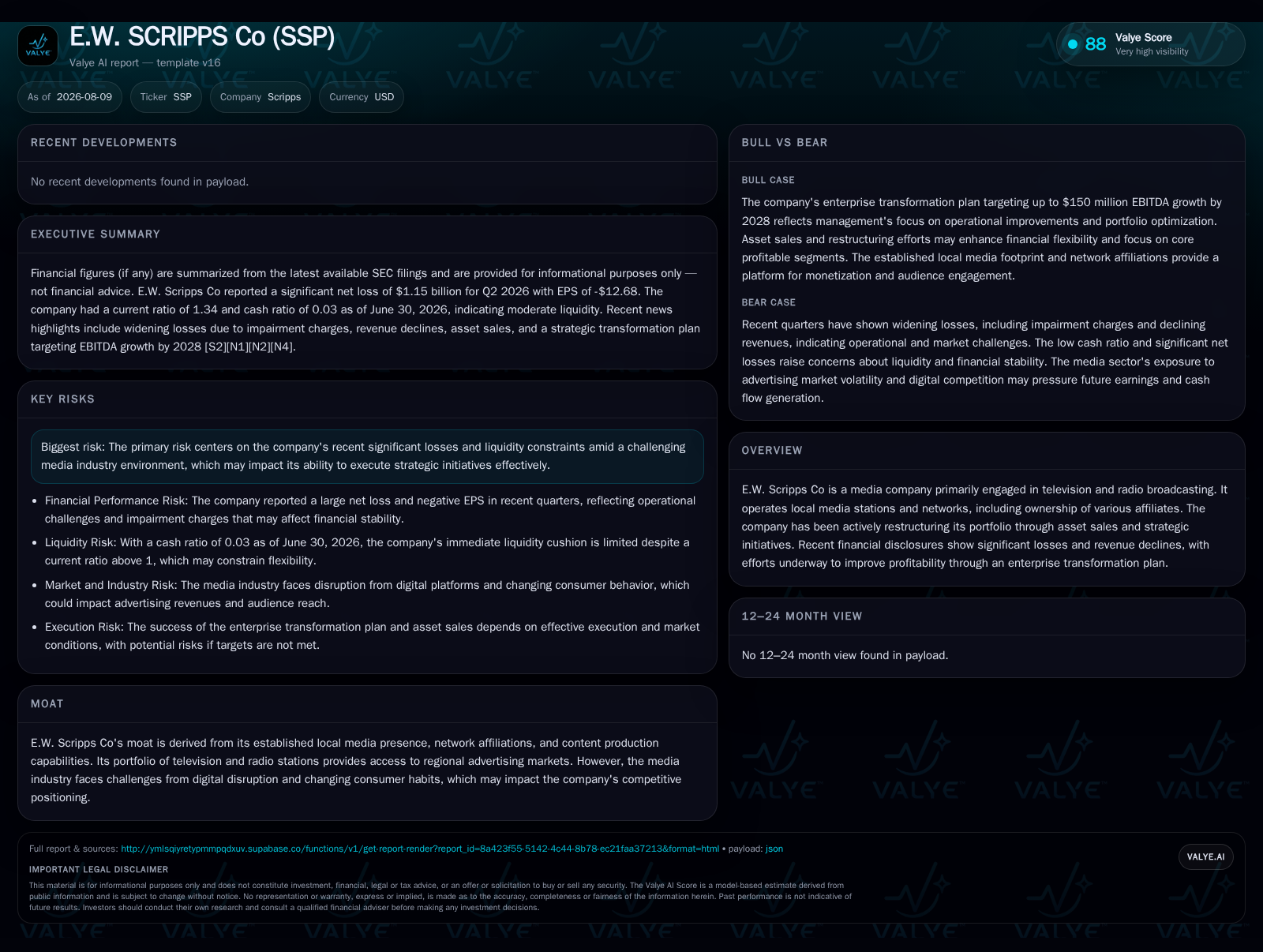
E.W. Scripps continues to grapple with significant earnings pressure as advertising revenues decline and digital disruption weighs on traditional broadcast streams. The company’s recent quarterly filings highlight ongoing portfolio rationalization through local TV station divestitures. A strategic enterprise transformation plan aims to restore profitability but execution risks remain high under heavy debt leverage.
Recent Operating Update: Amplified Losses during Portfolio Rationalization
E.W. Scripps’ Q2 2026 results confirm intensifying pressures from deteriorating local advertising demand—a core revenue driver for its extensive network of over-the-air television stations—and ongoing disruption from shifting consumer preferences toward digital content consumption [S2][N2][N3][N1]. These trends have driven revenue declines alongside widening net losses, reflecting structural challenges rather than temporary market fluctuations.
Strategically, the company has accelerated portfolio adjustments by completing the previously announced sales of the WRTV station in Indianapolis for $83 million and the WFTX station in Fort Myers for $40 million during Q1 2026 [S1][S19]. While these divestitures reduce geographic reach and scale—potentially impacting local market penetration—they provide critical liquidity relief during mounting operational stress.
Business Model: Local Broadcasting Revenue Under Pressure
Scripps operates a portfolio exceeding 60 local television stations affiliated predominantly with major networks including ABC (18 stations), NBC (11), CBS (9), FOX (4), plus independents [S1]. This footprint reaches approximately one-quarter of U.S. television households, underpinning a business model reliant on monetizing localized audience engagement.
Advertising revenue constitutes the primary income source, generated through selling commercial slots to regional advertisers. These contracts depend heavily on audience ratings and demographic appeal—metrics increasingly challenged by platform fragmentation and changing viewer habits. Retransmission consent fees paid by cable and satellite providers represent a complementary stable cash flow stream; however, these fees require strong affiliate agreements to maintain negotiating leverage.
Industry Dynamics and Competitive Landscape
The media broadcasting sector is undergoing profound disruption as OTT streaming services erode traditional over-the-air viewership bases. Audience fragmentation diminishes advertiser willingness to pay previous CPM levels, pressuring core advertising revenue across the industry.
Within this environment, Scripps contends with competition from larger-scale regional broadcasters such as Nexstar Media Group and Gray Television that benefit from broader geographic reach and operational synergies enhancing their negotiating strength with distributors and advertisers. Regulatory constraints on broadcast spectrum allocation further limit expansion possibilities.
Consequently, Scripps faces heightened execution risk balancing scale limitations against the need to sustain retransmission fee income and adapt to evolving consumption patterns.
Growth Drivers: Digital Initiatives and Operational Efficiencies
Management has launched an enterprise transformation plan focused on cost containment through programming efficiencies and workforce restructuring aimed at offsetting margin pressures stemming from revenue softness [S2][N1]
Potential growth avenues include expanding digital streaming engagement leveraging owned content to capture incremental ad dollars; exploring reacquisition or acquisition of stations if regulatory conditions allow; innovating localized targeted advertising via data analytics to improve monetization per impression; and securing retransmission fee increases anchored by the ongoing importance of local news and sports content.
However, realization of these drivers depends critically on reversing secular declines in traditional ad spend migration and scaling digital revenues beyond nascent levels.
Risks and Watchpoints: Elevated Leverage Amid Operating Headwinds
Additional risks include prolonged weakness in local advertising budgets due to economic or structural factors; intensified OTT competition fragmenting audiences; rising programming costs outpacing revenue growth; and potential unfavorable renegotiation of affiliate agreements critical for retransmission fee income.
Failure to deliver on transformation initiatives could delay return to profitability and exacerbate financial strain.
Monitoring Points: Indicators of Strategic Progress
Investors should closely watch quarterly advertising revenue trends to discern whether recent declines represent cyclical troughs or ongoing deterioration. Updates on cost-saving program effectiveness will signal management’s ability to control margins amid top-line pressure. Outcomes from retransmission fee negotiations will indicate stability or growth potential in recurring cash flows.
Further station sales or acquisitions will materially affect scale metrics impacting competitive positioning. Finally, digital platform engagement metrics will provide evidence on the success of diversification efforts beyond traditional broadcast channels.
Financial Profile Discussion
While asset divestitures have provided episodic liquidity relief easing immediate refinancing pressures, sustainable financial health depends on successful operational turnaround within an evolving media landscape [S1][S19]
This analysis synthesizes publicly available SEC filings alongside contemporaneous disclosures without constituting investment advice or research views.
Disclaimer: This is research-only, informational analysis and not investment advice. It may include AI-generated interpretation and general industry context. Always verify important details using primary sources.

Comments