
United States Gasoline Fund Balances Futures Market Dynamics and Regulatory Constraints in Q2 2026
UGA’s latest quarterly update highlights operational resilience amid gasoline futures market volatility and regulatory position limits.
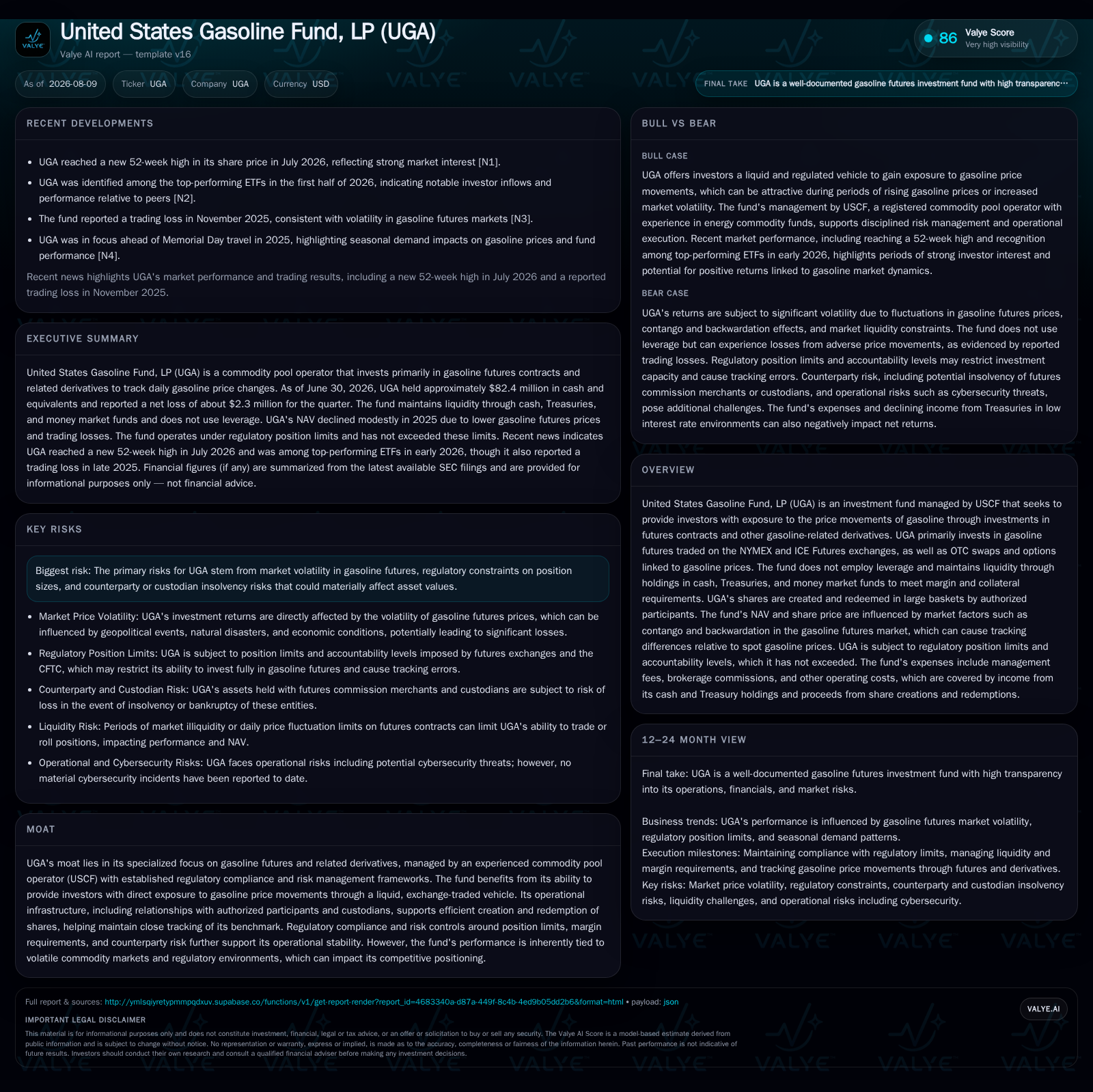
United States Gasoline Fund, LP (UGA) remains a specialized commodity ETF offering direct exposure to gasoline price movements through futures contracts and related derivatives. Its latest quarterly filing reveals a steady approach to liquidity management and regulatory compliance, with no material changes to risk factors. UGA operates within strict regulatory frameworks that impose position limits and accountability levels, which along with inherent gasoline futures market dynamics like contango and backwardation, can impact tracking accuracy and returns. The fund’s business model centers on managing exposure via gasoline futures while maintaining liquidity to meet margin obligations. Going forward, monitoring futures market structures and regulatory developments will be key to understanding UGA’s performance trajectory.
Recent Operating Update
United States Gasoline Fund, LP (UGA) disclosed its Q2 2026 operating results in the August 7th, 2026 10-Q filing [S2], reaffirming its steady-state operational posture without material changes to previously identified risks. Its July 29th, 2026 Form 8-K supplemented this with updated monthly account statements through June 30th, confirming no noteworthy deviation in asset composition or strategy [S3]. These updates underscore UGA’s continuous adherence to comprehensive regulatory compliance frameworks governing position limits and margin requirements under NYMEX and ICE Futures rules.
Even as gasoline futures markets remain volatile due to geopolitical events and supply-demand imbalances, UGA maintains liquidity primarily through cash equivalents totaling approximately $82 million as of June 30, 2026 [F1]. The absence of leverage supports liquidity resilience by reducing susceptibility to forced liquidation during margin calls.
Business Model Overview
UGA functions as an exchange-traded commodity fund specializing exclusively in unleaded gasoline exposure via standardized NYMEX futures contracts complemented by over-the-counter (OTC) swaps and options tailored around gasoline prices. Its revenue generation is principally through management fees assessed on assets under management (AUM), while returns delivered to investors hinge on the accurate replication of spot gasoline price movements through holding these derivative instruments.
Investors pay for shares traded on NYSE Arca, enabling liquid access without direct physical fuel ownership. Authorized participants play a critical role by creating or redeeming large baskets of shares to align supply with underlying NAV changes driven by gasoline futures price moves. This mechanism is vital in minimizing discrepancies between market share price and net asset value, although perfect tracking remains challenged by structural futures market phenomena like contango and backwardation [S1].
Tracking error arises because UGA rolls expiring near-month futures into longer-dated contracts—a process adversely impacted when the futures curve is in contango (upward sloping), causing negative roll yields that reduce total return relative to spot prices. Conversely, backwardation scenarios (downward sloping curves) can beneficially boost returns but increase tracking variability. UGA’s investment strategy explicitly avoids leverage or significant deviations from its target exposure ratio, seeking instead steady participation in price trends within defined regulatory boundaries [S1].
Industry Structure and Competitive Position
Within the broader commodity ETF sector focused on energy futures, UGA occupies a niche as a pure-play gasoline investment vehicle. It competes indirectly with other energy-focused ETFs such as United States Oil Fund (USO), which blends crude oil and refined products exposure; Invesco DB Energy Fund (DBE), offering diversified energy commodities; or Vanguard Energy ETF (VDE), which targets the broader energy equity sector.
What differentiates UGA is its singular focus on unleaded gasoline prices accessed exclusively via regulated futures markets coupled with OTC derivatives managed by USCF—a registered commodity pool operator experienced in navigating Futures Commission Merchant (FCM) relationships, margin requirements, and clearing processes. This specialization requires strict internal controls to observe position limits imposed by exchanges—such as NYMEX’s accountability levels capped at thousands of contracts per month—to prevent concentration risk or potential market manipulation concerns.
The fund's structure as a limited partnership aligns investor interests but introduces tax complexity that typical equity ETFs do not encounter. Regulatory compliance extends beyond CFTC oversight into global derivative regulations if transactions occur off-exchange or involve non-U.S. parties [S1]. Maintaining sound counterparty risk profiles for OTC derivatives is imperative given valuation uncertainties inherent outside centralized clearing venues.
Growth Drivers
UGA’s growth prospects correlate strongly with rising investor appetite for liquid vehicles delivering targeted exposure to volatile energy commodities. The first half of 2026 has witnessed notable inflows into top-performing energy ETFs amid heightened fuel price fluctuations driven by seasonality, refining capacity constraints, geopolitical uncertainties, and evolving environmental policy landscapes [N2]
As gasoline retail prices remain sensitive to crude oil trends plus localized supply-demand shocks, traders and portfolio managers increasingly seek efficient hedging instruments or speculative plays accessible without physical logistics burdens. UGA’s exchange-traded format offers transparency, intraday tradability, and cost efficiencies attractive compared with direct commodity ownership or mutual fund alternatives.
Innovation within derivatives markets further supports product relevance; tailored swaps or options linked directly to NYMEX gasoline benchmarks enhance fund capability to manage downside risks or optimize exposure dynamically. Regulatory clarity surrounding position limits also facilitates institutional participation reassuringly bounded by compliance regimes.
Risks and Watchpoints
Despite operational strengths, UGA faces several inherent risks amplifying investment uncertainty:
- Commodity Price Volatility: Gasoline futures markets are notoriously cyclical yet susceptible to unpredictable geopolitical events or natural disasters affecting supply chains [S1].
- Contango-Backwardation Effects: Persistent contango produces negative roll yields eroding returns over time compared with spot pricing [S1]. This structural drag can discourage buy-and-hold investors despite short-term upside potential.
- Regulatory Constraints: Position limits imposed by NYMEX/ICE limit aggregate holdings per participant; exceeding accountability levels could force position reductions impacting fund strategy and creating temporary tracking error spikes [S1].
- Counterparty Risk: OTC swap counterparties impose credit risk distinct from exchange-cleared contracts; defaults could impair asset valuations adversely [S1].
- Liquidity Management: Margin calls during periods of heightened volatility require available cash collateral; failure here can force contract liquidation at unfavorable prices affecting NAV stability.
- Tax Complexity: As a limited partnership using derivatives extensively, tax treatment may be complex for shareholders potentially affecting after-tax returns [S1].
- Operational Risks: Cybersecurity vulnerabilities impacting custodians or administrators could disrupt settlement or transaction processing impinging on share liquidity and investor confidence [S1].
Overall performance reviews following quarterly reports combined with external fuel market analytics provide essential confirmation points for the fund’s strategic positioning.
Financial Profile Discussion
As of June 30, 2026, cash and cash equivalents stood at approximately $82 million—providing liquidity buffer for margin requirements amid volatile gasoline prices [F1]. This financial position supports stable operation without resorting to leverage. Maintaining this capital robustness enables effective responses to margin calls or temporary liquidity demands arising from market price shocks or regulatory changes.
Operating expenses mainly consist of administrative fees payable to USCF as commodity pool operator alongside custodian fees paid to BNY Mellon. Due diligence around counterparty credit quality for OTC derivatives is central given their impact on periodic net asset valuation adjustments included within income statement figures.
In conclusion, UGA exemplifies a highly specialized commodity ETF navigating complex energy markets via prudent risk management tethered closely to regulated futures exchanges. Investors demanding focused gasoline price exposure benefit from the fund’s transparent structure supported by experienced operational oversight though must recognize intrinsic market dynamics that can dampen returns or cause tracking divergence intermittently.
This analysis is based solely on publicly available SEC filings dated up through August 7th, 2026 ([S1], [S2], [S3]) and company facts as of June 30th, 2026 ([F1]). It leverages established industry knowledge frameworks around commodity exchange-traded funds without providing any investment research views or forward-looking statements.
Disclaimer: This is research-only, informational analysis and not investment advice. It may include AI-generated interpretation and general industry context. Always verify important details using primary sources.

Comments