
United States 12 Month Oil Fund Balances Oil Futures Exposure Amid Regulatory and Market Constraints
USL provides oil price exposure through futures contracts, navigating contango, position limits, and liquidity management challenges.
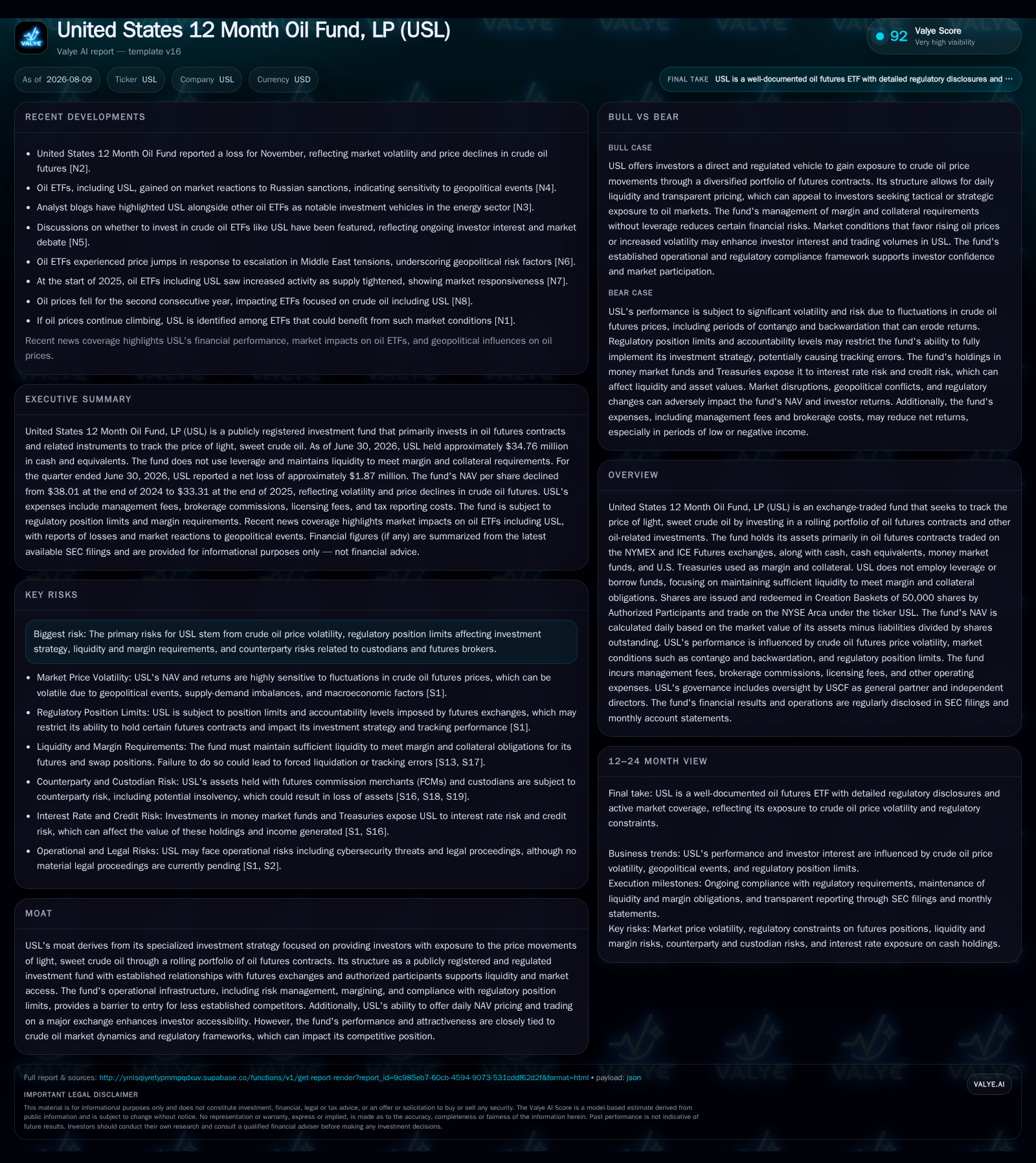
The United States 12 Month Oil Fund, LP (USL) is an ETF that tracks the price movements of light, sweet crude oil via a rolling portfolio of futures contracts primarily on NYMEX. Its latest quarterly filing confirms ongoing redemption activity and steady liquidity management without leveraging, while reaffirming the critical risks posed by commodity price volatility, regulatory position limits, and margin requirements. USL's business model centers on delivering oil price exposure to investors through a regulated and liquid vehicle but must actively manage futures market dynamics such as contango to mitigate tracking error versus spot prices. Continued demand for commodity ETFs and evolving futures market conditions will drive USL’s near-term performance and investor appeal.
Recent Operating Update
In its latest quarterly filing dated August 7, 2026, United States 12 Month Oil Fund, LP (USL) reported redemption activity of 550,000 shares during Q2 2026 executed in blocks of 50,000 shares known as Redemption Baskets handled by Authorized Participants [S2]. This liquidity event reflects active secondary market dynamics where large institutional investors transact sizable blocks efficiently. USL reiterated no changes in its risk profile or internal control environment during this period [S2]. Monthly account statements including Statements of Income (Loss) and Changes in Net Asset Value (NAV) are published regularly in compliance with Commodity Exchange Act requirements [S3]. The fund continues to not use leverage or borrowings to meet margin obligations but relies on liquid assets for collateral [S1], reflecting prudent liquidity management aligned with regulatory expectations.
Business Model Overview
USL is structured as a Delaware limited partnership that operates as a commodity pool offering investors exposure to light, sweet crude oil price movements through a rolling portfolio of oil futures contracts primarily traded on the New York Mercantile Exchange (NYMEX) [S1]. Rather than holding physical oil, USL targets daily percentage changes in its NAV per share that approximate the average prices of benchmark oil futures contracts. This is accomplished by continuously rolling over near-month futures contracts into longer-dated contracts to maintain consistent exposure without physical delivery risk.
Shares trade publicly under the ticker USL on NYSE Arca. Primary purchasers and redeemers are Authorized Participants who transact Creation or Redemption Baskets of 50,000 shares [S1][S2], a mechanism common among ETFs facilitating liquidity while ensuring alignment between market prices and underlying asset values. USL monetizes through management fees levied as a fixed percentage of NAV paid monthly [S20]. It earns additional income from investments in cash equivalents and U.S. Treasury securities held both for collateralizing margin obligations on futures positions and preserving liquidity [S1][S4].
Margin requirements are significant operational considerations; USL must hold sufficient liquid assets not only to satisfy current margin calls but also potential future collateral needs arising from volatile crude oil prices [S24]. The fund maintains most of its net assets allocated toward trading positions in Oil Interests balanced against cash and short-term investments used explicitly for margin collateral at Futures Commission Merchants (FCMs) [S7][F1]. The absence of leverage means USL is limited to investing within the bounds of its net asset value without borrowing capacity.
Industry Structure and Competitive Position
Commodity ETFs focused on oil futures like USL occupy a specialized niche between direct commodity trading and equity investments in energy companies. They provide investors a liquid vehicle for participating in crude oil price movements without physical storage complications or direct commodity ownership risks. Key peers include United States Oil Fund (USO), which operates similarly though possibly with varying contract durations and roll strategies.
These funds rely heavily on robust infrastructure comprising exchanges like NYMEX and ICE Futures for contract standardization and clearing; authorized participants who facilitate large-scale share creation/redemption; custodians safeguarding liquid collateral; and compliant intermediaries managing margining requirements.
Challenges unique to the segment include managing tracking error arising from contesting factors like position limits imposed by exchanges which restrict maximal contract holdings per entity, potentially forcing partial investment strategies diverging from ideal benchmarks [S1]. Additionally, the rolling mechanism confronts structural market effects such as contango—where longer-dated futures trade at premiums causing roll losses—or backwardation yielding gains—affecting returns relative to spot prices.
Compared with physical commodity trusts that hold tangible inventories of crude oil or energy sector equity ETFs such as Vanguard Energy ETF (VDE), USL offers purer exposure to crude oil price dynamics albeit with greater sensitivity to futures market peculiarities and associated operational risks.
Growth Drivers
Investor appetite for direct commodity exposure through regulated ETFs continues to support demand growth for products like USL. Heightened volatility in crude oil markets driven by geopolitical tensions, supply-demand imbalances, and macroeconomic factors draws both speculative traders and hedgers into these instruments seeking tailored risk profiles without physical ownership complexities.
Broader adoption of exchange-traded products facilitates inflows supported by enhanced regulatory transparency compared to over-the-counter derivatives markets. Innovations in roll strategies optimizing contract selection can improve long-term return profiles despite structural headwinds from contango scenarios.
Global trends underpinning rising energy demand also bolster interest in investment vehicles tied directly to crude oil prices.
Risk Factors and Watchpoints
The primary risk remains commodity price volatility which directly influences NAV fluctuations—and hence share price—potentially resulting in total investment loss for shareholders [S1]. Volatility exacerbates margin call risks requiring timely collateral replenishment; failure could force adverse liquidation events harming investor returns.
Position limits enforced by NYMEX/ICE Futures serve as fixed ceilings constraining maximal contract holdings; surpassing these can necessitate position reductions affecting tracking fidelity relative to benchmarks [S1]. Daily price change limits can temporarily suspend trading beyond fixed thresholds reducing liquidity at critical times.
Operational risks center around counterparty exposures involving FCMs and custodians entrusted with safeguarding cash equivalents posted as collateral. Although regulatory segregation mitigates asset commingling risks, insolvencies could still imperil funds [S21]. Cybersecurity threats pose additional concerns managed by comprehensive third-party oversight programs led by the general partner USCF [S14].
Tax considerations are more complex due to USL’s limited partnership structure requiring individual investors’ allocation of income/loss that may diverge from economic realities; changes in tax law may introduce uncertainties affecting after-tax returns [S1]
What To Watch Next
Key milestones include ongoing monitoring of redemption/creation basket activity indicating shifts in investor demand or sentiment towards crude oil exposures [S2]. Tracking error metrics vis-à-vis benchmark futures contract prices will reveal efficacy amid regulatory constraints.
Margin requirement trends amid fluctuating volatility will be signals for operational stress levels potentially impacting liquidity policies. Enhancements or shifts in roll strategies could surface through updated disclosures influencing future return prospects.
Regulatory developments addressing position limits or derivatives use globally—including impacts from EU rules when transacting non-U.S. counterparties—may alter permissible investment scope requiring adaptation [S1]. Market dislocations derived from geopolitical events affecting energy supply chains will continue dictating short-to-medium term NAV volatility patterns.
Financial Profile Discussion
As of June 30, 2026, USL held approximately $34.8 million in cash and equivalents representing liquid collateral backing its futures positions without any debt or leverage usage [F1][S2][S4]. This substantial cash buffer aligns with fund policy avoiding leveraging while ensuring compliance with margin calls; it notably supports share redemption obligations executed through authorized baskets typically sized at 50,000 shares [S2][S20].
Operating expenses have been fully covered by income generated via management fees based on NAV plus yields from invested cash equivalents without necessitating asset liquidation beyond basket transactions historically reported through December 31, 2025 filings [S4][F1]. Management fees are assessed daily at a fixed rate annually approximating 0.60% of average NAV paid monthly reflecting administrative costs tied primarily to BNY Mellon custody services plus contractual licenses related to NYMEX technologies [S20].
Net income reported was negative $2.5 million for calendar year ended December 31, 2025 driven primarily by marked-to-market unrealized losses on open contracts consistent with volatile underlyings rather than operational inefficiencies [F1]. This outcome underscores the fund's sensitivity to fluctuations in the underlying benchmark prices rather than traditional revenue sources seen in operating companies.
This analysis reflects information available as of August 9, 2026. It synthesizes recent SEC filings focused on operational updates alongside established industry knowledge related to commodity ETFs investing in oil futures. Interpretation emphasizes durability of USL's exposure strategy amid known cyclical challenges intrinsic to crude oil markets including regulatory limitations impacting contract holding capacities. Investors must recognize unpredictable commodity price behaviors tied strongly to macroeconomic fundamentals distinguish these funds from conventional equity investment vehicles.
All data points originate strictly from documented SEC disclosures () or validated companyfacts metrics ([F1]). No forward-looking financial projections or investment advice are provided herein.
Disclaimer: This is research-only, informational analysis and not investment advice. It may include AI-generated interpretation and general industry context. Always verify important details using primary sources.

Comments