
BioScience Health Innovations Builds Foundation for Scale with Proprietary Wellness Products and ERP Upgrade
BHIC focuses on mental health and general wellness supplements, advancing infrastructure and capital markets positioning to enable second-half growth.
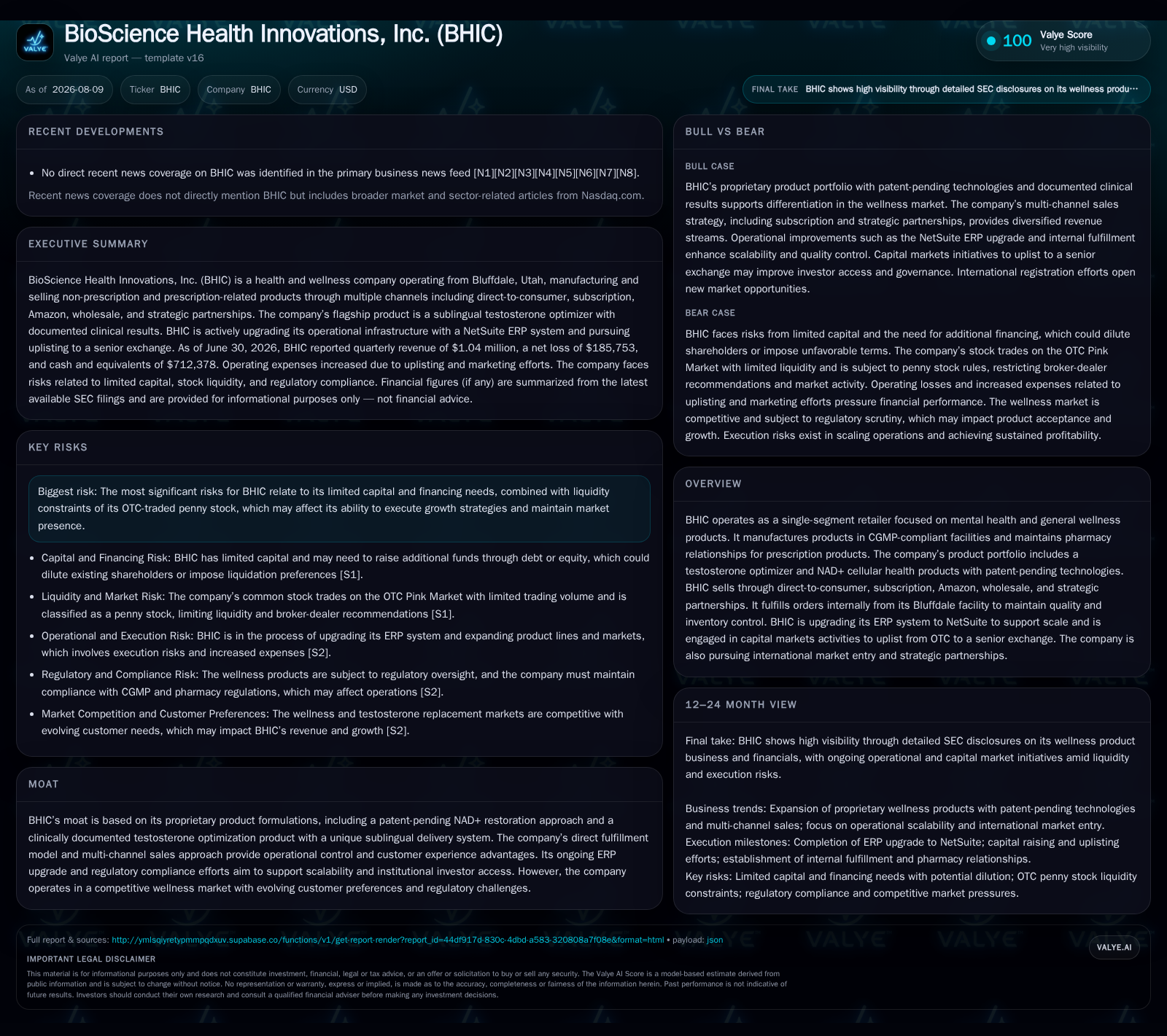
In its 2026 second quarter filing, BioScience Health Innovations, Inc. (BHIC) detailed a deliberate 'preparation-for-scale' phase emphasizing supply chain strengthening, vendor qualification, and ERP system upgrades. The company markets proprietary nutraceutical products, including a patent-pending NAD+ cellular health formulation and clinically documented testosterone optimizer, through multi-channel sales including direct-to-consumer subscription and wholesale. BHIC’s transition from OTC to senior exchange status and international market pursuits reflect strategic efforts to enhance liquidity and distribution breadth. However, capital constraints and OTC penny-stock liquidity remain salient risks that may impact growth execution.
Recent Operating Update: Preparation for Scale
BioScience Health Innovations (BHIC) reported in its Q2 2026 Form 10-Q that the first half of the year was purposefully structured as a "preparation-for-scale" phase aimed at laying operational foundations for accelerated revenue growth later in the year [S2]. Key initiatives included solidifying the supply chain by qualifying ingredient vendors while ending reliance on previous related-party suppliers. Management emphasized internal staff training improvements alongside maintaining an active research & development pipeline to support product innovation continuity. A major operational upgrade underway is implementation of the NetSuite ERP system designed to unify accounting, inventory management, order fulfillment accuracy, and overall organizational scalability. These measures are complemented by capital market activities where BHIC closed its initial Regulation A funding round—crossing shareholder thresholds necessary for uplisting from its current OTC ticker status to a more senior public exchange. Engaging specialized advisors for exchange application reflects BHIC’s intent to improve liquidity and broaden investor accessibility. The company continues operating as a single segment focused on mental health and wellness product retailing with performance assessments centralized by the CEO who acts as Chief Operating Decision Maker (CODM), indicating lean reporting structures consistent with emerging growth-stage companies
Business Model: Proprietary Nutraceuticals with Multi-Channel Fulfillment
BHIC’s core business model is concentrated on developing, manufacturing (via CGMP-compliant facilities), marketing, and selling nutraceutical products centered on mental health enhancement and general wellness support. Its flagship offerings include a patented sublingual testosterone optimization formula supported by clinical documentation plus a novel NAD+ cellular health product leveraging patent-pending restoration technology—key intellectual property differentiators in the competitive supplement space. The company monetizes through diverse channels: direct-to-consumer (DTC) e-commerce including subscription models aiming for recurring revenue streams; sales through Amazon’s platform tapping broader online consumers; wholesale distribution reaching retailers or strategic partners; plus selected collaborations aimed at market expansions [S1][S2]. Orders are fulfilled internally from BHIC’s Bluffdale facility ensuring tight quality oversight and agile inventory management—a notable operational advantage versus competitors relying heavily on third-party logistics providers which can introduce variability in customer experience standards
Subscription revenues contribute predictable cash flow but require ongoing customer retention management; DTC customer acquisition hinges on effective digital marketing investments balanced against evaluating customer lifetime value (LTV) versus costs (CAC). Wholesale accounts expand retail footprint albeit often at lower margins than direct channels but enhance brand visibility. The recent ERP upgrade is expected to materially improve order fulfillment accuracy—a vital KPI in reducing product returns—and support scalable growth by unifying front-end sales data with back-office inventory control processes.
Industry Structure and Competitive Positioning
The nutraceuticals and wellness retail sector is characterized by rapid innovation cycles in formulations coupled with stringent regulatory compliance demands regarding product claims, ingredient sourcing, CGMP manufacturing compliance, labeling transparency, and marketing practices. Customer preferences evolve swiftly under health trends emphasizing mental well-being, personalized supplements backed by clinical research evidence, and convenient delivery mechanisms such as sublingual absorption or cellular health approaches.
BHIC competes broadly against established multi-channel operators like Herbalife Nutrition that leverage global distribution infrastructure; specialized retail chains such as GNC Holdings focused on brick-and-mortar presence; direct sales-oriented firms like LifeVantage Corporation emphasizing proprietary formulations; ingredient suppliers like Nutrien Ltd.; plus major e-commerce platforms including Amazon itself hosting a multitude of third-party supplement brands. BHIC’s proprietary formulations combined with internal fulfillment afford certain moat characteristics in quality control and differentiated product delivery experiences within its niche of mental wellness supplements.
However, the company faces intense price competition exacerbated by many low-cost generic nutraceutical options and ongoing regulatory uncertainty about claim substantiation which can impact marketing effectiveness. The company’s nascent stage current scale constrains marketing budget deployment impacting customer acquisition pace while fulfillment center scalability tied closely to recent ERP implementations remains an execution risk.
Regulatory changes impacting ingredient approvals or marketing claims pose persistent threats affecting both revenue potential and operational expenditures increasing compliance costs. Competitive intensity from well-funded incumbents or new entrants can pressure pricing structures limiting margin expansion opportunities. Additionally, achieving meaningful subscription retention amidst evolving customer preferences challenges longer-term LTV gains necessary for unit economics optimization.
International expansion ambitions entail risks including diverse regulatory landscapes requiring tailored registration processes along with potential supply chain complexities introducing delays or cost escalations impacting profitability.
What to Watch Next
Key near-term milestones include tracking the effect of ERP go-live on order fulfillment KPIs such as accuracy rates, inventory turnover speed, customer satisfaction scores related to shipping times/returns rates reflecting operational improvements post-upgrade. Monitoring progress toward uplisting approval will be a critical liquidity event potentially enhancing institutional investor access thereby easing future financings required to fuel growth initiatives.
Continued R&D pipeline disclosures relevant to new product launches especially around NAD+ technologies could signify sustained product innovation competency essential for competitive differentiation. Subsequent quarterly filings will reveal how effectively new supply chain arrangements translate into stable gross margins amid scale rise plus whether subscription retention improves signaling durable recurring revenue establishment.
Regulatory audit outcomes pertaining to CGMP compliance or marketing claims would serve as another important barometer of operational risk management efficacy shaping long-term viability assessments.
Financial Profile Discussion
As of June 30, 2026, BHIC held approximately $712 thousand in cash alongside $260 thousand total debt resulting in a net cash position indicative of moderate liquidity buffer supporting near-term working capital needs without excessive leverage [F1][S2]. This balance sheet shows prudent capital structure management relative to early stage operations yet also underscores finite runway necessitating successful uplisting or additional capital raises for sustained expansion efforts.
Capital expenditures directed toward ERP upgrades likely exert pressure on cash flows short-term but represent foundational investments improving operating efficiency critical for step-function growth expected later this year following completion of preparatory initiatives described above [S2]. Absence of off-balance sheet arrangements reduces complexity risk enhancing financial transparency attractive to potential institutional investors during uplisting process.
Disclaimer: This is research-only, informational analysis and not investment advice. It may include AI-generated interpretation and general industry context. Always verify important details using primary sources.

Comments