
ADMA Biologics Elevates Plasma-Derived Therapeutics with Yield Enhancements Amid Supply Chain Focus
The company's integrated plasma collection and manufacturing model, combined with FDA-approved specialty biologics, positions it uniquely in the immunodeficiency treatment market.
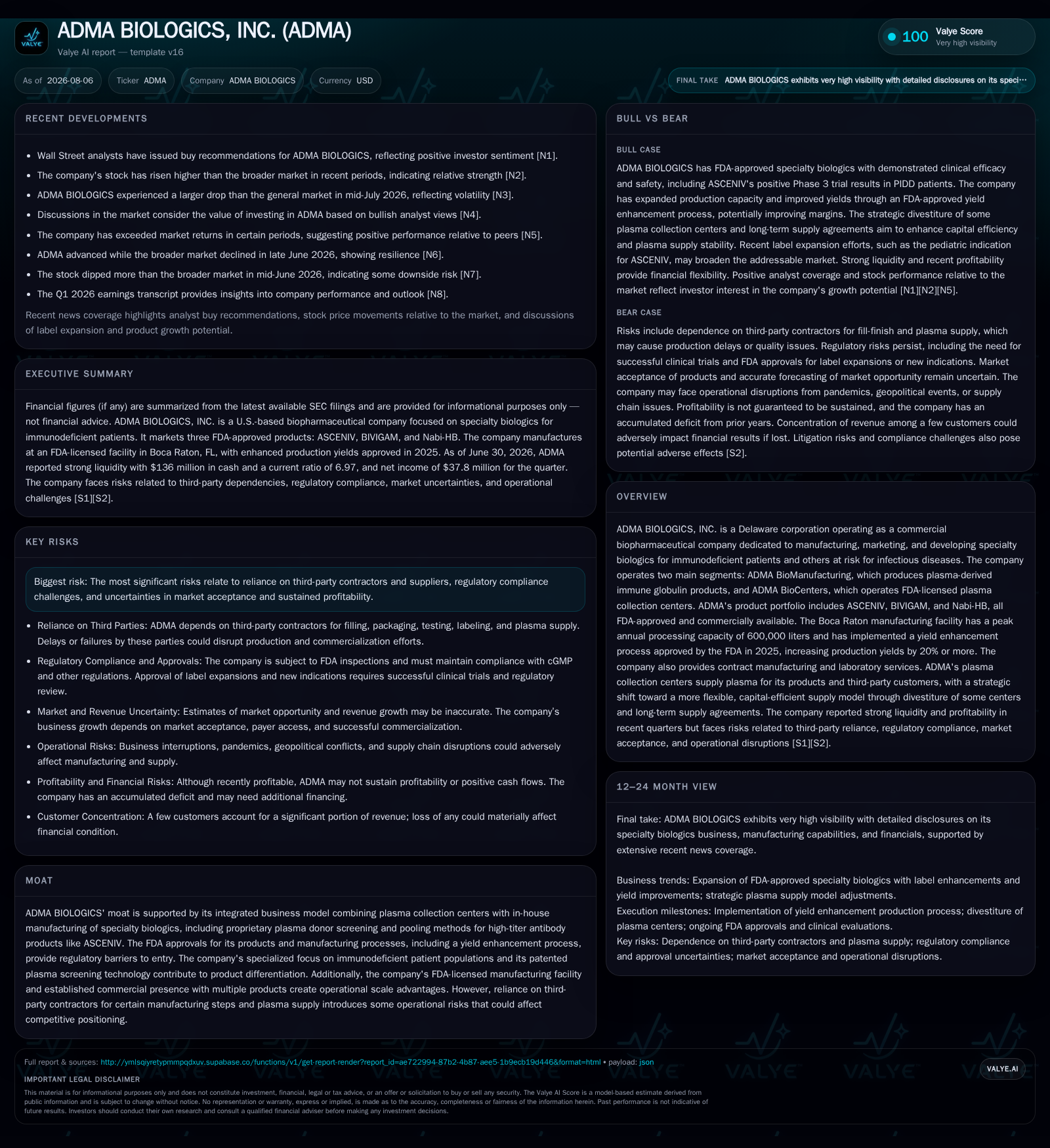
ADMA Biologics continues to strengthen its commercial and manufacturing operations as reflected in its latest quarterly filing for Q2 2026. The company benefits from FDA-approved products such as ASCENIV and BIVIGAM targeting primary immunodeficiency diseases, supported by its integrated plasma collection centers and a Boca Raton facility boasting a significant yield enhancement process. Operationally, challenges remain regarding third-party supplier dependencies and regulatory compliance risks. Financially, ADMA maintains solid liquidity alongside substantial debt obligations requiring careful management. The strategic focus on supply chain resilience, product pipeline development including hyperimmune globulins, and expansion of capacity underpin near-term growth opportunities, tempered by regulatory and market uncertainties.
Recent Operating Update
In its Q2 2026 Form 10-Q filing dated August 5, 2026 [S2], ADMA Biologics reaffirmed the continued commercialization of its core FDA-approved products ASCENIV and BIVIGAM. The Boca Raton facility is now operating with a yield enhancement process approved by the FDA in 2025 that boosts production yields by approximately 20% per liter of processed plasma [S1]. This marks the first full year where yield-enhanced production supports improved gross margins and operational leverage. The filing also highlights ADMA’s strategy to balance research initiatives and commercialization efforts carefully—particularly given the complex requirements around high-titer antibody plasma sourcing for ASCENIV’s RSV indication [S2]. Recent event filings additionally emphasize further business updates that focus on scaling manufacturing while expanding plasma supply networks [S3].
Business Model
ADMA operates an integrated biopharmaceutical platform combining licensed plasma collection centers (ADMA BioCenters) and biotechnology manufacturing (ADMA BioManufacturing). This vertical integration allows the company to control plasma source quality through proprietary donor screening systems tailored to high-titer antibodies targeting viral pathogens like RSV [S1]. Revenue generation predominantly derives from sales of immune globulin products, notably ASCENIV (approved for primary immunodeficiency disease treatment), BIVIGAM (broader immunoglobulin therapy), and Nabi-HB (hepatitis B immune globulin) commercially available in the U.S. market. The Boca Raton manufacturing plant possesses a peak annual processing capacity of around 600,000 liters of plasma, which feeds into fractionation processes producing IVIG products with specialized formulations [S1].
In addition to direct product sales, ADMA provides contract manufacturing services for third parties utilizing its FDA-approved fill-finish lines—a diversification avenue that leverages existing plant assets [S1]. These contracts supplement revenue streams but also introduce dependence on third-party customer demand variability.
Monetization revolves around price-per-treatment unit contracts via hospital systems, specialty pharmacies, and distributors serving immunocompromised patients managed by specialist physicians. Insurance reimbursement dynamics shape net realized pricing power. Volume growth depends on expanding the donor base in plasma centers (enhancing liters collected) and increasing capacity utilization at the Boca facility.
Industry Structure and Competitive Position
The biopharmaceutical industry segment ADMA occupies targets immunodeficient patients requiring intravenous immune globulin (IVIG) therapies derived from human plasma. It sits along a value chain spanning p lasma donor recruitment/collection centers; licensing/manufacturing plants regulated under strict FDA biologics license applications (BLA); clinical trial development for novel hyperimmune formulations; and commercial distribution through specialist healthcare providers.
Competitors fall broadly into integrated manufacturers like Grifols and CSL Behring—with large-scale plasma collection networks linked to global biologics production—and specialty biotech firms focusing on niche hyperimmune products or contract manufacturing groups servicing broader pharmaceutical demand [S1]. ADMA differs from larger incumbents by virtue of smaller scale but focuses strategically on high-margin niche products such as ASCENIV with differentiated high-titer RSV antibodies backed by proprietary screening technology which can translate into clinical outcome advantages
Capacity constraints at these plants tend to be capital intensive due to cold-chain storage needs for raw plasma materials as well as aseptic processing complexity. Regulatory barriers include routine inspections with frequent scrutiny over manufacturing rigor, donor health screening standards, and post-market pharmacovigilance reporting [S11]. Operational flexibility through owning both collection centers and production facilities enhances supply chain resilience compared to peer pure-play contract manufacturers or fractionators reliant solely on third-party plasma suppliers.
Growth Drivers
Multiple vectors underpin ADMA’s growth potential:
- Expansion of ASCENIV Uses: Medical education efforts aim to increase market penetration among PIDD patients while pursuing regulatory pathways for label expansions potentially supported by historical Phase II data and real-world evidence studies demonstrating reduced infection rates [S13].
- Manufacturing Yield Enhancements: The yield improvement process launched commercially in 2025 is expected to sustainably increase output volumes without proportional increases in raw material volumes, supporting margin expansion starting fiscal year 2026 [S13].
- Plasma Collection Center Portfolio Optimization: Strategic divestitures completed recently thin capital intensity exposure while retaining seven FDA-approved centers supplying critical high-quality plasma. Long-term supply agreements diversify procurement risk from external sources [S6].
- Pipeline Development: SG-001 pneumococcal hyperimmune globulin advances preclinical studies aiming at a pre-IND submission in fiscal year 2026; accelerated regulatory review may be possible through a granted Commissioner’s National Priority Voucher (CNPV) application [S1].
- Contract Manufacturing Services: Utilizing excess fill-finish capacity offers a complementary revenue stream with potential margin benefits if third-party demand scales.
- Market Trends: Increasing diagnosis rates of immunodeficiency disorders globally combined with rising awareness among specialist clinicians support sustained demand growth for IVIG therapies. Favorable reimbursement environments enhance commercial viability.
Risks / Watchpoints / Growth Constraints
ADMA faces several operational and strategic risks:
- Third-Party Dependencies: Outsourcing drug substance filling, labeling, testing operations introduces execution risk that delays or quality lapses could disrupt product availability impacting revenues negatively [S2]. Similarly, reliance on some external suppliers for source plasma remains a supply chain vulnerability.
- Regulatory Compliance: Given the high scrutiny of both collection centers and biologics manufacturing plants by the FDA and other agencies, any adverse inspection outcomes or warning letters pose costly remediation demands or market withdrawal risks [S2][S11][S26]. Regulatory delays also affect pipeline molecule approvals.
- Market Acceptance Uncertainty: While ASCENIV is approved for PIDD treatment, further label expansions depend on successful trial results and regulatory reviews which may not materialize timely or at all [S23]. Additionally, pricing pressures from payers represent ongoing challenges.
- Litigation Exposure: ADMA currently faces securities class-action litigation complicating management focus with attendant financial uncertainties [S11][S23].
- Capital Intensity & Leverage: Managing nearly $200 million in outstanding debt against $136 million cash creates leverage risk that necessitates positive operating cash flow generation to avoid refinancing challenges or covenant breaches.
- Clinical Development Risks: Pipeline candidates require successful clinical trials; failure could result in costly write-offs or strategic setbacks [S23].
What to Watch Next
Key execution points that will shed light on enterprise momentum include:
- Quarterly volume metrics for liters of plasma processed and capacity utilization rates at Boca Raton facility illustrating operational scale-up success.
- Clinical data readouts or regulatory filings relating to SG-001 pneumococcal hyperimmune globulin indicating near-term pipeline progress.
- Updates on distributor diversification efforts expanding ASCENIV/BIVIGAM reach beyond current major customers.
- Outcomes from regulatory inspections across both segments signaling compliance status.
- Progress on mitigating third-party dependence through supply agreements or internal capability expansions.
- Financial indicators reflecting sustained positive cash flows sufficient to service debt maturities without dilutive capital raises.
Financial Profile Discussion
As of June 30, 2026, ADMA held approximately $136 million in cash and equivalents balanced against $198 million in total debt obligations resulting in net debt near $62 million [F1]. The company reports a healthy current ratio near 6.97 times current liabilities ($528 million current assets vs. $75.8 million current liabilities) signaling short-term liquidity strength [F1].
Operating income gains tied closely to improved yields reducing cost per gram manufactured alongside increased commercial uptake will directly influence future margin trajectories.
This analysis is based solely on publicly available SEC filings dated through August 5, 2026 and reputable market news sources without offering investment advice.
Disclaimer: This is research-only, informational analysis and not investment advice. It may include AI-generated interpretation and general industry context. Always verify important details using primary sources.

Comments