
Verra Mobility’s Q2 Beat Highlights Resilience Amid Regulatory and Legal Challenges
Despite ongoing legal hurdles and regulatory scrutiny, Verra Mobility surpassed Q2 expectations, reflecting operational robustness in automated traffic enforcement.
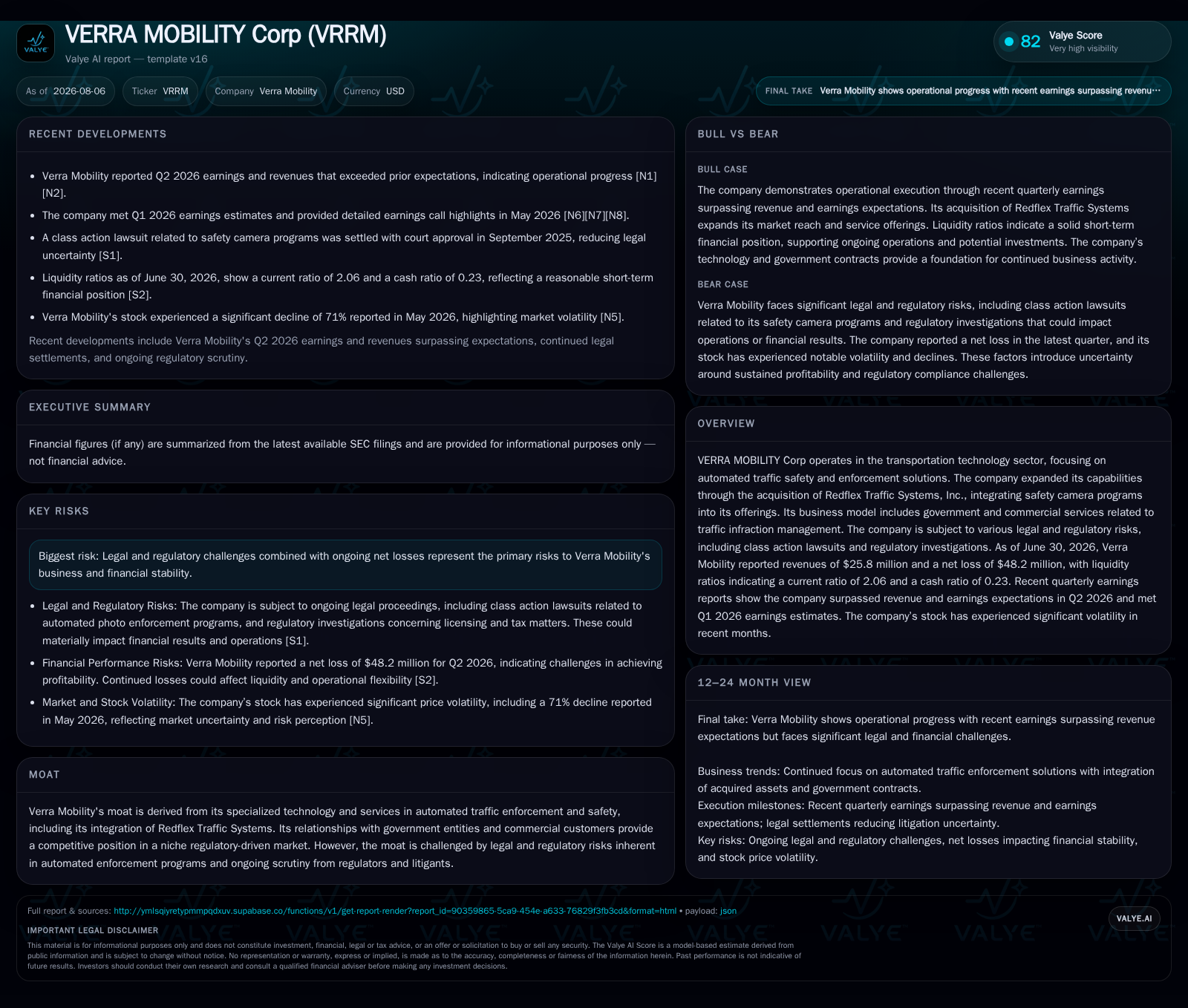
Verra Mobility reported second-quarter 2026 revenues of $25.8 million, surpassing consensus estimates alongside a narrower-than-expected net loss of $48.2 million [S2][N1][N2]. This performance illustrates the company's ability to sustain growth and operational efficiency despite significant legal and regulatory risks tied to its automated traffic enforcement programs. Integration of Redflex Traffic Systems enhances Verra’s portfolio breadth, supporting scale and deeper service offerings to government and commercial customers. Going forward, contract renewal rates, lawsuit developments, and expansion into new jurisdictions will critically shape its trajectory amid a complex regulatory environment.
Q2 Earnings Outperformance Defies Legal Headwinds
Integrated Offering Through Redflex Acquisition Supports Scale and Service Depth
Verra Mobility’s integration of Redflex Traffic Systems since its June 2021 acquisition has materially enhanced its suite of offerings within automated traffic enforcement technology [S1]. Redflex is renowned for safety camera systems equipped with license plate recognition technology enabling efficient violation detection across multiple jurisdictions. Combining these hardware assets with Verra’s software-based violation processing platforms strengthens the company’s value proposition for government clients who seek turnkey enforcement solutions—from equipment installation to infraction management and adjudication support.
The merged capabilities presumably elevate customer stickiness via broader service scope and technical synergies in data analytics—a critical factor in improving accuracy and reducing disputes that often trigger costly litigation. Contract renewals within this segment serve as a direct metric of customer satisfaction and pricing power resilience during competitive pressures. The integrated footprint may also yield scale economies in service delivery, enhancing gross margin potential over time if maintained.
Regulatory Environment Shapes Contract Stability and Pricing Power Dynamics
Verra operates in a highly regulated industry characterized by legal challenges including ongoing class actions targeting the legality of automated photo enforcement programs [S1]. These litigations impose costs but paradoxically reinforce client dependency due to the complex regulatory landscape that governs traffic law enforcement implementations. Government agencies rely on compliant vendors who can navigate licensing intricacies, tax assessments, and evolving legislation—barriers that elevate switching costs.
This creates a nuanced pricing environment where despite reputational risks linked to public opposition or political pushback, customers maintain mandatory relationships with companies like Verra for disruption-free program execution. However, these same dynamics heighten legal risk concentration which must be managed prudently to preserve contract renewal rates—the linchpin of recurring revenue quality.
Competitive Positioning Among Automated Enforcement Industry Leaders
In context with peers such as American Traffic Solutions—known for extensive government agency engagements—and Conduent Transportation—which emphasizes violation processing platforms—Verra Mobility's combined technology stack post-Redflex acquisition positions it competitively within enforcement program management [S1]. While peers offer overlapping services, Verra's breadth across hardware deployment aligns it closer to integrated solution providers rather than pure software vendors.
Nonetheless, competitive differentiation hinges not merely on product breadth but also on system uptime reliability, accuracy of license plate recognition technology, integration success rate with legacy municipal infrastructures, and ability to manage public safety technology compliantly amidst regulatory scrutiny. Sustaining scale within government contracts while expanding commercial services in fleet compliance offers an additional buffer from highly regulated revenue streams alone.
Key Growth Drivers: Jurisdiction Expansion, AI Integration, and Commercial Demand
Growth prospects rest substantially on expanding automated enforcement coverage into new municipalities increasingly prioritizing road safety through technology mandates [S1]. Artificial intelligence enhancements integrated into data analytics platforms may improve violation identification accuracy while reducing manual review costs—thereby improving average revenue per processed violation.
Moreover, growing commercial demand for fleet compliance solutions—outside traditional government channels—provides a diversification vector supporting higher-margin services. These developments collectively could drive greater volumes processed under contract terms with positive mix effects.
Tracking increases in government client count alongside improvements in contract renewal rates will validate the efficacy of such growth initiatives.
Navigating Legal Risk: Litigation Impact on Financial Health and Operational Focus
Legal proceedings remain a defining operational challenge for Verra Mobility [S1]. Recurring class actions rooted in the legality or constitutionality of automated photo enforcement programs impact not only financial performance via settlement or defense costs but also influence customer retention risk through reputational damage.
The company's disclosures acknowledge exposure to regulatory investigations at multiple jurisdictional levels—including tax assessments—that can unpredictably affect future results. Successful navigation hinges on robust compliance frameworks and proactive engagement with regulators capable of mitigating escalation risks. Although litigation costs weigh on margins presently, Verra’s Q2 results indicate manageable impact thus far supported by operational resilience.
"Forward Look": Monitoring Contract Renewals, Client Metrics, and Regulatory Developments
Key near-term milestones include the outcome of major contract renewal negotiations crucial for maintaining recurring revenues tied to large municipal programs [S2][S3]. Monitoring shifts in government client count or changes in average revenue per contract will act as leading indicators of competitive positioning strength.
Attention should also focus on any regulatory clarifications or newly enacted restrictions that might alter program viability or shift enforcement methods—potentially requiring rapid technology adaptations or contractual re-pricing. Additionally, evolutions in legal case counts or material settlements would materially affect both operational forecasts and financial outlooks.
Regular updates on technology integration success rates—particularly concerning AI implementation—and system reliability metrics remain essential to anticipate sustained client confidence.
Financial Profile Discussion: Balancing Investment with Liquidity Amid Ongoing Losses
Verra Mobility’s balance sheet shows cash & equivalents of approximately $49.5 million as of June 30, 2026, with current assets of $490.7 million and current liabilities of $238.4 million, yielding a current ratio of 2.06 which indicates adequate near-term liquidity [F1]. Total debt was reported at about $1.037 billion as of December 31, 2025, with net debt near $987 million after accounting for cash holdings [F1].
This capital structure exposes Verra to refinancing or covenant risks particularly should litigation outcomes deteriorate operating performance materially beyond current losses totaling $48.2 million this quarter [S2]. Balancing these financial tradeoffs will remain central as Verra seeks durable profitability alongside mandated service expansions within an evolving regulatory landscape.
This analysis synthesizes public filings from August 2026 along with sector-specific context without providing investment advice or research views.
Disclaimer: This is research-only, informational analysis and not investment advice. It may include AI-generated interpretation and general industry context. Always verify important details using primary sources.

Comments