
Fusemachines Faces Liquidity and Customer Concentration Challenges Amid Enterprise AI Market Expansion
Fusemachines Inc. combines AI software platforms and talent development services to address a growing enterprise AI market, but faces near-term liquidity constraints and customer concentration risks.
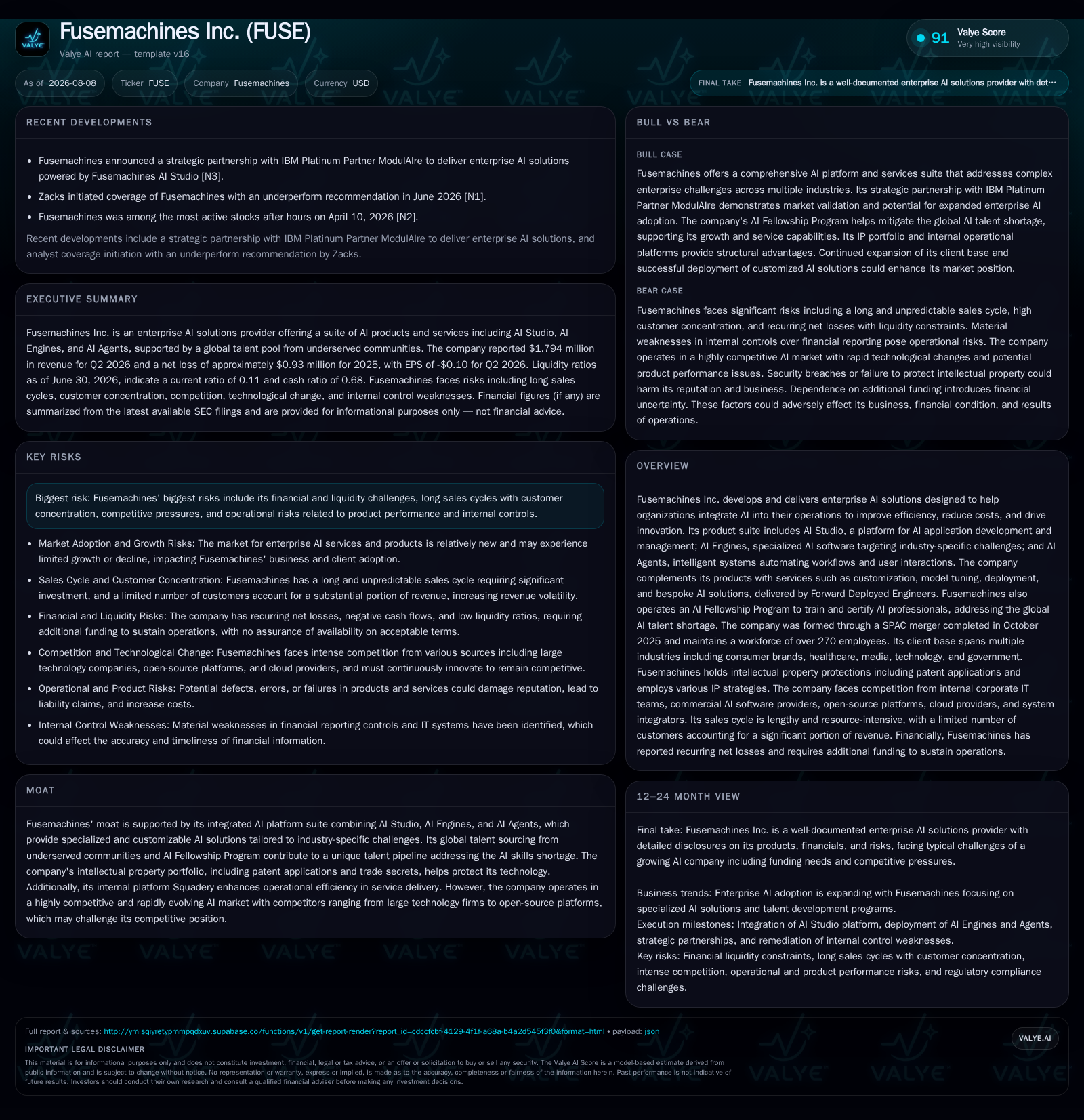
Fusemachines Inc., a recently public enterprise AI solutions provider, reported ongoing liquidity strain and sharp customer concentration in its latest quarterly filing, underscoring operational risks despite its integrated AI platform offerings. The company's product suite—including AI Studio, AI Engines, and AI Agents—targets industry-specific automation needs coupled with a strategic AI fellowship program supporting talent pipelines. While the expanding global demand for enterprise AI offers growth runway, Fusemachines must overcome long sales cycles, competitive pressures from larger players, and substantial financial headwinds evident in its sub-1.0 current ratio and negative operating income. Analysts should monitor contract renewals, deployment ramp rates, and cash management for signs of stabilization.
Recent Operating Update
In its August 7, 2026 10-Q filing, Fusemachines disclosed persistent liquidity pressures marked by $368,000 in cash against approximately $18.7 million in current liabilities as of June 30, resulting in an extremely weak current ratio of 0.11 [F1][S2]. This imbalance exposes the company to near-term funding risks unless mitigated through additional capital raises or improved working capital management. Operating losses remain material with the last complete year (2025) showing a net loss nearing $0.9 million and an operating loss exceeding $5.9 million on revenues just under $7.7 million [F1]. No recent disclosures suggest a meaningful improvement in cash flow dynamics or profitability.
An accompanying August 7 event filing (8-K) affirmed no material litigation impacting operations currently but highlighted governance efforts following the SPAC merger completed in October 2025 [S3]. The merger transitioned Fusemachines into a publicly traded entity during expanding opportunities in enterprise artificial intelligence software and services.
Business Model and Product Offering
Fusemachines operates an integrated enterprise AI solutions business structured around three core product pillars:
AI Studio: A comprehensive platform enabling enterprises to build, deploy, monitor, and manage machine learning models through an end-to-end lifecycle approach. It integrates multiple layers—business applications/workflows supported by an "AI Hub" for model management, a data layer connecting diverse sources, and governance modules ensuring compliance and security [S1][S14].
AI Engines: Industry- and problem-specific AI applications built on top of AI Studio that tackle targeted challenges such as fraud detection in food & beverage transactions or document analysis for loans. These engines leverage contemporary advanced technologies including large language models (LLMs), computer vision, and deep learning to provide tailored business outcomes rather than generic tooling [S1][S14][S22].
AI Agents: Intelligent automated systems designed to streamline operational tasks like candidate interviewing during recruitment processes. These agents exemplify workflow automation aimed at reducing manual effort across customer business functions.
Complementing these software offerings is a mix of professional services encompassing customization, model tuning, integration into existing workflows, deployment support, and bespoke solution development conducted by forward deployed engineers [S14][S22]. Customers engage Fusemachines either via software subscriptions/licenses or bespoke service contracts — sometimes simultaneously depending on complexity.
Additionally, Fusemachines runs an AI Fellowship Program, training and certifying hundreds of AI professionals predominantly from underserved communities in regions like the U.S., Nepal, and the Dominican Republic to address severe industry-wide skill shortages [S1][S14]. This initiative supports internal talent pipelines while advancing its social mission.
This hybrid SaaS plus services model is typical among enterprise AI vendors addressing complex digital transformation requirements where turnkey platforms need extensive adaptation alongside skilled human expertise.
Industry Structure and Competitive Landscape
The broader enterprise artificial intelligence software sector is dynamic but fragmented, characterized by rapid technological shifts including the rise of foundation models and scalable cloud-native architectures. Established hyperscalers such as Microsoft Azure (with Azure OpenAI Services), Google Cloud Vertex AI, and AWS SageMaker dominate foundational capabilities—offering extensive infrastructure with broad integrations—but often lack the highly specialized customization Fusemachines delivers through its vertical-focused Engines.
Competition also arises from specialized vendors offering niche AI applications as well as open-source frameworks that reduce barriers for internal teams at large enterprises to develop custom ML solutions independently. Moreover, the severe shortage of qualified data scientists fuels demand for combined software+services firms capable of delivering end-to-end project execution rather than pure-play platforms.
Fusemachines occupies an integrator role downstream of technology research by combining proprietary IP—backed by patent applications—and its teaching program into offering personalized industry use cases. However, its scale is modest relative to major cloud providers; risks include being outspent on R&D or overshadowed by ecosystem lock-in effects favoring those larger players.
Growth Drivers
Enterprise adoption of AI continues accelerating driven by mandates for cost optimization, operational efficiency improvements via automation (e.g., hiring workflows), enhanced analytics accuracy (e.g., sales forecasting), and digital innovation imperatives across sectors including consumer brands, healthcare, media, technology services, and government entities [S1]
Fusemachines’ ability to offer customized vertical engines with measurable ROI addresses specific market demand differing from generalized platforms requiring internal heavy lifting. The Fellowship Program not only mitigates hiring bottlenecks for the company itself but also strengthens client trust given ongoing skills scarcity worldwide.
Expansion opportunities revolve around converting pilot deployments into scale projects—increasing ARR through upsells—and extending geographic reach particularly where Fusemachines can source local engineering talent cost-effectively. Synergies between product innovation (enhanced engine sophistication) and professional services delivery efficiency will be important levers.
Risks and Operational Constraints
Revenue concentration is high: two customers accounted for nearly one-third of total revenues in 2025—the loss or downsizing at any one client could materially impact financial results given absence of automatic renewals or long-term contracts with stringent termination terms [S21]. Further volatility arises from prolonged sales cycles typical within enterprise AI buying processes that weigh factors beyond product features such as vendor reputation or budget cycles.
Competitive threats range from rapid evolving technology rendering current engines obsolete to intensified margin pressures due to aggressive pricing by hyperscalers bundling AI capabilities within broader cloud stacks [S1][S4]. Legal risks pertaining to intellectual property claims remain present given industry litigiousness although no material litigation currently exists for Fusemachines [S4][S11]. Regulatory compliance on emerging governance standards around ethical AI may increase operational overheads [S13].
What To Watch Next
Key milestones indicative of improving operating health include accelerated conversion of pilot programs into expansion deals visible through rising bookings or disclosed pipeline growth metrics.
Monitoring renewal rates with key customers will provide insight into retention resilience amid customer concentration risks. Progress reports on talent certification throughput via the Fellowship program may signal capability buildup supporting future delivery volumes.
Product-wise innovation cadence reflected in new engine launches or agent deployments may reveal R&D momentum necessary to compete technologically with large cloud vendors offering increasingly embedded solutions.
Finally, management commentary addressing strategic responses to marketplace challenges—particularly regarding service delivery scaling or competition—will be crucial.
Financial Profile Discussion
As of June 30, 2026 balance sheet data shows cash & equivalents totaled just $368,000 against current liabilities approximating $18.7 million bringing the current ratio down to about 0.11—a dangerously low liquidity measure indicating severe short-term funding constraints absent corrective actions [F1][S2]. Total debt was about $1.05 million at end-2025 with net debt after subtracting cash roughly $680,000 [F1].
Operating income remains negative with a loss exceeding $5.9 million at year-end 2025 amid flat revenue near $7.7 million pointing to continuing scale inefficiencies early post-SPAC combination transition [F1]. The company carries a sizable accumulated deficit (~$35 million) reflecting multiple years of investment-heavy losses without profitability achieved yet [S5].
Such leverage on working capital suggests an urgent need for either external financing or operational initiatives targeting cost structure improvements along with revenue acceleration through customer expansions.
Overall Fusemachines exhibits typical early-stage public company financial risk profiles common among highly technical SaaS plus professional service providers still establishing reliable profitability vectors amid complex sales environments.
Disclaimer: This analysis is for informational purposes only without research view regarding securities trading decisions. All data cited are based on public SEC filings as noted.
Disclaimer: This is research-only, informational analysis and not investment advice. It may include AI-generated interpretation and general industry context. Always verify important details using primary sources.

Comments