
AA Mission Acquisition Corp. II Eyes Food and Beverage Targets Leveraging China Ties and Management Expertise
The SPAC maintains solid capital footing and focuses on proprietary sourcing within food and beverage, facing geographic-specific regulatory risks.
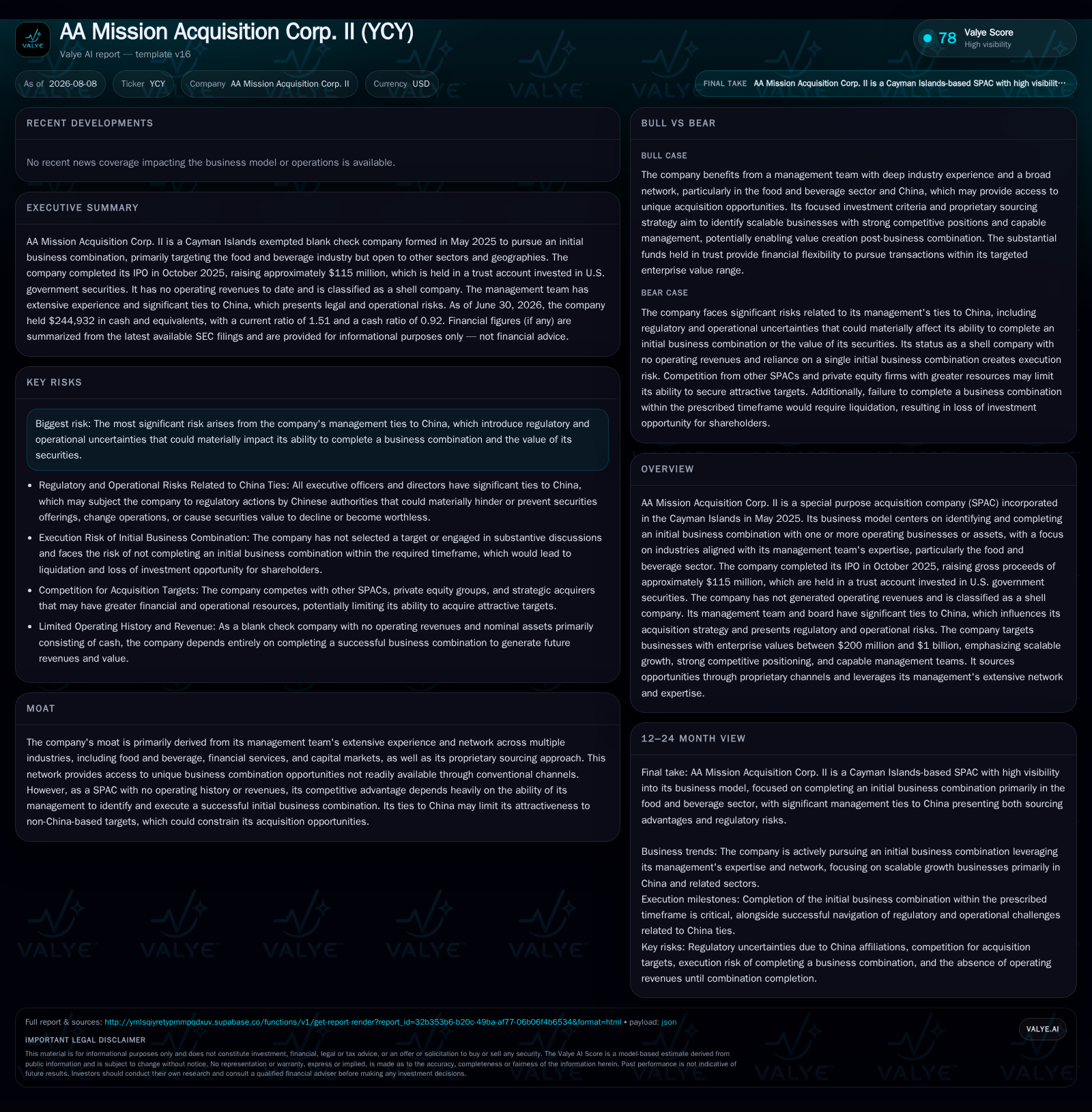
AA Mission Acquisition Corp. II, a Cayman Islands-based SPAC, reported no changes in risk factors or operating status in its latest quarterly filing, confirming its pre-combination shell position with approximately $115 million raised in its IPO mostly held in trust [S2][F1]. The management team’s extensive experience and sector focus on food and beverage underpin a proprietary deal sourcing approach that aims to avoid auction processes, though its strong ties to China introduce regulatory complexity and may limit target universes [S1][S4]. The company is under typical SPAC time pressure to consummate an initial business combination within the mandated window, balancing shareholder redemption rights and geopolitical risks that affect deal execution [S1][S2].
Latest Quarter Update Validates Capital Hold and Shell Status Without Operational Revenue
In its most recent quarterly filing dated August 7, 2026, AA Mission Acquisition Corp. II (YCY) confirmed it remains a pre-combination blank check company holding approximately $115 million in gross proceeds from its October 2025 IPO primarily in a trust account invested in U.S. government securities [S2][F1]. The filing reports no operating revenues or active business operations, consistent with its status as a special purpose acquisition company seeking an initial business combination. Importantly, there have been no updates altering the risk factors disclosed at IPO, maintaining transparency on ongoing regulatory and operational uncertainties tied to its management's geographic affiliations [S2]. Operating losses remain minimal as expected given the absence of direct business activity prior to completing a de-SPAC transaction [F1]. This capitalization through trust funds forms the financial bedrock enabling continued pursuit of acquisition targets while protecting investor principal subject to redemption rights.
Management Experience Drives Proprietary Sourcing Strategy Within Target Sector Focus
AA Mission Acquisition Corp. II explicitly focuses on leveraging its management team's deep expertise and network to identify acquisition targets primarily within the food and beverage industry [S1][S4]. The team collectively brings decades of cross-industry experience ranging from financial services and capital markets to private equity and leadership within publicly traded companies. Rather than participating in broadly marketed SPAC deals exposed to competitive auction pressures, AA Mission emphasizes proprietary sourcing channels cultivated via established relationships with founders, executives, investors, venture capitalists, and private equity sponsors across key sectors [S5]. This approach aims to unlock unique opportunities not widely accessible to average industry participants—an important moat element given the crowded SPAC market landscape. The targeted focus on businesses valued between $200 million and $1 billion aligns with management’s historical knowledge base enabling active post-combination operational guidance to scale growth platforms efficiently [S23]. Such selective sourcing supports improved deal quality prospects relative to indiscriminate bidding scenarios common among more generic blank check vehicles.
China Connections Define Unique Risk Profile And Potential Deal Access Constraints
A distinguishing feature shaping AA Mission Acquisition Corp. II’s strategic profile is that all executive officers possess significant ties to the People’s Republic of China (PRC) [S4]. While these connections offer privileged insight into local markets potentially enhancing access to China-based targets via trusted networks, they also embed layers of geopolitical and regulatory complexity uncommon for many U.S.-listed SPACs. Regulatory regimes in China affecting offshore offerings, data privacy, anti-monopoly investigations, and auditor inspections by PCAOB authorities create material uncertainties that could hinder or delay consummating an initial business combination or impair post-merger company operations [S4][S18].
This bifurcated risk-reward dynamic means AA Mission Acquisition Corp. II may find itself at a disadvantage when courting non-China targets wary of complex jurisdictional entanglements while simultaneously benefiting from inside channels granting potential exclusivity within Chinese consumer markets where many private companies seek public listings amid restricted domestic IPO options. Consequently, this geographic concentration shapes core investment risks including valuation volatility driven by cross-border enforcement actions or shifting policy priorities on foreign investment in sensitive sectors.
SPAC Industry Context Illuminates Positioning Versus Peer Vehicles And De-SPAC Timelines
The firm raised roughly $115 million in gross proceeds through issuance of units consisting of shares paired with warrants exercisable post-initial business combination at $11.50 per share—a structure typical among contemporaneous SPACs targeting mid-market acquisitions [S10]. Since closing its IPO in October 2025, approximately ten months have elapsed without a completed merger or asset acquisition [F1], consistent with sector benchmarks imposing typical two-year mandates for closing deals or winding down by returning funds to shareholders.
Relative to landmark SPACs such as Pershing Square Tontine Holdings (PSTH), which operated at much larger scale with more complex sponsor promote structures and extended timelines, AA Mission Acquisition’s scale situates it comfortably among specialized sector-focused vehicles like Social Capital Hedosophia Holdings that also pursue targeted thematic acquisition strategies rather than broad industrial scopes.
Investor confidence during this interim phase depends heavily on visible deal pipeline development alongside careful management of redemption rights exposing dilution risks if significant shareholders elect cash-out prior to deal closure—a perennial challenge for smaller SPACs balancing liquidity retention against shareholder opt-outs [S24]
Pathways To Growth Hinged On Initial Business Combination Execution Within Mandated Window
Growth prospects for AA Mission Acquisition Corp. II ultimately rest upon consummating a high-quality initial business combination aligned with management’s strategic criteria emphasizing scalable consumer brands enjoying defensible competitive advantages within food and beverage markets characterized by strong consumer loyalty or proprietary product positioning [S23]. II derive from typical SPAC-related execution hazards augmented by geopolitically linked regulatory risks stemming from its management’s PRC affiliations. If the company fails to announce or consummate an initial business combination within its completion window—usually capped near two years—it would be forced into liquidation returning trust account proceeds adjusted for permitted withdrawals thereby extinguishing public shareholder rights except warrant holders who lose residual value [S26].
Moreover, shareholder redemption rights present a double-edged sword: while affording investors liquidity protections they can erode available transaction cash pools reducing deal feasibility or forcing unfavorable adjustments impacting existing shareholders’ residual equity value post-deal completion [S24]. Furthermore, Chinese government policies concerning overseas listings create enveloping uncertainties regarding approval processes for mergers involving Chinese targets including restrictions on accounting firm inspections by PCAOB authorities that complicate compliance with SEC proxy solicitation rules impacting transaction timing and successful closure probabilities [S18].
Sponsor reputation constitutes an intangible yet critical variable influencing target access as well as ongoing investor confidence essential amid heightened scrutiny faced by foreign-affiliated shell companies publicly listing U.S.-based firms.
'What To Watch': Signs Of Deal Pipeline Momentum, PIPE Support, And Timing Milestones Ahead
Investors tracking AA Mission Acquisition Corp. II should monitor forthcoming disclosures keyed around announcements of letters of intent or definitive merger agreements providing tangible evidence of pipeline traction both qualitatively via partnership descriptions and quantitatively reflecting target valuations ideally within stated $200 million-$1 billion enterprise value brackets [S2][S1]. In parallel PIPE investor participation updates signal institutional validation necessary for achieving net tangible asset thresholds required under New York Stock Exchange rules for transaction approval.
Additional critical markers encompass disclosed shareholder redemption election levels upon deal proposals revealing market confidence measured against dilution fears plus any amendments proposed to charter documents impacting redemption mechanisms potentially adjusting shareholders’ prerogatives ahead of vote events.
Together these signals function as leading indicators foreshadowing potential de-SPAC transaction closure imminence fundamental for realizing value creation embedded in current unit prices.
Financial Profile Discussion: Trust Account Health Underpins Capacity To Execute Transaction
The latest balance-sheet snapshot reveals cash and equivalents standing near $245 thousand as of June 30, 2026 accompanied by current assets totaling approximately $401 thousand against current liabilities near $266 thousand yielding a current ratio of around 1.51—a measure consistent with ongoing solvency albeit reflecting minimal operating activity consistent with pre-combination shell status [F1]. Operating incomes remain negligible negative reflective of startup phase administrative expenses rather than substantive commercial operations illustrating standard financial characteristics across similarly sized blank check entities pre-deal foray.
While the nominal absolute cash figure appears small relative to initial trust holdings quoted at about $115 million due largely to categorization conventions separating operating funds from escrowed amounts invested conservatively in government-backed securities per regulatory requirements ensuring principal protection pending merger completion—the large bulk remains safeguarded thus preserving capacity needed for planned acquisitions thereby supporting investor security until deal closure.
This liquidity profile aligns well with typical early-stage SPAC financial health metrics signaling readiness for continued due diligence alongside measured expense discipline necessary until definitive agreements materialize without pressing withdrawal demands disrupting operational runway.
Disclaimer: This is research-only, informational analysis and not investment advice. It may include AI-generated interpretation and general industry context. Always verify important details using primary sources.

Comments