
biote Corp. Drives Practitioner Network Expansion to Scale Hormone Optimization Platform
The company leverages integrated practitioner certification, software, and branded supplements to build recurring revenue streams amid ongoing legal and profitability challenges.
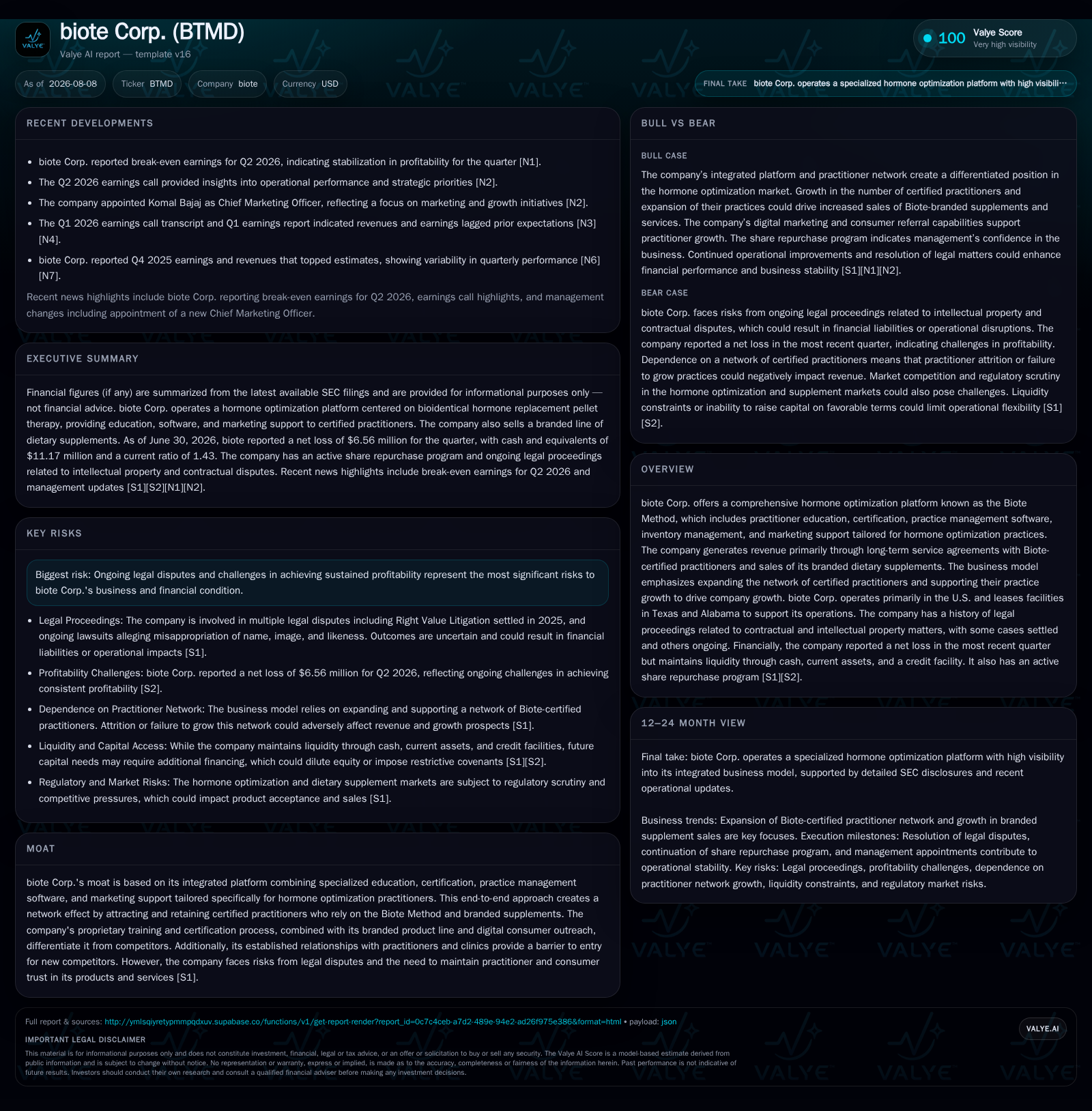
biote Corp. continues to grow its network of certified hormone optimization practitioners and enhance its digital platform offerings, underpinning a dual revenue model of long-term service agreements and branded supplement sales. Recent quarterly results show progress toward profitability with break-even earnings reported in Q2 2026, supported by practitioner expansion and e-commerce supplement growth. However, the company faces ongoing legal risks and must manage leverage carefully in its pursuit of scale. Success depends on sustaining practitioner retention, growing digital engagement, and navigating regulatory scrutiny in a competitive healthcare services landscape.
Recent Operating Update
biote Corp.'s Q2 2026 results reflect a pivotal point as the company achieved break-even earnings for the quarter, demonstrating operational leverage from scaling its hormone optimization platform [N1][S2]. This milestone follows sustained efforts to expand its network of Biote-certified practitioners—the primary channel through which recurring service agreement revenue is generated. The increased practitioner base coupled with growth in e-commerce supplement sales underpins this improved financial performance [N2][S2]. The company has actively repurchased shares under a $20 million program during the quarter, signaling management confidence amid scaling efforts [S2].
Business Model and Strategic Strengths
biote Corp. operates an integrated hormone optimization ecosystem centered on what it terms the "Biote Method." This offering uniquely bundles several components: specialized clinical education and certification for practitioners; proprietary practice management software designed to streamline operations; marketing support aimed at driving patient acquisition; and a suite of branded bioidentical dietary supplements offered through both practitioner clinics and direct-to-consumer e-commerce channels [S1].
Revenue predominantly arises from long-term service contracts with certified practitioners that create recurring subscription-like income streams. These contracts embed platform dependency as practitioners rely on continuous access to education updates, software tools, and product inventory facilitation. Supplement sales provide an adjunct but fast-growing secondary revenue stream enhanced by expanding online retail presence [S1]. This dual-revenue model distinguishes biote from purely software-focused vendors or standalone supplement manufacturers by tightly integrating practitioner enablement with product sales.
The company’s practice management software adoption is crucial for enhancing practitioner efficiency and retention—key levers for deepening network effects and increasing average revenue per practitioner [S1]. The marketing support component also aims to reduce customer acquisition cost (CAC) for practitioners by funneling inbound patient demand through coordinated digital campaigns targeting bioidentical hormone therapy consumers
Facility leases in Texas (headquarters, training centers) and Alabama (compounding facility operated by subsidiary Asteria Health) provide operational footholds necessary to deliver these integrated services across the U.S., suggesting prudent investment in infrastructure complementary to its digital health platform ambitions [S1].
Industry Structure and Competitive Positioning
The healthcare services industry encompassing hormone optimization platforms involves navigating complex regulatory environments due to the clinical nature of treatments and dietary supplement regulations. biote Corp.'s comprehensive approach combining certification, software solutions, clinical support, and product commercialization creates substantial switching costs for practitioners anchored into its ecosystem. This integrative model fosters network effects as newly certified practitioners become consumers of both enhanced practice tools and supplements.
Peers can be loosely benchmarked against telehealth companies like Hims & Hers Health that similarly marry digital health services with branded product lines. biote's additional focus on practitioner training sets it apart from telehealth pure-plays or isolated supplement manufacturers by embedding itself upstream within clinicians’ workflows.
Challenges include competitive pressure from emerging digital health platforms offering alternative practice management solutions or direct-to-consumer supplement brands leveraging broad e-commerce channels without corresponding clinical ties. Pricing power appears linked closely to continuous value delivery through education updates and software improvements.
Growth Drivers
Growth catalysts stem principally from expanding the certified practitioner registry—a critical KPI tracked internally—as this directly scales the recurring revenue base. Efforts targeting increased practitioner recruitment combined with retention through ongoing certification renewal requirements underpin top-line visibility.
Broader adoption trends toward personalized hormone therapies among aging demographics further bolster demand structural footing for biote’s offerings. Concurrently, rising consumer acceptance of bioidentical hormone supplements supports volume expansion within e-commerce sales channels.
Digital innovation remains vital; enhancements in software usability and patient engagement features can drive deeper integration into clinic workflows while improving outcomes that reinforce platform value propositions.
Regulatory approvals facilitating expanded product offerings or more streamlined prescribing mechanisms would serve as additional tailwinds along with strategic partnerships connecting biote-certified clinics to wider healthcare provider networks.
Risks and Growth Constraints
Regulatory compliance continues to represent a critical risk given the medical nature of hormone optimization treatments intersecting FDA-regulated supplements. The company must also navigate intellectual property disputes given its proprietary methodology; ongoing litigation—though currently not materially adverse—is a reminder of potential disruption risks [S22].
Scaling challenges may emerge from ensuring consistent practitioner training quality amid rapid network expansion, sustaining sufficient marketing ROI to attract both practitioners and consumers while managing CAC effectively.
Financial leverage remains notable with net debt near $114 million against relatively modest cash balances as of mid-2026—even after recent share repurchases—indicating careful capital deployment is essential lest financial flexibility be impaired [F1]
Market acceptance also hinges on maintaining consumer trust in the efficacy and safety profile of supplements—a reputational risk amplified by any adverse regulatory developments or publicized litigation outcomes.
What to Watch Next
Key milestones involve tracking quarterly increases in the number of active Biote-certified practitioners alongside renewals rate metrics which indicate network stability. Supplement sales volumes through e-commerce should be monitored closely as an indicator of consumer brand traction outside direct clinical encounters.
Technology adoption rates within existing practices will signal incremental pricing power potential via upselling enhanced software modules or marketing packages.
Furthermore, progress in resolving or mitigating legal disputes related to prior contractual conflicts could de-risk balance sheet volatility.
Management disclosures around margin improvement initiatives post-Q2 record break-even profitability will shed light on path toward sustained operating leverage.
Finally, any announcements related to expanded clinic partnerships or regulatory milestones enabling new products would provide incremental growth visibility.
Financial Profile Discussion
As of June 30, 2026, biote Corp.’s cash balance stood at approximately $11.2 million against total debt nearing $125 million, resulting in net debt close to $114 million with a current ratio of 1.43 indicating moderate short-term liquidity coverage [F1]. The leverage level reflects prior acquisitions such as Asteria Health—a strategic move augmenting product manufacturing capabilities—and ongoing investment in platform build-out.
Recent quarters saw narrowing net losses culminating in reported break-even Q2 earnings suggesting improving operational efficiency driven largely by top-line scale gains rather than cost cutting alone [N1][S2]. The share repurchase program underway demonstrates confidence but also reallocates capital away from potential reinvestment zones.
Maintaining compliance with credit covenants tied to net leverage ratios will be critical ahead of term loan maturity dates approaching May 2027 [S4], especially if macroeconomic conditions pressure refinancing options or if operational cash flow generation does not accelerate sufficiently.
Overall cash flow sustainability depends on continuing expansion of stable recurring revenue streams from service agreements supplemented by growing high-margin branded supplement sales bolstered by efficient marketing spend [S1][F1]
Conclusion
biote Corp.’s integrated hormone optimization platform shows tangible evidence of maturing into a scalable business model grounded in certified practitioner network expansion combined with consumer-facing branded supplement growth. Achieving Q2 break-even earnings marks important validation that its multi-pronged strategy leveraging education, digital health tools, and product sales can deliver sustainable profitability once critical mass is attained.
Nevertheless, execution risks tied to legal challenges, regulatory compliance complexities, leveraging financial structure constraints, plus competitive pressures necessitate cautious monitoring going forward. Key indicators such as practitioner network metrics, supplement volume trends, technology adoption rates, and margin improvements will confirm whether biote successfully converts early-stage momentum into durable market leadership within this niche healthcare services sector.
This analysis is based solely on publicly available filings including Form 10-K dated March 13, 2026; Form 10-Q dated August 7, 2026; Form 8-K filings; recent news reports; and associated proprietary data extracts. It does not contain investment advice or research views regarding securities.
Disclaimer: This is research-only, informational analysis and not investment advice. It may include AI-generated interpretation and general industry context. Always verify important details using primary sources.

Comments