
SHF Holdings Faces Revenue Pressure and Indemnification Risk in Cannabis Financial Services
Recent quarterly disclosures reveal SHF Holdings' challenges with account attrition, regulatory complexity, and indemnification obligations within its cannabis-focused banking platform.
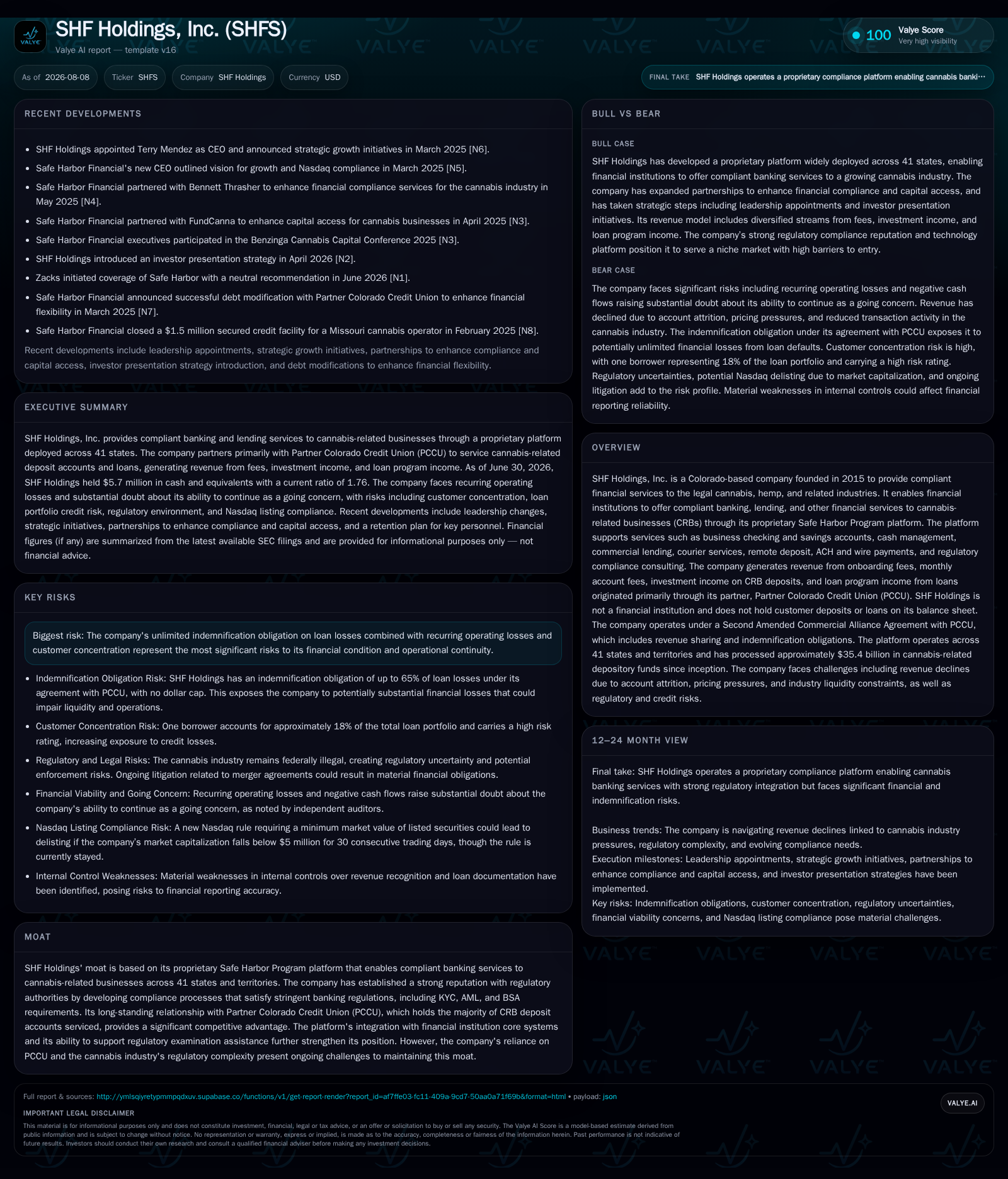
SHF Holdings operates a proprietary compliance platform enabling financial institutions to serve cannabis-related businesses through deposit and lending services. The company’s latest quarter highlights persistent revenue decline driven by account attrition, lower deposit balances, and subdued transaction activity amid industry-wide economic pressures. While a recent contract amendment increases SHF’s revenue share on loans, it also imposes a significant indemnification obligation tied to loan losses. Legal disputes related to its acquisition and liquidity constraints add further risk layers. SHF’s position as a compliance intermediary dependent on its partner credit union underpins both its moat and vulnerability, with upcoming litigation outcomes, account trends, and regulation changes critical to monitor.
Recent Operating Update: Continued Pressure Amid Industry and Legal Challenges
SHF Holdings’ most recent Form 10-Q filed August 7, 2026 provides the latest detailed operating snapshot. The company reported ongoing revenue declines primarily attributed to attrition among cannabis-related business (CRB) deposit accounts, diminishing average deposit balances, and reduced transaction volumes within the broader cannabis economy [S2][S1]. These factors directly reduce the fee income from account maintenance and transaction activity, which are core revenue pillars in its specialized financial services model.
A notable structural change embedded in the Second Amended Cannabis Account Agreement (CAA) has boosted the company’s share of loan program income from roughly 35% to up to 65%, which could bolster revenues if loan origination volumes grow or stabilize [S1]. However, this increased revenue share is linked to an unlimited indemnification obligation on any loan losses—a substantial operational leverage point signaling some risk transfer back onto SHF that could significantly impact future profitability depending on credit quality and claim frequency [S1].
On the legal front, SHF remains engaged in litigation over acquisition terms related to Abaca (formerly Rockview Digital Solutions), where procedural rulings have favored neither party conclusively yet. Approximately $3 million remains deposited in the Denver District Court pending resolution of disputes anticipated at trial in August 2026 [S7][S9]. The outcome will materially affect financial obligations and potentially influence market perception.
Further complicating near-term outlook is Nasdaq's recent adoption of a rule requiring listed companies maintain a minimum market capitalization of $5 million continuously or face delisting without cure period—an issue SHF flagged explicitly given its trading levels [S2][S9]. Unlike traditional banks, SHF does not take deposits or hold loans; instead, it functions as an intermediary providing onboarding, KYC/AML/BSA compliance consulting, regulatory examination assistance, deposit servicing infrastructure, cash management tools, payment origination (ACH/wire), commercial lending support via PCCU partnership, remote deposit capabilities, and courier services.
Revenue streams arise from multiple complementary sources: onboarding fees reflecting complex due diligence requirements; recurring monthly fees based on account size and activity; investment income earned on deposits maintained at PCCU; and shared loan income generated by underwriting commercial loans through PCCU [S1]. This hybrid monetization capitalizes on both transactional volume (fees) and asset deployment (investment/loan income) while leveraging regulatory expertise as a competitive differentiator.
The value proposition centers on mitigating regulatory risk inherent in serving CRBs by delivering deep compliance technology integration directly into partner financial institution systems—a critical factor given the sector’s tangled federal-state legality conflicts requiring strict adherence to FinCEN guidance and other oversight regimes.
Industry Structure & Competitive Position
Specialized financial services catering to CRBs occupy a niche marked by complex regulation, significant compliance burdens, and low tolerance for misstep by banks due to federal enforcement risks. SHF competes among providers offering proprietary compliance platforms (Safe Harbor Financial, Hypur), specialty lenders (Fourth Corner Credit Union), fintech firms delivering high-risk KYC/AML solutions, as well as regulatory consultants facilitating lawful cannabis banking.
SHF’s principal competitive moat derives from its long-standing relationship with PCCU—the primary chartered institution holding most deposits—and its technology platform's integration depth supporting multi-state operability and examination readiness [N/A S1 context]. This partnership affords both scale benefits and regulatory credibility difficult for new entrants or generic fintechs lacking direct institutional ties to replicate easily.
The company's operational effectiveness hinges heavily on preserving trust with PCCU since it neither holds deposits nor loans directly. This arrangement limits balance-sheet risk but necessitates upstream certification of liquidity adequacy under indemnification covenants tied to loan loss exposures [S1][S4]. Maintaining seamless platform uptime integrating with core banking systems also serves as operational gatekeeping against competitor substitution.
Growth Drivers: Market Expansion Meets Regulatory Nuance
Potential growth levers include expanding legalization across U.S. jurisdictions fueling more CRB formation; increasing normalization enabling broader adoption of formal banking solutions over cash-intensive alternatives; technological enhancements improving operational efficiency; extension of lending programs specifically designed for cannabis operators’ capital needs; new partnerships with additional credit unions or banks expanding geographic reach; rise of integrated cash management services blending payments with compliance tracking; plus broader regulatory developments potentially reducing barriers for mainstream financial entities entering cannabis markets.
However, these drivers depend critically on evolving regulatory landscapes—both supportive policies accelerating bank participation in cannabis finance or adverse rule changes tightening scrutiny could materially shift demand dynamics.
Risks & Watchpoints: Indemnification Exposure & Market Viability Concerns
Indemnification obligations represent perhaps the company’s most acute single-point risk. The Second Amended CAA requires SHF to absorb up to 65% of loan losses without caps—exposures that could surpass available liquidity amidst deteriorating credit environments within the cannabis industry [S1][S4]. The ongoing operating losses compound liquidity stress raising going concern flags despite access to a $150 million ELOC facility cited broadly in prior periods.
Customer concentration risk persists given reliance on PCCU for deposit custody alongside attrition trends eroding active account numbers and balances amid industry-wide economic headwinds. Revenue sensitivity tied directly to deposit activity means cyclicality or structural weakening in U.S. cannabis markets could depress fee generation further.
Legal uncertainties continue with active litigation over acquisition agreements adding contingent liabilities potentially up to $7.8 million plus costs if unfavorable resolutions occur [S7][S9]. Finally Nasdaq listing risk looms should market capitalization thresholds not be met once the new MVLS rules come into effect without relief.
Cybersecurity threats targeting proprietary compliance data systems may also pose material risks given reputational damage potential in case of breaches affecting sensitive financial/customer information [S22].
What To Watch Next
- Trial outcomes relating to Abaca acquisition disputes expected August 2026 will materially influence contingent liability profiles.
- Quarterly updates on CRB account base growth or attrition rates plus average deposit balances will signal whether revenue erosion stabilizes amidst economic pressures.
- Developments in regulatory guidance or law changes easing banking service access for CRBs could broaden TAM sustainably.
- Cash flow trajectories quarter-over-quarter will inform sustainability amid recurring operating losses; progress toward profitability is vital.
- Any Nasdaq MVLS rule enactment timing impacting listing status affecting secondary market liquidity availability.
- Expansion efforts beyond PCCU partnerships indicating platform scaling capacity versus dependence risks.
- Execution of retention agreements for key executives may affect leadership stability through near-term operational challenges [S3][S15]
Financial Profile Discussion
As of June 30, 2026, SHF Holdings reported approximately $5.73 million in cash and equivalents against current liabilities of about $6.21 million resulting in a current ratio near 1.76—indicating moderate short-term liquidity cushion amid operating stresses [F1]. Total debt stood at roughly $10.75 million as of September 30, 2025, yielding a net debt position around $5 million adjusted for cash holdings [F1].
Despite these balances suggesting some liquidity coverage, persistent operating losses and negative operating cash flows constrain free cash generation capacity and elevate refinancing dependency risks if business conditions worsen or indemnification claims crystallize [F1][S1][S14]
The company maintains access to a sizeable revolving credit line ($150 million ELOC) which management cites as a mitigating factor though lending availability could be subject to covenants tied to ongoing legal exposure or market conditions.
In sum, balance-sheet metrics reveal moderate resilience but underscore the necessity for improved gross margins or offsetting growth drivers given ongoing cash burn realities.
This analysis synthesizes publicly available SEC filings dated through August 2026 alongside sector context relevant for specialized financial intermediaries serving regulated cannabis operators. It highlights strategic positioning nuances balancing growth opportunities endowed by regulatory expertise with pronounced settlement exposures inherent in evolving contract amendments tied to lending indemnifications. Key operational milestones forthcoming center primarily around legal proceedings outcomes and core platform financial metrics tracking demographic retention within a volatile end-user segment marked by legal complexity.
All factual statements rely exclusively on cited filings referenced by their document codes within brackets [] herein.
Disclaimer: This is research-only, informational analysis and not investment advice. It may include AI-generated interpretation and general industry context. Always verify important details using primary sources.

Comments