
Virtus Investment Partners Tackles Fee Compression and Asset Volatility Through Diversified Multi-Manager Model
Q2 2026 earnings reflected pressure from market volatility and fee compression, underscoring the firm's reliance on its multi-manager investment approach and broker-dealer distribution platform.
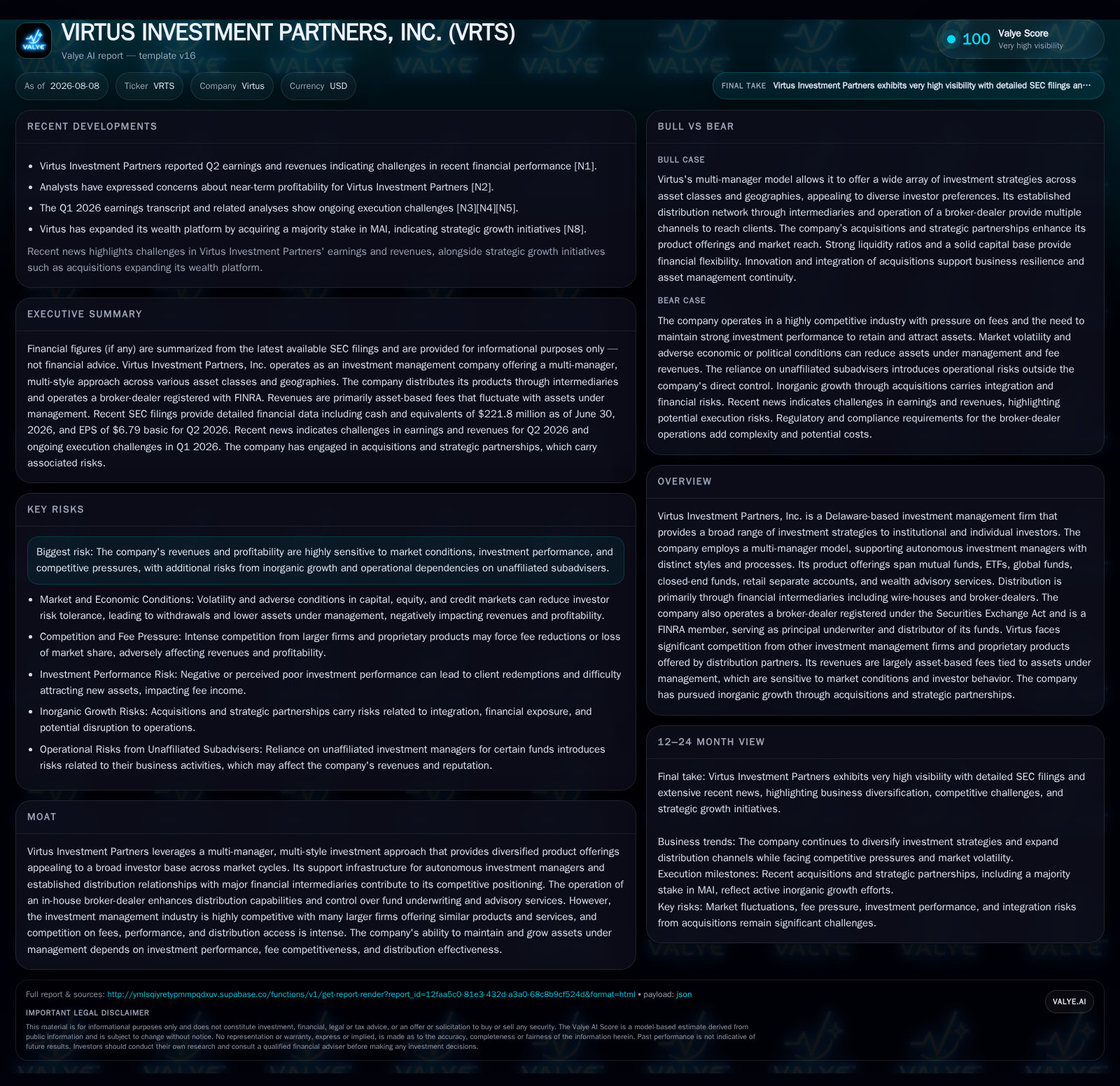
Virtus Investment Partners reported Q2 2026 results below expectations due to fluctuating assets under management (AUM) amid volatile markets, which pressured fee revenues. The company’s multi-manager model offers diversified investment strategies through autonomous sub-advisers, while its in-house broker-dealer supports distribution control. However, profitability remains sensitive to market swings and performance of sub-advisers. Industry challenges include intense fee competition and regulatory compliance demands tied to broker-dealer operations. Key growth hinges on equity market recovery, continued intermediary partnerships, and product innovation.
Q2 2026 Earnings Fall Short: Market Fluctuations Weigh on Fee Revenue
Virtus Investment Partners’ Q2 2026 results disclosed on August 7 revealed earnings below consensus estimates largely due to volatility in financial markets driving down assets under management (AUM), directly impacting fee-based revenue streams [S2][N1]. Given Virtus's revenue model is predominantly asset-based fees on mutual funds, ETFs, closed-end funds, retail separate accounts, and advisory services, even modest declines in AUM exert outsized influence on profitability because many operating expenses remain fixed or contractual [S1]. The filing also detailed an increased contingent consideration liability associated with recent acquisitions—specifically Keystone National Group—valued at over $100 million using options pricing and discounted cash flow methods reflecting future performance contingencies that add complexity to the balance sheet risk profile [S9]. This contingent liability example illustrates how acquisitions amplify accounting judgment requirements and potential episodic financial impacts.
Multi-Manager Architecture as a Double-Edged Sword: Diversification versus Complexity
Virtus’s business model centers on a multi-manager structure wherein autonomous investment teams or sub-advisers manage distinct strategy portfolios under the company’s brand umbrella across diverse product types such as open-end mutual funds, ETFs, closed-end funds, and separately managed accounts targeting both institutional and retail investors [S1]. This setup offers strategic advantages by enabling product diversification across styles and asset classes that may smooth net inflows/outflows cyclically and mitigate concentration risks. However, dependence on independent sub-advisers introduces operational complexity—performance volatility at the sub-adviser level can prompt client withdrawals selectively reducing particular fund assets even if aggregate AUM appears stable. Moreover, multi-layered fee components including administrative fees paid to third-party managers combined with Virtus's internal fees can compress margins internally despite client-level fee generation. This model requires meticulous oversight on manager retention policies and aligning incentives across layers to sustain durable profitability.
Broker-Dealer Subsidiary Strengthens Control but Faces Regulatory Complexity
A defining feature of Virtus’s distribution approach is its ownership of a FINRA-member broker-dealer registered under the Securities Exchange Act that functions as principal underwriter for its funds [S1]. Operating an in-house broker-dealer allows more direct control over product placement within wirehouses, broker-dealers, independent advisors, and other intermediaries compared with firms relying solely on third-party distributors. It facilitates tailored marketing efforts, underwriting efficiencies, and potentially higher distribution fees captured internally. Nevertheless, this benefit comes at the cost of increased regulatory scrutiny given broker-dealer compliance obligations surrounding recordkeeping, anti-money laundering protocols, suitability standards, and securities laws adherence—exposures highlighted periodically through litigation risks noted in recent filings [S7]. Balancing these dynamics shapes Virtus’s cost structure versus distribution penetration capabilities.
Competitive Positioning Amid Larger Asset Managers and Boutique Firms
Within the competitive landscape dominated by large diversified asset managers such as BlackRock and T. Rowe Price who leverage scale economies for lower effective pricing or extensive passive product suites, Virtus occupies a middle ground with a differentiated multi-manager product offering appealing particularly to clients seeking actively managed strategies across multiple disciplines [S1][N2]. Its ability to attract capital partly depends on maintaining strong boutique-like appeal via autonomous sub-advisers delivering specialized expertise while enjoying some operational leverage from parent infrastructure. However, this positioning subjects Virtus to intense fee compression pressures because larger peers can afford lower fees while boutique rivals compete fiercely for niche segments emphasizing outperformance potential. Maintaining a competitive fee schedule without sacrificing product quality or distribution reach is thus an ongoing challenge.
Growth Drivers: Market Gains, Distribution Reach, and Product Innovation
Key growth vectors for Virtus align with broader industry trends: rising equity markets directly increase net asset values boosting AUM-based fees; improved performance relative to benchmarks enhances client retention; expanding relationships with wirehouses and broker-dealers broaden distribution footprint enabling more net inflows; simultaneous development of new products—in particular ETFs that attract cost-conscious investors—and alternative investments respond to evolving client preferences [S1][N4][N5]. Additionally, demographic drivers such as growing retirement savings pools fuel demand for diversified active/passive solutions accessible through fiduciary advisors underpinning brokerage channels vital for Virtus’s business model.
Risk Factors: Market Sensitivity, Fee Compression, Sub-Adviser Dependency
Principal risks permeate from dependence on volatile financial markets that swing AUM levels unpredictably affecting revenue streams; contracted or renegotiated investment management agreements can reduce fee rates under competitive pressure; reputational damage linked to poor sub-adviser performance prompts redemptions hurting both firm top-line and operating margin sustainability; operational risks include regulatory vulnerabilities inherent in broker-dealer activities alongside technology system failures; finally integration complexities from inorganic growth initiatives such as recent Keystone acquisition may strain management focus or financial resources absent disciplined execution [S1][S2][N3]. Monitoring these factors remains critical for assessing ongoing stability.
Forward-Looking Indicators: AUM Trends, Client Flows, Distribution Health
Investor focus should remain centered on actionable KPIs exposed each quarter: net inflows versus outflows reflecting demand dynamics; comparative investment performance metrics versus relevant benchmarks measuring manager effectiveness; shifts in distribution channel penetration indicating breadth of third-party intermediary acceptance; average fund size changes signaling consolidation or fragmentation effects within product categories; frequency of fund closures or launches revealing innovation pace all combine to signal trajectory potential ahead of formal guidance updates [S2][S3]. Such metrics provide early warnings or confirmations around sustained recovery in fee income post-market disruptions.
Disclaimer: This is research-only, informational analysis and not investment advice. It may include AI-generated interpretation and general industry context. Always verify important details using primary sources.

Comments