
Zevra Therapeutics Advances Rare Disease Therapy Amid Regulatory and Commercial Hurdles
Zevra’s recent clinical success with MIPLYFFA for Niemann-Pick Disease Type C contrasts with ongoing regulatory challenges and complex government pricing compliance.
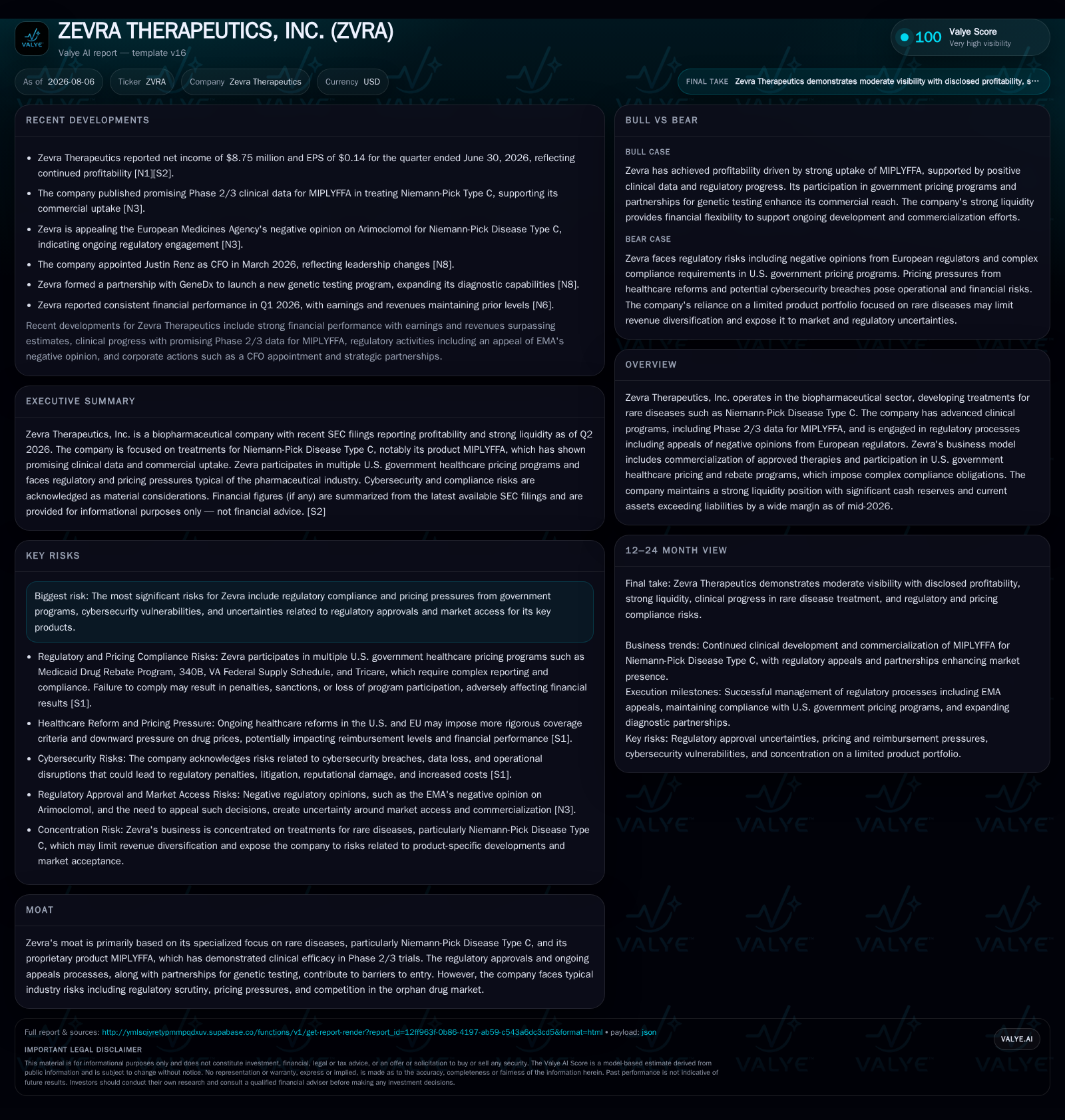
Zevra Therapeutics has reinforced clinical confidence in its orphan drug MIPLYFFA through promising Phase 2/3 data, underscoring its potential to address Niemann-Pick Disease Type C. The company faces significant regulatory uncertainty after a negative European Medicines Agency opinion on Arimoclomol, which it is actively appealing, delaying EU market access. In the U.S., Zevra navigates complex Medicaid Drug Rebate Program obligations that could impact margins and cash flow timing. Despite these challenges, a strong cash position and liquidity provide operational flexibility to support ongoing R&D and commercial scaling efforts.
Recent Operating Update: Clinical Progress Anchors Zevra’s Growth Narrative
Zevra Therapeutics’ latest Q2 filing highlights sustained advancement of MIPLYFFA, targeting Niemann-Pick Disease Type C, a rare lysosomal storage disorder with limited treatment options. The publication of positive Phase 2/3 data demonstrates meaningful improvements on disease-specific safety and efficacy endpoints, reinforcing the therapeutic’s value proposition within a highly specialized orphan drug niche [N5]. This progress is critical given the challenges endemic to rare disease trials, such as slow enrollment and the need for robust endpoints that satisfy regulators’ evidentiary standards.
The clinical momentum establishes a foundation for pivotal regulatory submissions and payer engagement strategies essential to orphan drug commercialization. As orphan drugs command premium pricing justified by clinical benefit in small populations, maintaining enrollment pace and confirming durable safety signals are vital KPIs signaling demand durability [S1]. This positions Zevra favorably relative to peers who often encounter extended development timelines due to patient scarcity.
Regulatory Environment: EMA Appeal Injects Market Access Uncertainty
Despite encouraging clinical results, Zevra faces a significant hurdle following the European Medicines Agency's negative opinion on Arimoclomol—closely related to MIPLYFFA—in treating Niemann-Pick Disease Type C [N3]. The company has formally appealed this decision [S2], acknowledging the resultant delay in European market entry.
This appeals process introduces near-term uncertainty over international commercialization timing. While the FDA’s orphan drug pathways may expedite U.S. approval, European regulators often require divergent evidence standards that can prolong review durations. This dynamic affects geographic rollout strategies and potential partnership syndication.
The outcome of this appeal will critically influence Zevra's ability to access key patient markets in Europe. A successful reversal would not only open revenue channels but also enhance the company’s regulatory credibility [S3]. Conversely, an adverse ruling may necessitate alternative strategies such as localized licensing or delayed launches
Commercial Compliance Complexity: Medicaid Drug Rebate Program Challenges
Zevra operates within a demanding U.S. healthcare pricing framework that includes participation in the Medicaid Drug Rebate Program (MDRP), entailing quarterly rebate payments based on reported average manufacturer price (AMP) metrics adjusted for inflation [S1]. Compliance demands are rigorous; inaccuracies or delays can trigger civil penalties or exclusion from federal reimbursement programs.
These rebate obligations compress effective net prices below list prices, exerting margin pressure uncommon in less-regulated sectors. Moreover, AMP calculations involve complex interpretations subject to retrospective adjustments up to three years post-reporting, requiring robust compliance infrastructure.
This environment impacts revenue recognition timing: gross revenue may be recorded before rebate settlements reduce actual cash collections, creating cash flow lags even amid volume growth. Such dynamics have precedent among specialty pharmaceutical peers navigating evolving rebate landscapes.
Business Model Dynamics: Orphan Drug Commercialization Amid Pricing Constraints
Zevra's commercial strategy centers on monetizing MIPLYFFA through direct sales complemented potentially by licensing or milestone revenues. Targeting a narrow rare disease population necessitates precision marketing coupled with partnerships that facilitate patient diagnosis—a common bottleneck in orphan drug adoption.
Orphan designation confers exclusivity incentives enabling premium price points but also entails mandatory government rebates limiting net margins [S1]. Inclusion in additional formularies such as Tricare Retail Pharmacy further extends rebate obligations impacting realized revenue per unit.
Given limited patient numbers inherent to rare diseases, volume expansion relies heavily on label extensions or geographic market penetration post-approval. Uptake depends on physician awareness initiatives, payor reimbursement negotiations, and accumulating post-market safety data influencing prescriber confidence.
Growth Drivers: Clinical Milestones, Label Expansion, Strategic Partnerships
Key growth levers include advancing pipeline candidates through critical clinical milestones—such as enrollment completions and interim analyses supportive of label expansions—and securing positive regulatory decisions beyond initial markets.
Strategic collaborations with genetic testing entities enhance patient identification efficiency crucial for orphan indications typically hindered by underdiagnosis [N5]. Additionally, licensing or co-commercialization agreements could diversify revenue streams while mitigating regional market risks posed by heterogeneous regulatory environments.
Innovations in formulation or delivery modalities may improve payer receptivity or patient adherence—both important for maximizing value capture in rare disease segments characterized by high therapy switching costs but low initial awareness.
Risks & Watchpoints: Regulatory Outcomes, Pricing Pressures, Execution Challenges
The resolution timeline of the EMA appeal remains a critical risk factor; extended delays or unfavorable outcomes would materially constrain Zevra’s growth trajectory [N3],[S3]. Updates from this process will serve as leading indicators of international market potential.
Ongoing scrutiny of MDRP submissions poses compliance risks; any enforcement actions or reporting inaccuracies could trigger financial penalties or reimbursement interruptions [S1]. Additionally, state-level drug price transparency laws introduce further complexity affecting cost structures.
Scaling commercialization post-approval entails execution risk related to patient identification rates and competition from emerging therapies within the rare disease ecosystem. Maintaining disciplined R&D spending aligned with funding runway is essential to sustain development pipelines supporting indication diversification [S2]. Cybersecurity vigilance remains paramount given increasing threats targeting proprietary clinical data.
Financial Profile Discussion: Strong Liquidity Supports Strategic Flexibility
As of June 30, 2026, Zevra Therapeutics held approximately $145 million in cash and equivalents with current assets significantly exceeding current liabilities—resulting in a current ratio above 5.0—indicating robust short-term liquidity [F1]. This financial strength provides critical runway for ongoing development investments and buffers against regulatory or commercial uncertainties.
Reported total debt stood near $63.6 million at end-2025; however, net debt metrics reveal a net-cash position offering balance sheet flexibility without immediate refinancing pressures [F1]. This contrasts favorably with many clinical-stage biotech peers facing frequent capital raises under dilutive terms.
Financial risks primarily relate to managing costs associated with compliance infrastructures mandated by government programs alongside scaling commercial capabilities contingent on successful approvals. Maintaining substantial cash reserves mitigates short-to-medium term liquidity risks despite reimbursement uncertainties discussed earlier [S2]
In conclusion, Zevra Therapeutics is navigating a pivotal phase marked by encouraging clinical validation tempered by complex regulatory landscapes requiring careful management of commercialization execution risks alongside prudent financial stewardship.
Disclaimer: This analysis is based solely on available public disclosures as cited without endorsement or investment research view regarding Zevra Therapeutics securities.
Disclaimer: This is research-only, informational analysis and not investment advice. It may include AI-generated interpretation and general industry context. Always verify important details using primary sources.

Comments