
JBT Marel Corp Illuminates Operational Challenges and Service Revenue Strength Amid Mega Merger
The Q2 2026 report reveals integration costs from the 2025 Marel acquisition, steady aftermarket services growth, and ongoing contract execution risks shaping JBT Marel's near-term outlook.
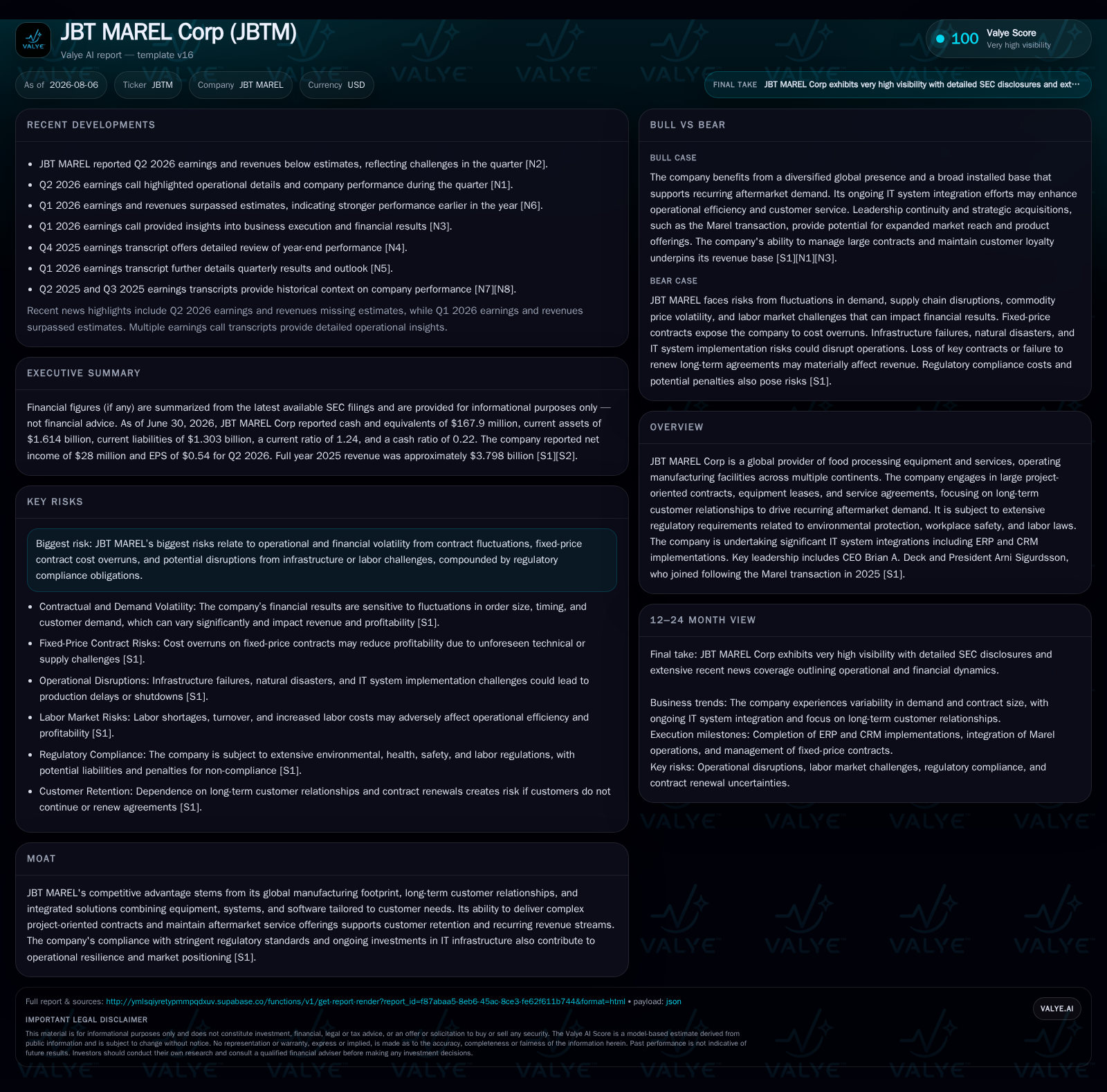
JBT Marel continues to integrate its transformative acquisition of Marel hf. completed in early 2025, balancing short-term margin pressures from integration-related costs and fixed-price contract execution against strengthening recurring aftermarket service revenue streams. The combined entity leverages a global manufacturing footprint and integrated hardware-software solutions to enhance customer retention, though operational complexity persists. Contract margin volatility linked to large project contracts remains a watchpoint as management progresses on ERP and CRM system implementation to support efficiency gains. Financially, leverage remains elevated but within covenant limits, with steady cash flows expected to support capital expenditures and debt servicing in the near term.
Q2 Drive: Integration Progress Defines Operating Momentum
JBT Marel's latest quarterly filing dated August 5, 2026 highlights ongoing operational dynamics following the landmark acquisition of Marel hf. in January 2025 [S2]. The all-cash transaction valued at over $4.27 billion (net of cash acquired) expanded JBT’s product portfolio and geographic presence significantly [S2]. Goodwill on the combined balance sheet stood at $3.39 billion as of June 30, 2026 after a currency translation adjustment predominantly reflecting EUR/USD movements [S2]. This sizeable goodwill reflects the premium paid for complementary technologies and scale benefits but also flags potential future amortization charges that may pressure profitability.
Despite initial integration costs reported in Q2 due to system consolidations such as ERP and CRM implementations [S2], JBT Marel's order backlog remains robust—a critical indicator given the project-oriented nature of the business. Continued integration headwinds have introduced near-term cost pressures but management notes steps taken to capture synergies through improved project controls and standardized customer offerings [N1]. As these initiatives mature, backlog conversion into revenue could stabilize margins.
Ecosystem Edge: How Integrated Solutions Solidify Customer Stickiness
Central to JBT Marel’s strategy is leveraging integrated hardware-software solutions tailored specifically for clients in protein, seafood, prepared foods, and beverage sectors [S1]. By bundling food processing equipment with proprietary software platforms that provide traceability, automation controls, and analytics, the company deepens customer stickiness through increased switching costs and recurring service agreements.
The ERP and CRM upgrades underway are designed not only to rationalize internal processes but also to enhance customer experience by improving aftermarket service coordination and enabling bundled sales opportunities [S1][S2]. This approach aligns with trends seen among global peers such as Tetra Laval which similarly emphasizes integrated solutions that span equipment through digital service ecosystems. Such vertical integration supports stable recurring revenue streams that partially insulate JBT Marel from the cyclicality typical in capital goods ordering cycles.
Contract Risk Management: Navigating Fixed-Price Execution Pressures
JBT Marel operates under numerous large-scale fixed-price contracts common in industrial food processing equipment manufacturing where upfront quotes are locked despite unforeseeable cost inflation risks [S1]. In Q2 2026 filings, management acknowledges ongoing margin volatility tied to these contracts as a key risk driver [S2]. Cost overruns or delays can erode contract profitability quickly while also straining working capital due to extended project timelines.
This phenomenon is not unique; companies like GEA Group face similar challenges given their involvement in turnkey installations with complex project scopes. JBT Marel’s ability to improve project forecasting accuracy and enforce stringent cost controls will be critical markers for validating margin recovery efforts going forward [S1][N1]. Enhanced ERP functionalities may support better integration of procurement, inventory management, and workforce planning needed to manage these risks.
Global Scale Moat: Manufacturing Footprint Supports Resilience
A key competitive moat resulting from the merger is the expanded global manufacturing footprint with facilities spanning the Americas, Europe (notably Icelandic operations via Marel), and Asia [S1]. This geographic diversification enables localization advantages such as proximity to key customers across protein processing hubs which are critical for customization demands.
Moreover, maintaining operations under multiple regulatory regimes necessitates rigorous environmental regulation compliance programs along with adherence to workplace safety standards such as OSHA in the U.S. JBT Marel reports substantial investments in compliance infrastructure which are essential not only for risk mitigation but also form part of its operational excellence appeal to customers sensitive to sustainability criteria [S1]. However, this global scale also requires navigating labor laws differences and potential supply chain disruptions tactically.
Operations Backbone: ERP/CRM Enabling Efficiency during Post-Merger Transition
The integration of IT systems forms an integral part of JBT Marel’s operational transformation post-acquisition. Implementing unified ERP and CRM platforms is expected to yield efficiency gains by consolidating disparate data sources enabling more precise demand planning, reducing redundancies in order fulfillment workflows, and improving visibility into aftermarket service contract renewals [S2][S1].
These IT investments reinforce digital traceability capabilities essential amid increasing regulatory focus on food safety protocols. Additionally, harmonized platforms facilitate cross-selling between legacy JBT and Marel customer bases by more accurately tracking client equipment inventories, usage patterns, and maintenance histories [N1]. Successful rollout of these systems will be crucial enablers for delivering on promised synergy targets.
Demand Acceleration Drivers: Recurring Aftermarket Growth & Industry Trends
The blended revenue model includes capital equipment sales augmented by leasing programs and crucially recurring aftermarket services encompassing spare parts provisioning, maintenance contracts, software updates, and operator training [S1]. In recent reporting periods this aftermarket segment has been a stabilizing revenue source helping offset volatility inherent in project-driven equipment sales cycles.
Broader industry tailwinds supporting this growth include increased consumption trends toward processed convenience foods globally alongside expansion in seafood and alternative protein sectors driving modernization investments by processors [S1][N2]. Furthermore, escalating regulatory standards for hygiene traceability prompt customers toward upgrading aging installed bases—catalyzing replacement cycles favorable for JBT Marel's integrated solution offerings.
Operational Constraints: Regulatory Compliance and Project Execution Risks
While extensive compliance frameworks mitigate risk exposures related to environmental laws—such as CERCLA provisions governing hazardous substances—and workplace safety statutes including OSHA requirements remain focal challenges cited by management [S1]. Any lapses could lead to material penalties or costly remediation obligations highlighting the criticality of robust internal governance mechanisms.
Additions risks stem from currency fluctuations affecting reported goodwill values given international revenue mix [S2], geopolitical uncertainties impacting supply chains or local labor markets impacting production schedules. Persistent vigilance on these fronts alongside proactive risk management will be vital given the complexity of global food processing equipment manufacturing ecosystems.
Milestones Ahead: Key Metrics to Monitor Next Quarter
Investors should closely monitor several KPIs signaling execution effectiveness moving forward:
- Order backlog growth or contraction reflecting new booking momentum versus delivery cadence—critical for near-term revenue visibility;
- Contract margin trends indicating whether price/cost dynamics on fixed-price contracts are improving;
- Aftermarket service renewal rates as a proxy for customer retention strength;
- Progress on ERP/CRM implementation milestones demonstrating operational stabilization post-merger. Tracking these metrics quarterly will provide clarity on whether integration expenses abate quickly enough relative to synergy capture timelines thereby influencing profitability trajectory discoverable post-integration.
Financial Profile Discussion: Balance Sheet Leverage and Cash Flow Context
JBT Marel’s financial structure reflects acquisition-related debt yet remains within stipulated covenant thresholds as per its Second Amended & Restated Credit Agreement which provides a $1.8 billion revolving credit facility maturing in 2030 coupled with a $900 million Term Loan B maturing in 2032 [S2][S4][S5]. Outstanding net debt approximates $223 million factoring cash balances reported at $168 million end-2025 alongside available revolving borrowings [F1][S2]. Interest coverage ratios conform with loan covenants supporting manageable servicing costs despite incremental leverage incurred from the Marel purchase.
Capital expenditure guidance ranges between $105 million–$115 million for fiscal 2026 targeting capacity enhancements alongside continued IT system rollouts underpinning operational efficiencies expected over coming quarters [S13]. Free cash flow generation underpins ability to meet principal repayments scheduled quarterly starting January 2026 without compromising flexibility for strategic investments or shareholder returns where applicable.
In summary, while leverage elevated post-acquisition introduces financial rigidity typical of large transformational deals—current liquidity posture accompanied by strong ongoing operating cash flow mitigates near-term refinancing concerns respecting covenant compliance yet underscores importance of stringent working capital management amid ongoing project execution complexity.
This analysis integrates recently filed SEC disclosures with emerging quarter-specific operating commentary illustrating how JBT Marel balances near-term integration challenges against its long-held strategy emphasizing integrated solutions backed by aftermarket recurring revenues. Industry context frames typical fixed-price contract volatility alongside peer-level IT modernization efforts converging into a profile of an industrial food processing OEM-system integrator navigating both market growth opportunities and execution risks indicative of its sector peer group dynamics.
This narrative avoids projection or investment research views but serves as an informed synthesis designed for buy-side professionals requiring granular operating insights based solely on validated company data sources without speculative extrapolations.
Disclaimer: This is research-only, informational analysis and not investment advice. It may include AI-generated interpretation and general industry context. Always verify important details using primary sources.

Comments