
ExxonMobil's Q2 2026 Performance Strengthens on Upstream Growth and Refined Product Margins Amid Market Disruptions
ExxonMobil reported robust second-quarter earnings growth driven by advantaged upstream volumes and elevated global refining margins despite Middle East supply disruptions.
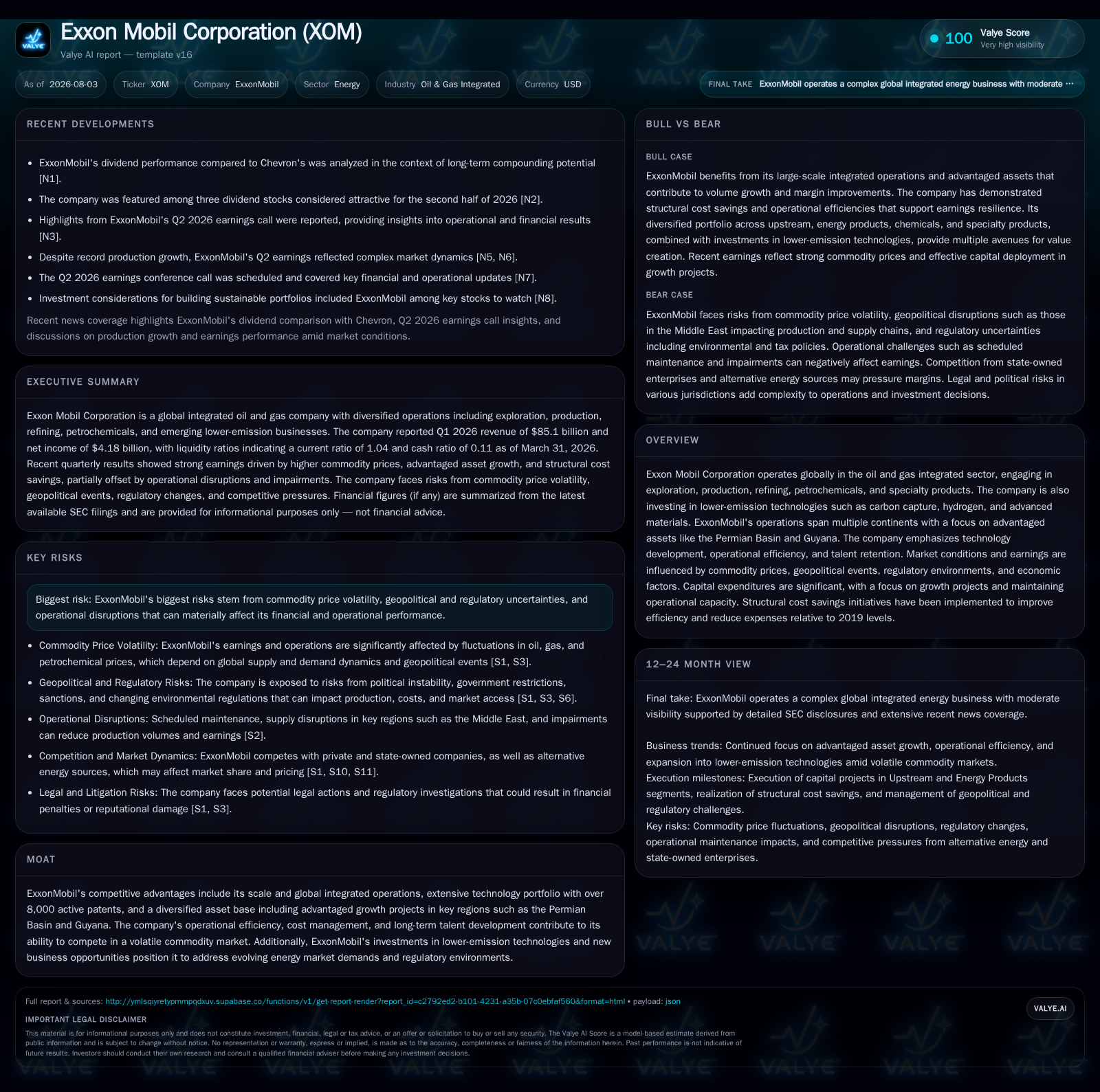
In Q2 2026, ExxonMobil delivered a substantial earnings increase fueled by higher crude prices, growth in high-return projects like Guyana and the Permian Basin, and unprecedented refining margin expansion due to global capacity constraints. The company’s integrated business model benefits from diversified operations across upstream production, downstream refining, and petrochemicals, supported by a focus on operational efficiency and structural cost savings. However, ongoing geopolitical volatility in the Middle East and temporary volume impacts highlight key risk factors. ExxonMobil continues to allocate capital toward advantaged hydrocarbon assets while advancing lower-emission investments, balancing near-term cash flow with long-term transition strategies. The company maintains a strong liquidity position and disciplined capital allocation including dividends and buybacks.
Recent Operating Update: Q2 2026 Highlights
Upstream volumes reflected both headwinds and tailwinds: volume growth from strategic projects in Guyana and the Permian Basin contributed an incremental $1.14 billion in earnings while base volumes slightly declined, impacted negatively by $1.06 billion due to Middle East disruptions [S19]. This dynamic confirms the company’s advantaged asset strategy partially buffering geopolitical volatility effects. Operational emphasis on structural cost reductions also played an important role, adding $170 million in earnings uplift during Q2 attributable to sustained improvements implemented since 2019 [S19]. Meanwhile, depreciation expenses increased substantially by about $3.7 billion compared to prior period levels partly because of asset base growth from recent capital spend cycles [S2].
The Specialty Products segment saw a decrease in sales volumes relative to prior year but realized margin improvements owing largely to higher basestock margins during supply chain disruptions; combined with operational efficiencies this translated into a net positive earnings effect despite challenging feed costs in Asia [S11]. Corporate & Financing expenses rose by nearly $200 million mostly driven by lower interest income alongside adverse tax impacts demonstrating sensitivity of non-operating lines to macro variables [S11].
Business Model Analysis
ExxonMobil operates as a fully integrated oil & gas major spanning upstream exploration/production, midstream logistics (primarily through partnerships), downstream refining/petrochemical manufacturing, specialty products manufacturing, and increasingly underpinned by investments into lower-emission energy solutions including carbon capture and storage (CCS), hydrogen production, ammonia, lithium extraction, advanced recycling technologies (Proxxima TM), and digital infrastructure support for low-carbon data centers [S1][S16]. Revenue streams are diversified across these segments with monetization reliant on combination of commodity prices (crude oil, natural gas), refined product margins (gasoline/diesel/cracking spreads), petrochemical product demand/pricing (performance chemicals/lubricants), licensing arrangements for proprietary specialty materials technologies, and emerging carbon credit or subsidy mechanisms tied to emissions reduction projects.
Upstream generates revenue primarily through BOE production volumes multiplied by realized commodity prices adjusted for regional pricing differentials; advantaged positions like Permian shale tight oil or deepwater Guyana basin projects yield premium margin returns supporting cash flow stability even during volatile periods [S1][S19]. Downstream profits emerge mainly from refinery throughput capacity utilization weighted against refining crack spreads—operational efficiency here is paramount given cyclical margin swings driven by global capacity outages or maintenance schedules [S2][S16]. Specialty Products represent a high-margin niche modeled on volume sales to industrial end-users balanced with premium pricing on specialty formulations; here margins correlate with feedstock costs and also product mix shifts towards performance materials which ExxonMobil is expanding via patent-backed innovations reported at over 8,000 active world-wide patents as of year-end 2025 [S1].
Capital allocation reflects this integrated model—expenditure priorities tilt toward scaling competitive upstream growth projects alongside sustaining refining throughput capabilities while selectively funding emerging technology platforms aimed at long-term emissions mitigation aligned with global energy transition frameworks such as net-zero Scope 1 & 2 targets for operated assets by 2050 overall and Permian unconventional net zero ambition by 2035 [S16]. This dual approach shields upstream/downstream cash flow generation while providing optionality from nascent low-carbon business lines.
Industry Structure and Competitive Position
As one of the largest integrated majors alongside peers such as Chevron, Shell, BP, and TotalEnergies, ExxonMobil leverages scale advantages that provide robust hedging capacity against commodity price cycles through portfolio diversity across geographies and businesses segments. Peer benchmarking commonly focuses on metrics like production growth rates in advantaged basins (e.g., Permian vs. Anadarko basin plays elsewhere), reserve replacement ratios reflective of future resource sustainability, refinery utilization rates in light of tightening global capacity outlooks post-pandemic expansions/contractions, as well as technology leadership particularly in emission reduction innovations such as CCS deployment or methane emissions monitoring programs.
ExxonMobil distinguishes itself with its extensive technology portfolio — more than 8,000 active patents — underpinning proprietary process improvements that boost recovery rates upstream while enhancing specialty product differentiation downstream [S1]. The firm has also accelerated structural cost savings of over -15% since the pre-pandemic base year of 2019 improving its competitive cost curve position relative to peers who face challenges integrating diverse assets amid inflationary inputs [S7][S23]. Its disciplined capital return policy combining growing dividends (totaling approximately $8.6 billion distributed in first half of 2026) alongside $10 billion in stock repurchases demonstrates confidence in free cash flow resiliency even amid volatile commodity environments [S13][N1].
Growth Drivers
Several distinct drivers underpin ExxonMobil’s medium-term growth outlook:
- Advantaged Upstream Expansion: Record production uplift stemming from Guyana deepwater fields plus scaled Permian unconventional output underpins rising upstream cash flow resilience despite localized geopolitical interruptions affecting volumes elsewhere (e.g., Middle East) [S19].
- Refining Margin Optimization: Continued global refinery closures have reduced throughput capacity tightening crack spreads unusually high above historic norms; ExxonMobil’s strategically positioned refineries maximize value capture during this period [S2].
- Petrochemical Capacity Investments: Rising plastics demand coupled with expansion into performance chemicals offers volume/margin upside linked closely with global industrial activity levels tied to economic growth prospects [S22].
- Lower-Emission Technology Adoption: Capital directed toward CCS projects aiming at net-zero emissions compliance along with hydrogen/ammonia production facilities creates new business lines expected to mature steadily over next decade subject to regulatory clarity and policy support gradients globally [S16][S23].
- Structural Cost Efficiency Gains: Ongoing expense discipline yielding cumulative savings against expense base established pre-pandemic mitigates inflationary pressures allowing margins expansion under stable or rising commodity price regimes [S7].
Risks and Constraints
Despite positive momentum several risks moderate near-to-medium term outlook:
- Commodity Price Volatility: Market swings in crude oil or natural gas prices directly affect revenues—downturns rapidly compress upstream earnings despite partial offsets from downstream margin improvements; forward-looking derivatives mark-to-market valuations introduce timing noise into quarterly earnings results shown throughout early 2026 intervals [S18][N3].
- Geopolitical Instability: The continuing Middle East supply disruptions materially reduced ExxonMobil’s regional volume contributions causing a more than $1 billion earnings drag paired with broader uncertainty over exporting pathways impacting market dynamics sector-wide [S19][N1].
- Regulatory Evolution: Increasing environmental legislation imposing emissions standards or punitive taxation regimes pose variable financial impacts; regulatory heterogeneity among jurisdictions complicates planning especially around emerging low-carbon technology investments dependent on policy incentives remaining stable [S17][S21].
- Reserve Replacement Challenges: Maintaining reserve life metrics through successful exploration/discovery is critical; lower success rates or asset divestitures could impair sustainable production over longer horizons albeit partially addressed via acquisitions filtered through strategic fit criteria emphasizing scale synergies and low supply cost profiles [S2][N1].
- Operational Risks: Equipment failures or accidents could lead to impairment charges or downtime; planned maintenance schedules reflect tradeoffs balancing short-term volume losses with longer-run reliability improvements vital for steady cash flow generation.
What To Watch Next
Key indicators and milestones signaling operational success or emerging headwinds include:
- Quarterly tracking of BOE production splits indicating ongoing momentum from Guyana/Permian vs volume loss areas.
- Refinery utilization rates vis-à-vis cracks spreads trajectory amid evolving global capacity constraints.
- Capital expenditure pacing relative to announced $27–29 billion annual guidance assessing project execution velocity.
- Progress reports on emissions intensity reductions particularly methane abatement across operated assets consistent with announced targets.
- Updates on structural cost savings quantification assessing whether efficiency gains continue offsetting inflationary cost pressures.
- Shareholder return activity including dividend growth sustainability balanced against free cash flow generation post capex spend.
Financial Profile Discussion
Liquidity is reinforced by substantial cash holdings of $10.6 billion excluding restricted balances offsetting total debt load reported at approximately $42.4 billion at quarter-end producing a conservative net debt-to-capital ratio of approximately 10.7%—a slight improvement relative to year-end benchmarks indicative of prudent balance sheet management supporting investment-grade credit status requirements critical for accessing favorable financing terms if required for opportunistic M&A or project funding needs [S2]. Capital expenditures totaling roughly $13 billion year-to-date demonstrate commitment towards sustaining growth trajectories while financing outflows include steady shareholder distributions amounting to approximately $8.6 billion plus share buybacks totaling around $10 billion underscoring a balanced capital returns approach reinforcing investor confidence.
Overall ExxonMobil’s financial health supports continued deployment into advantaged hydrocarbon resources alongside an expanding portfolio of lower-carbon technologies affording strategic flexibility necessary under evolving energy transition conditions.
This analysis draws exclusively upon verified SEC filings through August 2026 complemented by contemporaneous market context without offering investment advice or forward-looking price forecasts.
Disclaimer: This is research-only, informational analysis and not investment advice. It may include AI-generated interpretation and general industry context. Always verify important details using primary sources.

Comments