
Claros Mortgage Trust Navigates Transitional CRE Lending Amid Competitive and Credit Challenges
Q2 2026 update reveals steady loan portfolio yield but deferred dividends and persistent credit risks in a competitive mortgage REIT landscape.
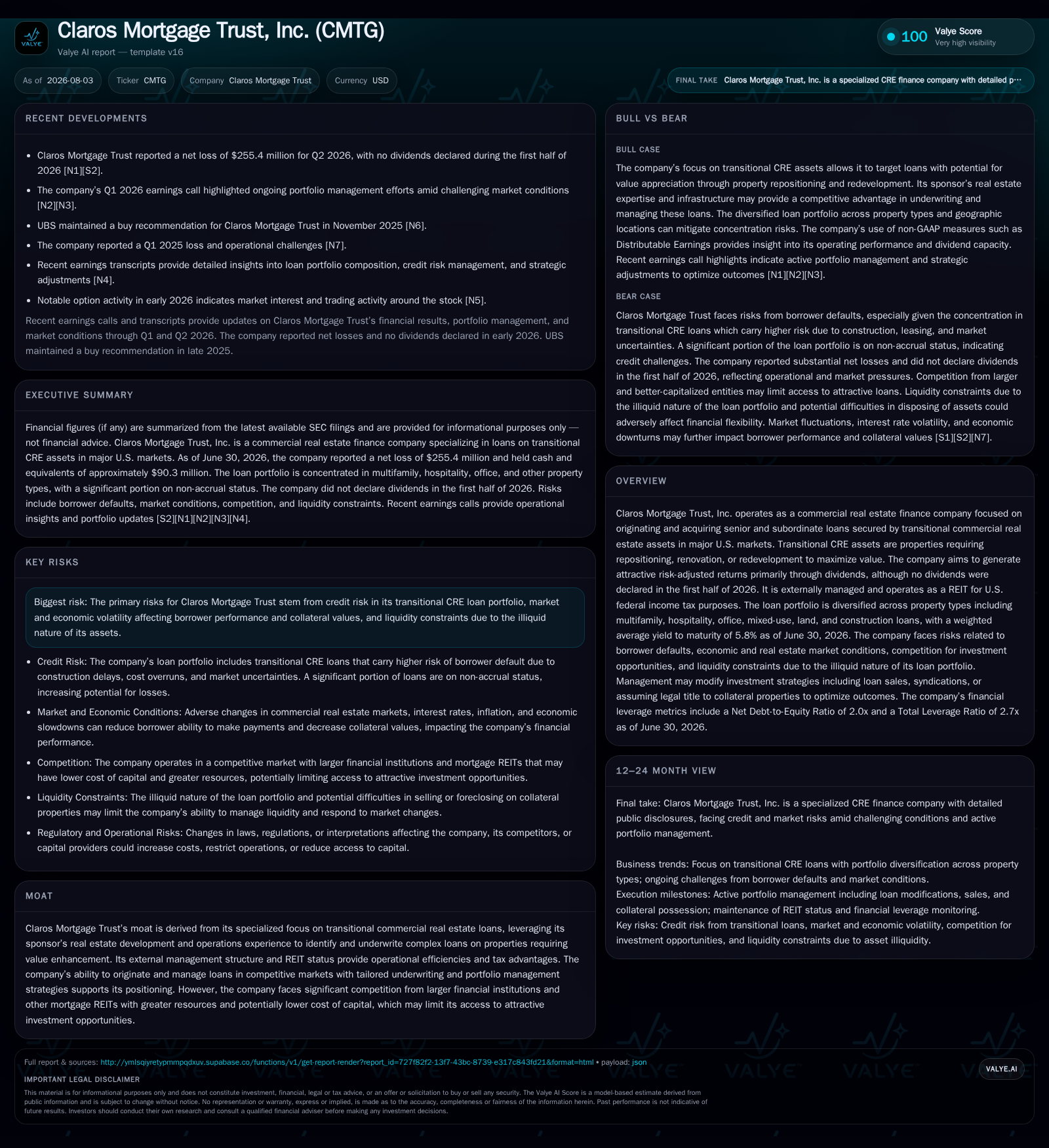
Claros Mortgage Trust, Inc. focuses on originating and acquiring loans secured by transitional commercial real estate assets across major US markets, aiming for attractive risk-adjusted returns primarily via dividends. The company’s Q2 2026 report shows a loan portfolio with a weighted average yield to maturity of 5.8%, but no dividends were declared in the first half of the year, reflecting ongoing credit uncertainties and portfolio management efforts. As an externally managed REIT, Claros leverages its sponsor’s real estate expertise but faces intense competition from larger peers with deeper pockets and lower capital costs. Key risks include borrower defaults, economic volatility, and liquidity limitations due to the illiquid nature of transitional CRE loans.
Recent Operating Update
Claros Mortgage Trust’s most recent quarterly report filed July 29, 2026 [S2], along with an accompanying Form 8-K issued the same day [S3], provide the latest operational insights into the company’s performance through the second quarter ended June 30, 2026. However, no dividends have been declared during the first half of 2026 [S2], illustrating ongoing capital preservation efforts amidst credit uncertainties that may accompany this higher-risk lending niche.
The absence of dividend payments is particularly relevant given that mortgage REITs like Claros typically distribute most of their taxable income to shareholders to maintain REIT tax status. This pause reflects either elevated credit risk concerns or strategic balance sheet management during a challenging environment for loans on properties undergoing repositioning or redevelopment — sectors inherently sensitive to execution risks.
Business Model
Claros Mortgage Trust operates primarily as a commercial finance company focused on originations and acquisitions of senior and subordinate loans collateralized by transitional CRE properties located in major U.S. markets [S1]. These transitional assets require active value enhancement via renovation, upgrading, leasing improvements, or redevelopment before achieving stabilized operations. As such, their financing carries elevated risks compared to stabilized properties due to uncertainty in project completion timelines, cost overruns, market absorption rates, and borrower execution.
The company extends senior loans secured by first-priority mortgages alongside subordinate debt instruments such as mezzanine loans secured via equity pledges rather than direct property liens [S2]. This layered capital structure implies varying risk-return profiles within the portfolio — with subordinate loans generally offering higher yields but greater credit risk exposure.
Claros is externally managed under a service agreement with its manager affiliated with Mack Real Estate Credit Strategies [S1]. While this external management model allows operational efficiencies and leverages sponsor expertise in real estate development and operations — critical for evaluating complex transitional projects — it also means that management fees are deducted from gross returns before net income accrues to shareholders.
As a registered REIT for U.S. federal tax purposes [S1], Claros benefits from pass-through taxation conditional upon distributing at least 90% of taxable income annually to shareholders. This status shapes cash flow allocation decisions heavily toward sustaining dividend streams but also leaves limited retained earnings flexibility.
Industry Structure and Competitive Position
Within the broader mortgage REIT sector specializing in commercial real estate lending, Claros occupies a niche focused on transitional CRE financing. Compared to large diversified mortgage REIT peers like Blackstone Mortgage Trust or Starwood Property Trust that hold more stabilized loan portfolios or broader commercial finance businesses, Claros's specialization offers differentiation backed by its sponsor’s development capabilities.
Nonetheless, this niche focus entails competing for deal flow against not only other mortgage REITs but also commercial banks and specialty finance companies with greater scale and access to lower-cost funding sources. The competitive environment can pressure loan pricing downward or restrict volume capacity.
Additionally, transitioning borrowers often face volatile market conditions impacting property cash flows and collateral values — factors that can elevate default rates relative to peers with more conservative underwriting footprints.
Growth Drivers
Several structural tailwinds underpin potential growth avenues for Claros Mortgage Trust:
Expanding Demand for Transitional CRE Financing: As urban renewal accelerates and investors seek value-add opportunities post-pandemic recovery phases, financing needs for renovation, redevelopment, and repositioning projects increase.
Rising Commercial Real Estate Transaction Volumes: Market volumes in key metropolitan areas potentially boost lending opportunities for firms specializing in tailored financing solutions for complex properties.
Market Dislocations Creating Loan Acquisition Opportunities: Episodic downturns or economic disruptions may generate nonperforming loan sales or distressed asset finance prospects suitable for Claros’s underwriting expertise.
Innovation in Loan Structuring: Diversifying debt products beyond traditional senior mortgages into mezzanine debt or structured subordinate tranches can enhance yield profiles while managing risk exposure tactically.
Success in leveraging these drivers will depend on maintaining disciplined underwriting standards focused on property-level fundamentals (such as loan-to-value ratios), borrower credit quality metrics, and managing workout strategies when needed.
Risks and Growth Constraints
Claros Mortgage Trust faces several noteworthy risks inherent in its operational focus:
Credit Risk Concentration: Loans on transitional CRE inherently carry higher probabilities of delayed project completions or borrower stress leading to payment defaults or diminished collateral values [S1]. Persistent elevated loss provisions could constrain earnings durability.
Interest Rate Volatility: Shifts in benchmark interest rates affect borrowing costs for mortgage REITs as well as refinancing conditions impacting underlying borrowers’ capacity to repay timely.
Liquidity Limitations: Illiquid loan assets lack robust secondary markets; thus monetizing positions rapidly without significant discounts can be challenging during market stress periods.
Competition: Larger financial institutions may crowd out smaller players like Claros by accessing prime deals at superior funding costs.
External Management Costs: While external management enables focus on core investment activities leveraging sponsor expertise, associated fees reduce distributable earnings compared to internalized models.
Economic Downturns: Cyclical downturns hit transient asset classes hard due to volatility in leasing velocity and valuation metrics tied closely to macroeconomic conditions.
What to Watch Next
Observing Claros’s progress over subsequent quarters should emphasize:
Loan Performance Metrics: Monitoring delinquency rates and realized credit losses will provide forward signals regarding portfolio quality stabilization or deterioration.
Dividend Policy Updates: Official projections or announcements regarding dividend resumption will reflect management confidence in sustainable earnings generation.
Loan Portfolio Composition Changes: Shifts toward newer originations versus aging assets may signal growth orientations or capital deployment strategies.
Capital Structure Adjustments: Any refinancing activity influencing leverage ratios or debt maturities will affect financial flexibility.
Management Commentary: Insights from earnings calls [N1] about competitive positioning relative to peers will illuminate strategy responsiveness amid evolving market conditions.
Financial Profile Discussion
As of June 30, 2026, Claros held $90.3 million in cash and equivalents providing a liquidity buffer relative to its outstanding debt load of approximately $100.7 million, implying a net debt position of roughly $10.4 million based on available figures [F1]. The lack of dividend distributions during H1 2026 indicates earnings retention perhaps driven by credit loss provisioning or conservative capital management decisions aligning with observed credit risks embedded within a transitional asset-focused portfolio [S2].
The firm's external management fee structure further impacts net income accruals realized by shareholders despite gross interest income generated from its loan pool.
This analysis synthesizes publicly disclosed regulatory filings as of mid-2026 without investment advice implications. It emphasizes operating specifics vital for understanding Claros Mortgage Trust's role within the mortgage REIT sector specialized in transitional commercial real estate finance.
Disclaimer: This is research-only, informational analysis and not investment advice. It may include AI-generated interpretation and general industry context. Always verify important details using primary sources.

Comments