
SecureTech Innovations Advances AI Manufacturing and Blockchain Amid Financial Reporting Challenges
SecureTech’s latest quarter underscores progress in its AI-driven industrial tech and blockchain initiatives while confronting financial restatements.
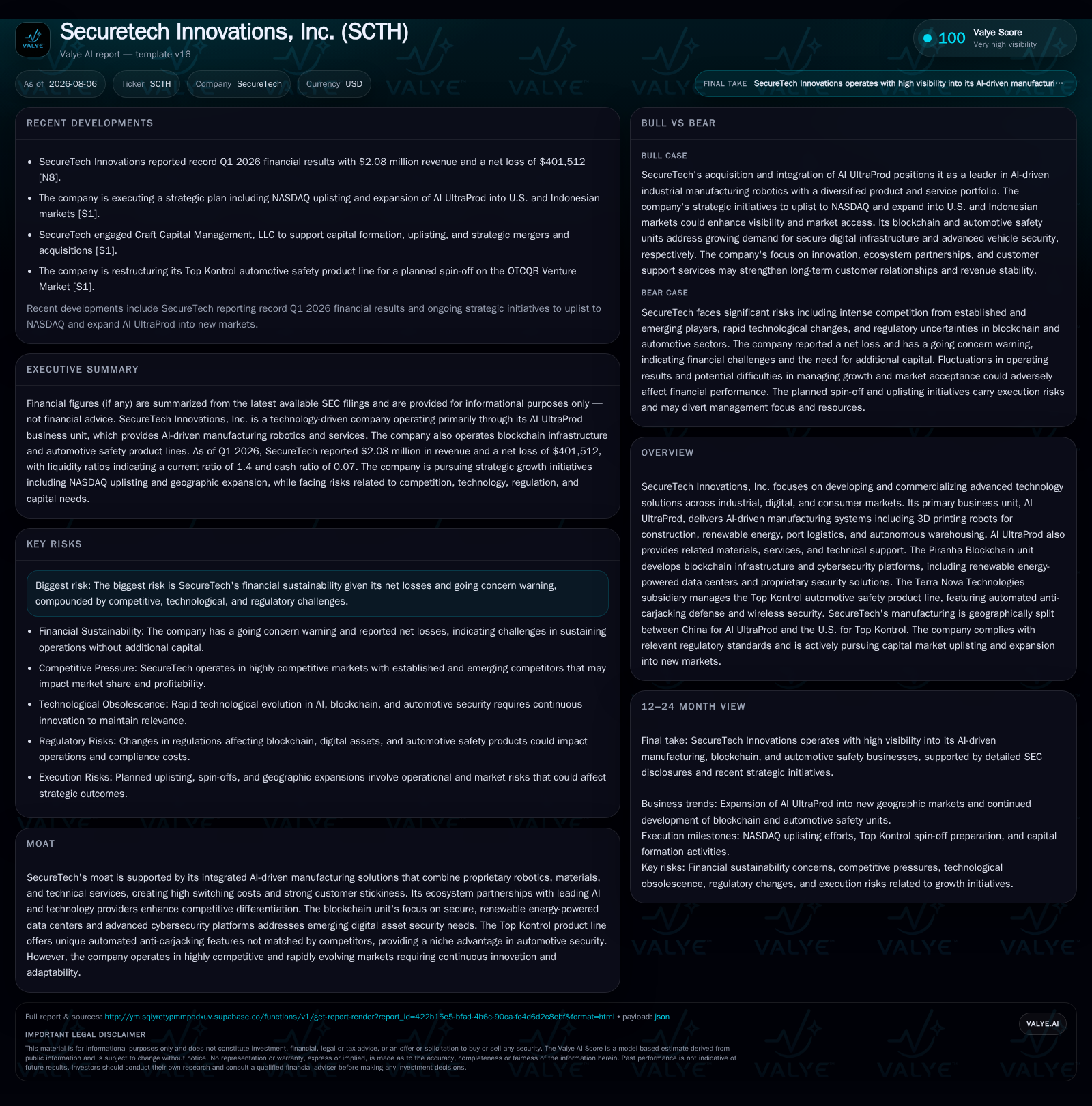
SecureTech Innovations, Inc. reported operational consolidation of its AI UltraProd acquisition with revenues driven primarily by this unit in the latest filings. The company is advancing its blockchain infrastructure initiatives and preparing a spin-off of its automotive security business, reflecting strategic portfolio alignment. However, management disclosed material weaknesses in internal financial controls necessitating restatements of prior periods. Balancing rapid technological expansion with financial reporting challenges will be critical for SecureTech’s pathway to sustainable growth.
Recent Operating Update
SecureTech Innovations' most recent quarterly filing dated May 15, 2026, highlights that the company's consolidated revenues are predominantly generated by AI UltraProd, acquired mid-2025 [S2],[S1]. This segment delivers advanced AI-driven manufacturing systems focused on industrial applications such as construction robotics featuring 3D printing capabilities, renewable energy equipment manufacturing support, port logistics automation, and autonomous warehousing solutions. Despite this operational progress, the company disclosed material weaknesses in internal control over financial reporting related to complex equity instruments and balance sheet asset classifications [S3]. These findings led to management deciding that prior period financial statements would require restatement. This restatement situation introduces near-term uncertainty that investors and stakeholders must monitor closely.
Business Model Analysis
SecureTech operates through three discrete business units: AI UltraProd (industrial AI-powered manufacturing), Piranha Blockchain (digital asset infrastructure), and Terra Nova Technologies (Top Kontrol automotive safety products) [S1]. The core revenue engine is AI UltraProd, which designs proprietary hardware combining robotics with embedded artificial intelligence to offer scalable manufacturing solutions tailored for high-growth sectors like renewable energy and logistics automation. This unit not only sells physical products but also provides technical support services and materials consumables associated with its systems—all of which create recurring revenue streams underpinning customer retention given the complexity and integration level. Manufacturing for AI UltraProd is concentrated in China to leverage cost advantages and established component supply chains.
Conversely, Piranha Blockchain is an early-stage growth area centered on developing renewable energy-powered data centers alongside proprietary cybersecurity platforms designed to secure cryptographic digital asset transactions. While this unit does not yet contribute materially to revenues or profits, it positions SecureTech within the expanding market for sustainable blockchain infrastructure—a segment experiencing heightened demand during growing regulatory scrutiny over cryptocurrency ecosystems.
The Top Kontrol product line under Terra Nova Technologies targets a niche but strategically important automotive safety hardware market focused on automated anti-carjacking defense systems. This product line is being prepared for an OTCQB spin-off aimed at unlocking shareholder value by establishing operational focus and enhancing market visibility separately from the group’s industrial and digital infrastructure businesses [S26]. Currently manufactured in the U.S., this division’s expected independent listing could attract investor interest specializing in automotive security solutions.
Revenue generation arises from hardware sales pricing combined with service contracts covering installation, maintenance, software updates embedded within AI systems, and licensing of intellectual property. The high degree of integration between AI algorithms, proprietary robotics components, and support services creates significant switching costs for customers who commit to SecureTech’s ecosystem. This integrated model attempts to insulate against commoditized pricing pressures prevalent among pure hardware vendors.
Industry Structure and Competitive Position
SecureTech sits within the broad industrial hardware and advanced manufacturing technology sector comprising firms developing industrial robotics, additive manufacturing equipment, blockchain data centers, and specialized security hardware. Its competitive set includes industrial automation leaders like Siemens or Honeywell regarding scale in manufacturing technology; blockchain infrastructure providers such as IBM Blockchain for secure digital assets; niche automotive security hardware vendors comparable to Viper or ADT Automotive; and additive manufacturing innovators like Stratasys providing context on 3D printing technologies.
What distinguishes SecureTech is its deep integration of artificial intelligence directly embedded into robotic manufacturing platforms paired with comprehensive technical support services structured around customer-specific solutions rather than off-the-shelf hardware. This end-to-end approach partially mitigates competitive threats by increasing customer reliance on SecureTech's proprietary software and materials supply chains. Nevertheless, the company remains relatively small-scale against established peers with global distribution networks endemic to those giants.
Blockchain operations leverage proprietary cybersecurity platforms powered by renewable energy—a factor aligned with industry trends toward sustainable infrastructure investment but also expose the company to risks around evolving cryptographic standards, regulatory compliance regimes regionally varying across jurisdictions, and the volatility of digital asset markets.
The planned spin-off of Top Kontrol aims at refining competitive focus by segregating automotive safety innovation into a more targeted public entity [S26]. This maneuver could sharpen management attention but brings transitional execution risk as well as dependency on successful market reception post-separation.
Growth Drivers
Growth prospects hinge substantially on continued expansion of AI UltraProd’s operations both geographically and sectorally. Following acquisition completion in mid-2025—which contributed approximately $7.7 million in annual revenue during FY2025—SecureTech aims to broaden its footprint into the U.S. and Indonesian markets via pilot deployments coupled with regional assembly hubs [S1],[S6]. These moves respond to rising demand for automated industrial solutions that increase precision while reducing labor-intensity across key sectors such as renewable energy fabrication installations.
Further upside lies in Piranha Blockchain's build-out of renewable energy-powered data centers underpinned by proprietary blockchain infrastructure software targeting enterprise-level cybersecurity needs emblematic of growing digital asset custody requirements globally [S1]. Should these initiatives scale successfully beyond proof-of-concept stages into commercial deployments this decade, they represent meaningful incremental diversification away from hardware-centric revenue streams.
The spin-off of Terra Nova Technologies (Top Kontrol) scheduled for late 2026 is designed both to unlock shareholder value through enhanced operational focus and capture investor segments attentive to automotive safety innovations featuring automated anti-carjacking technologies not widely matched by competitors [S26]
Finally,, capital formation partnerships initiated since late 2025—including exclusive engagements with Craft Capital Management for uplisting facilitation—and advisory relationships aimed at Bitcoin/Ethereum treasury strategies underscore management’s commitment to fortify SecureTech's financial base whilst targeting scalability [S6],[S7].
Risks and Watchpoints
Principal risk revolves around financial sustainability amid reported net losses compounded by a going concern warning from auditing firms [S22],[S3]. Material weaknesses identified in internal controls over complex equity instrument accounting exacerbate concerns over governance robustness affecting investor confidence until restatements are filed.
Technological risks include rapid obsolescence inherent in advanced robotics and blockchain fields requiring continuous R&D investment—iterations necessary to maintain differentiation versus dominant incumbents possessing greater scale resources [S1],[S27]. Supply chain disruptions remain salient due to dual manufacturing footprints between China (AI UltraProd) subject to geopolitical sensitivities and U.S.-based Top Kontrol lines vulnerable to raw material price inflation or regulatory changes.
Regulatory uncertainties particularly impact Piranha Blockchain's cryptocurrency-linked businesses facing evolving compliance frameworks globally alongside cybersecurity threat vectors threatening digital infrastructure integrity [S22]. Additionally, lengthy sales cycles characteristic of high-tech industrial solutions combined with fluctuating customer purchasing patterns introduce revenue volatility risk noted previously by management [S1],[S2].
The planned spin-off execution presents risks related to successful standalone operations readiness including capital adequacy post-separated entity establishment plus maintaining or growing customer traction independent of secured group synergies [S26].
What To Watch Next
Key upcoming milestones include SecureTech's targeted uplisting completion onto NASDAQ Capital Market projected for Q2 2026 contingent on meeting listing prerequisites [S6], which could enhance liquidity profiles if successfully executed.
Look for interim filings disclosing progress on restatement processes following identification of material control weaknesses announced mid-2026 [S3], serving as a barometer for transparency improvements.
Monitoring order backlog growth—particularly within AI UltraProd's geographic expansion zones like Indonesia—and initial revenue recognition from newly operational blockchain data centers will be telling indicators of execution effectiveness.
The Terra Nova Technologies spin-off slated for Fall 2026 represents a critical deconsolidation event warranting follow-up on governance structure establishment and stock issuance details affecting existing shareholders' equity stakes [S26]
Finally,, watch capital formation activities facilitated via Craft Capital Management or other partners that influence liquidity runway extension necessary given ongoing investment demands across R&D-heavy segments [S6],[S7].
Financial Profile Discussion
Balance sheet metrics from Q1 2026 show cash & equivalents at roughly $0.41 million against total debt near $0.20 million yielding a current ratio around 1.4—signaling cautious short-term liquidity coverage though indicating limited excess working capital buffer relative to current liabilities exceeding $6 million [F1]. Net debt is negative, reflecting cash balances exceeding outstanding borrowings, which provides some liquidity cushion amid expanding business scope [F1].
Continued dependence on external capital infusions remains vital given risks underscored by auditor's going concern attestation alongside forthcoming restatements complicating clear financial outlook visibility [S3],[S22]. Strategic partnerships targeting uplisting preparatory financing align with this imperative yet success hinges upon market receptivity and regulatory approvals well into calendar 2026 timelines.
In sum,, SecureTech finds itself navigating typical early-stage growth company balance-sheet pressures marked by sizable R&D outlays paired with sizable working capital needs while deploying innovative but capital-intensive assets across disparate but synergistic technology verticals.
This analysis synthesizes publicly filed disclosures without issuing investment advice or valuation conclusions. It aims solely at providing informed perspective grounded strictly in cited evidence relevant to SecureTech Innovations’ current operating context.
Disclaimer: This is research-only, informational analysis and not investment advice. It may include AI-generated interpretation and general industry context. Always verify important details using primary sources.

Comments