
Cayson Acquisition Extends Business Combination Deadline, Focuses on Asian Targets Excluding China VIEs
As a Cayman Islands SPAC with $60 million IPO proceeds in trust, Cayson Acquisition aims to complete a merger with Mango Financial while managing extension risk and capital preservation.
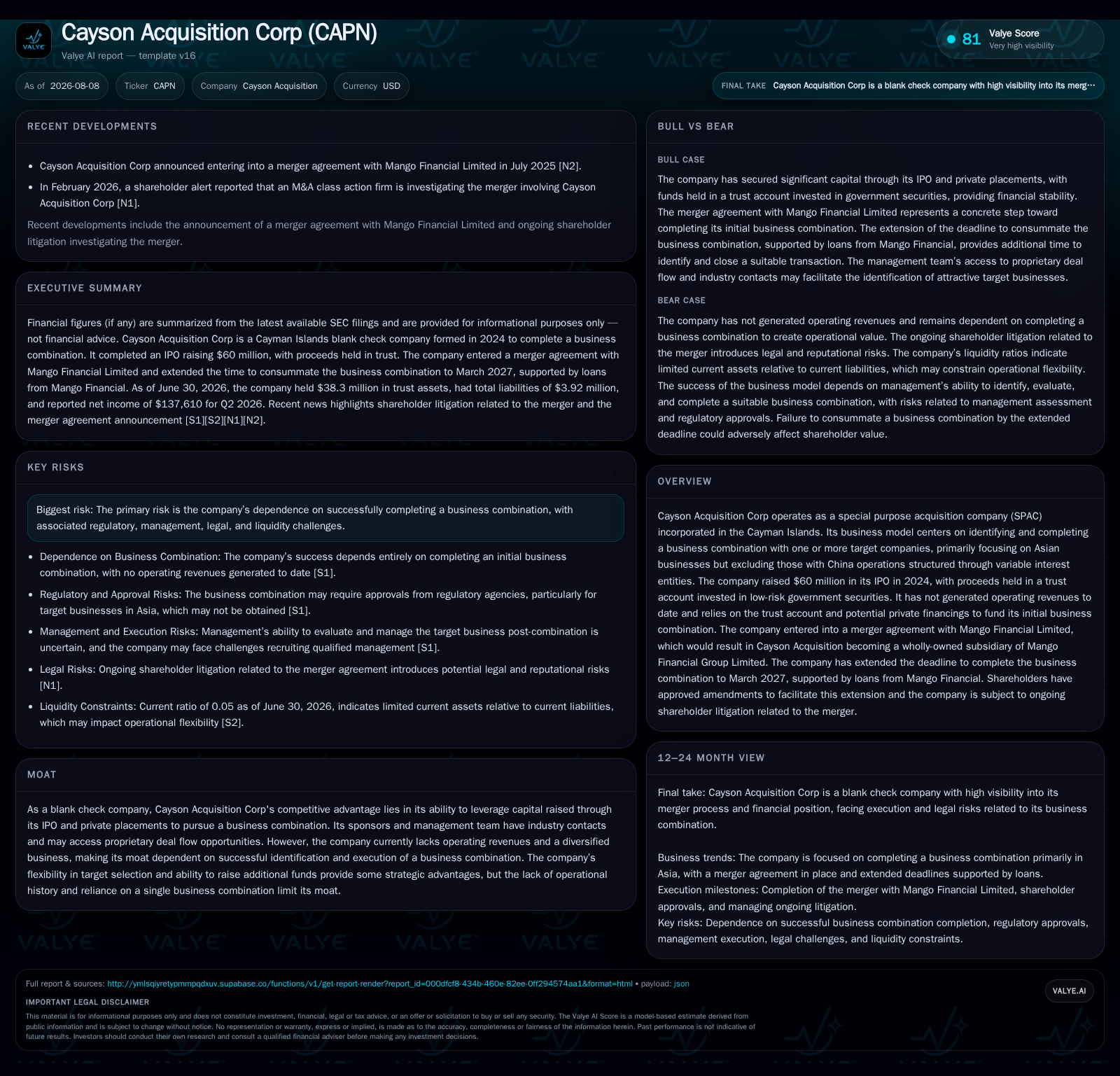
Cayson Acquisition Corp (CAPN), a blank check company formed in 2024, remains in the process of completing its initial business combination, focusing primarily on Asian targets but excluding China-based variable interest entities. The company raised $60 million in its IPO with additional private placements, proceeds held in a trust account invested conservatively for capital preservation. As of Q2 2026, CAPN has extended its deadline to finalize the merger with Mango Financial Limited until March 2027, reflecting typical SPAC timing challenges. Operatingly, the company incurs formation expenses and recognizes interest income on trust deposits, with no revenues yet. Its moat depends entirely on successful deal execution and sponsor quality while it faces liquidity and regulatory risks inherent to SPACs without diversified operations.
Recent Operating Update and Why It Matters Now
In its latest quarterly filing dated August 7, 2026, Cayson Acquisition Corp (CAPN) reported ongoing progress toward completing an initial business combination through a merger agreement with Mango Financial Limited [S2]. The filing confirms the company's continuation as a single operating segment focused exclusively on managing formation costs and generating interest income from capital held in trust. Notably, CAPN has extended the deadline to consummate this business combination on a monthly basis through March 23, 2027 [S3]. This extension underscores typical challenges faced by SPACs in closing deals—especially those targeting cross-border or emerging market companies—and reveals increased pressure on liquidity and timeline management.
The update matters because the success or failure of CAPN's de-SPAC transaction determines whether it transitions from a shell vehicle with nominal operations into an operating public business. Extension approvals signal both sponsor confidence and regulatory acceptance but highlight risks related to prolonged uncertainty including shareholder redemptions which shrink available merger proceeds.
Business Model Specifics: A Blank Check Company Focused on Asian Targets Except China VIEs
Cayson Acquisition operates as a Cayman Islands exempted blank check company formed explicitly to raise public and private equity capital with no commercial operations prior to completing a "business combination." At IPO in September 2024, CAPN issued 6 million units at $10 each for aggregate gross proceeds of $60 million along with an additional $2.3 million raised via private placements to sponsors including CEO Yawei Cao [S1]. Proceeds from the IPO and private placements were placed into a U.S.-based Trust Account invested conservatively in government securities designed to preserve capital pending deal consummation.
The SPAC's operational model is straightforward: it generates non-operating income exclusively through interest earned on Trust Account balances while incurring formation and administrative expenses related to due diligence and deal negotiation efforts [S2]. It has no revenue streams or traditional operating cash flows prior to completing a merger or acquisition.
Importantly, CAPN's strategic search criteria exclude firms structured as China variable interest entities (VIEs), reflecting sensitivities around Chinese regulatory frameworks that have complicated other Asia-focused SPAC transactions [S1]. This geographic and structural focus differentiates CAPN within the crowded SPAC universe but also narrows potential targets.
Upon completion of its initial business combination—which currently involves Mango Financial Limited—Cayson Acquisition anticipates becoming a wholly owned subsidiary of the merged entity [S3], thereby transitioning into a conventional operating public company.
Industry Structure and Competitive Positioning
Within the Special Purpose Acquisition Company sector, CAPN competes among dozens of blank check vehicles that seek to leverage public equity capital markets as conduits for private companies' public listings. CAPN's unique positioning lies in its Asian regional emphasis excluding risky China VIE structures—a niche where regulatory scrutiny remains intense globally.
This geographic strategy may yield proprietary deal flow access through sponsor networks familiar with Asian markets but entails elevated geopolitical risk compared to domestic-focused SPACs. Compared with peer SPACs targeting emerging markets or similar geographies, CAPN operates on modest scale—$60 million IPO proceeds place it more towards smaller scale peers [S1]. Capital adequacy for executing large deals relies partly on the ability to raise additional private financing alongside IPO proceeds if needed.
Sponsor reputation and transactional expertise are crucial competitive moats here; CAPN's sponsors bring Asia experience but no extensive operating track record reported yet [S1]. The narrow funnel of eligible targets limits competitive overlap somewhat but increases dependence on executing selected deals efficiently before deadlines expire.
Growth Drivers for Cayson Acquisition
Though pre-revenue as a blank check vehicle, CAPN’s growth prospects hinge entirely on effectively executing its de-SPAC strategy:
- Extended Deadline Flexibility: Monthly extensions up to March 2027 extend runway allowing more comprehensive due diligence or complex negotiations without requiring liquidation [S3].
- Asia Market Opportunity: The rising prominence of Asian financial services firms seeking alternative public listing routes amid changing capital markets offers potential high-growth targets.
- Sponsor Network Access: Sponsor affiliations provide potential proprietary deal pipelines which are critical given challenges accessing quality targets through open-market search.
- Private Financing Capability: Ability to raise additional funds through private placements enhances transaction size flexibility beyond initial $60 million IPO pool [S1].
- Investor Appetite: Ongoing investor demand for equity exposure to emerging markets like Asia supports capitalization adequately post-business combination.
Risks and Watchpoints
Key risks intrinsic to CAPN’s business include:
- Business Combination Completion Risk: Failure to close the announced Mango Financial merger or any alternative transaction by March 2027 would likely trigger liquidation per charter terms [S3].
- Redemption Risk: Public shareholders’ redemption rights may deplete trust account capital reducing the funds available for acquisition consideration or post-merger working capital [S2].
- Liquidity Constraints: Current liabilities significantly outstrip current assets ($1.82M vs $99k) reflecting limited operational cash outside trust accounts; minimal cash on hand (~$54k) heightens funding reliance [F1][S2].
- Regulatory Uncertainty: Cross-border mergers involving sensitive regions such as Asia face increased scrutiny that could delay approvals or impose costly conditions [S1].
- Limited Operational Track Record: Absent post-merger performance history makes it difficult for investors to gauge sponsor effectiveness or combined entity prospects.
- Dilution From Warrants/Rights: Shareholder dilution risks exist from outstanding warrants/rights part of IPO structure affecting long-term equity value [S1].
- Geopolitical Event Exposure: Broader geopolitical tensions impacting Asia investment climates could impair target valuations or integration feasibility.
What To Watch Next
Several critical execution milestones will inform CAPN’s trajectory:
- Business Combination Completion Status: Timely closing or meaningful progress announcements regarding Mango Financial Limited merger scheduled no later than March 23, 2027 [S3].
- Shareholder Redemption Rates: Disclosure of redemption volumes will clarify actual go-forward capital available for transaction financing [S2].
- Additional Private Placements Announced: Any new fundraising efforts will indicate capacity building ahead of larger transactions.
- Due Diligence Developments: Updates on due diligence outcomes including material contracts or regulatory clearances relevant to proposed merger partners.
- Operating Expense Management: Monitoring formation costs vis-à-vis interest income earned signals financial discipline affecting net asset preservation.
- Post-Merger Public Market Reaction: Once combined entity launches publicly, share price trends will reveal market confidence in deal rationales.
Financial Profile Discussion
As of June 30, 2026, CAPN held approximately $54,485 in unrestricted cash outside its Trust Account alongside about $38 million remaining in trust but subject to possible redemption by shareholders at roughly $11 per share redemption price [S2][F1]. Current liabilities significantly exceed current assets, resulting in a razor-thin current ratio near 0.05, indicating negative working capital conditions on an operational basis absent the Trust Account shield [F1]. Operating expenses mainly comprise corporate formation costs and administrative overhead partially offset by accrued interest income from conservative investments within the Trust Account—reflecting the standard economics across SPACs during their pre-merger phase [S2].
Recent filings note sponsors have contributed over $428k covering certain transaction expenses without repayment obligations, improving short-term liquidity flexibility [S2]. However, the overall financial position depends heavily on preserving Trust Account principal across an extended timeline while managing evolving transaction costs until completion or liquidation mandated by expiry dates.
The balance sheet composition—with significant deferred underwriting fees incurred during IPO formation costs—reflects typical early-stage blank check companies preparing for transformational mergers. No debt beyond working capital advances currently burdens the enterprise except promissory notes linked possibly to interim funding arrangements disclosed previously [F1][S12][S25]. Given absence of operating revenues thus far, net income mainly comprises non-operating gains from interest earnings within Trust Accounts partially offset by ongoing expenses resulting in small net positive income recorded at year-end December 31st, 2025 [F1][S1].
Ultimately, CAPN's financial profile exemplifies a well-capitalized early-stage acquisition vehicle preserving IPO funds prudently while absorbing manageable overheads pre-deal closure—a scenario common among peers racing against statutory deadlines amid complex dealmaking environments.
This analysis is based solely on publicly available SEC filings up through August 7th, 2026 and does not constitute investment advice. It focuses strictly on Cayson Acquisition Corp’s business model as a Special Purpose Acquisition Company and should be considered within broad industry contexts rather than predictive forecasts. Investors or analysts pursuing further information should review official filings directly for updates beyond this publication date.
Disclaimer: This is research-only, informational analysis and not investment advice. It may include AI-generated interpretation and general industry context. Always verify important details using primary sources.

Comments