
Agenus Advances Immunotherapy Pipeline with Strategic Phase 3 Focus Amid Financial Pressures
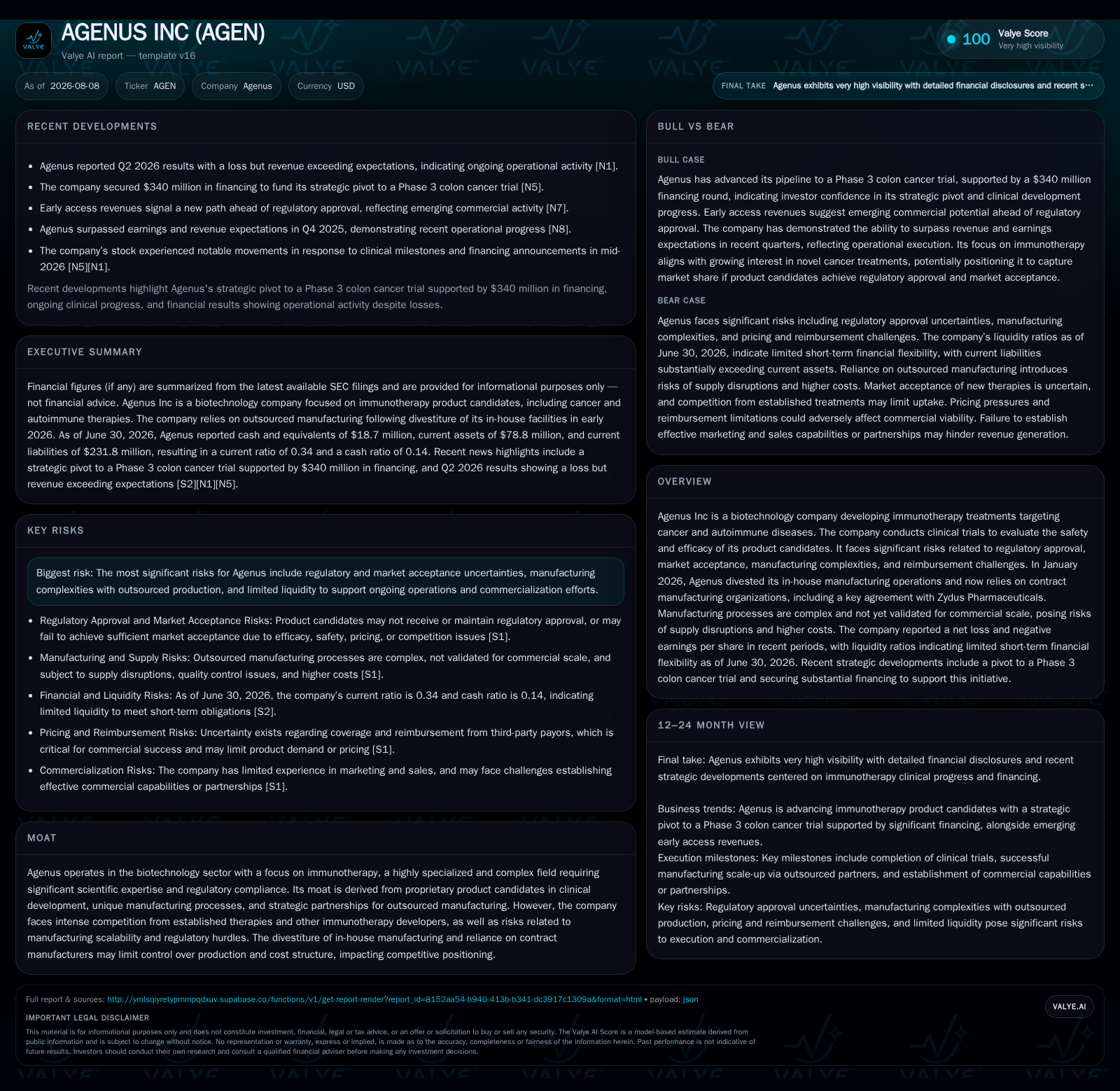
Q2 2026 filings reveal Agenus’ strategic commitment to a pivotal Phase 3 colon cancer trial supported by a $340 million private placement, alongside a shift to outsourced manufacturing that reshapes operational risk and cost dynamics.
Agenus Inc’s Q2 2026 report highlights a focused advancement of its lead immunotherapy candidate botensilimab in a Phase 3 colon cancer trial, underpinned by a substantial $340 million financing round. The company’s January 2026 divestiture of internal manufacturing in favor of contract manufacturing organizations like Zydus Pharmaceuticals introduces typical biotech outsourcing risks related to supply reliability and cost control. While clinical progress continues, Agenus faces significant liquidity constraints and regulatory uncertainties that elevate execution risk. Key near-term indicators include clinical enrollment milestones, regulatory interactions, and partnership developments critical to de-risking the path toward commercialization.
Q2 2026 Filing Highlights Strategic Shift Toward Late-Stage Clinical Development
Agenus’ August 7, 2026 Form 10-Q details a deliberate strategic refocus on advancing the pivotal Phase 3 ROBBIN trial evaluating its lead immunotherapy candidate botensilimab (AGEN1181) in colon cancer, administered alone or with balstilimab (BAL) [S2]. This concentration on late-stage development aims to expedite regulatory approval pathways—a key inflection point for unlocking commercial value within biotech where late-phase success heavily influences valuation.
This clinical pivot follows an oversubscribed $340 million private placement completed in July 2026 explicitly to fund accelerated patient enrollment and preparatory trial activities [N9], [N10]. While underscoring robust investor confidence in the pipeline’s potential, the financing also reflects the capital-intensive nature of late-phase trials and the dilution pressures common for companies at this stage.
Outsourced Manufacturing: Operational Implications of Divestiture
In January 2026, Agenus exited internal manufacturing operations, transitioning production responsibilities primarily to contract manufacturing organizations (CMOs), notably Zydus Pharmaceuticals under established agreements [S1], [S2], [F1]. This operational shift reduces fixed overhead but increases exposure to third-party risks including production delays, batch failures, or quality control issues—challenges endemic to biologics manufacturing at scale.
Zydus’ role encompasses complex biologic processes critical for botensilimab supply. Given that such manufacturing remains partially validated commercially, any disruptions could delay clinical timelines or inflate costs. Agenus' limited direct control post-divestiture necessitates stringent oversight mechanisms to mitigate these risks.
This outsourcing model aligns with broader biotech industry trends where nimble clinical-stage firms leverage CMOs to contain capital expenditure but must balance cost efficiency against potential impacts on supply chain reliability and regulatory compliance.
Clinical Pipeline Focused on Botensilimab Advancement
Agenus’ clinical portfolio centers around botensilimab as its flagship asset deployed both as monotherapy and combination therapy with balstilimab [S2]. The company manages multiple active trials requiring coordinated patient enrollment efforts—a critical driver of timely data generation and subsequent milestone payments under collaboration agreements.
Limited internal resources constrain simultaneous advancement across multiple candidates without risking capital dilution or execution distractions [S1]. This focused approach parallels peers like ImmunityBio who concentrate R&D efforts on high-potential immunotherapy assets while outsourcing ancillary development functions.
Comparative Positioning Among Immunotherapy Developers
Outsourcing introduces typical trade-offs: reduced capital intensity versus diminished control over production timelines and quality—factors that could affect speed-to-market if not carefully managed. Regulatory approval uncertainties remain consistent industry-wide given evolving FDA requirements for novel biologics.
Growth Drivers: Financing Support and Milestone-Linked Clinical Progression
The $340 million financing underpins critical Phase 3 enrollment milestones necessary for FDA submission readiness—milestones that are vital to unlocking milestone payments from partnerships or future royalty streams upon commercialization [N9], [S1]. These financial infusions are indispensable for sustaining expensive late-stage development.
Regulatory timelines remain variable; delays or requests for additional data could extend cash burn duration and necessitate further capital raises [S1]. Market acceptance post-approval depends heavily on demonstrating superior efficacy over existing therapies alongside securing favorable pricing/reimbursement—an ongoing sector-wide challenge exacerbated by public scrutiny on drug costs
Risks: Regulatory Uncertainty, Outsourcing Dependence, Liquidity Constraints
Agenus faces multiple risk vectors including regulatory approval uncertainty driven by efficacy/safety outcomes and manufacturing validation challenges linked to outsourced production [S1], [S2]. Dependence on CMOs elevates supply chain risk which could impact clinical trial continuity or eventual commercial supply.
Liquidity metrics reveal acute short-term financial stress: cash reserves stood at approximately $18.7 million against current liabilities exceeding $231 million as of June 30, 2026, producing a current ratio near 0.34—a level indicating constrained operational flexibility absent additional funding [F1], [S2]. Net debt approximates $11.6 million further underscoring capital scarcity.
Legal risks persist with ongoing securities litigation related to product claims; however, management reports no accrued contingent liabilities currently tied to these proceedings [S1]. These factors collectively heighten execution risk amid costly late-stage development demands.
Near-Term Catalysts: Enrollment Milestones, Regulatory Engagements, Partnership Developments
Key upcoming events include interim data releases from the ROBBIN Phase 3 trial as enrollment progresses backed by recent financing commitments [S2], [N9]. Critical FDA interactions such as End-of-Phase meetings or submission acceptances will materially influence development timelines and investor sentiment.
Expansion of manufacturing partnerships or licensing deals could alleviate operational burdens or provide supplementary capital—events serving as important signals regarding pipeline validation or adjustment needs.
Monitoring developments in litigation matters may also clarify contingent risk exposure impacting governance perceptions.
Financial Profile Discussion: Cash Resources vs. Current liabilities significantly exceed current assets ($78.8 million), yielding a low current ratio (~0.34) indicative of pronounced short-term liquidity constraints requiring further capital access strategies for sustained operations [F1], [S2].
Management acknowledges substantial doubt regarding going concern status conditional on successful financing within one year post-filing date. Interest expense increased quarter-over-quarter reflecting costs associated with recent financings aimed at supporting pipeline progression.
Hence, while recent equity infusion strengthens near-term funding sufficiency enabling key developmental milestones pursuit, vigilant monitoring of cash burn relative to inflows remains critical.
This analysis synthesizes Agenus Inc’s most recent SEC filings dated August 7 and August 6, 2026 ([S2], [S3]), its March annual report ([S1]), current financial snapshot ([F1]), supplemented by market news through mid-2026 ([N1]-[N10]). It integrates sector-relevant biotechnology context focusing on immunotherapy clinical progression dynamics, outsourcing implications, funding imperatives, regulatory uncertainties, and peer comparisons without speculative extrapolation.
Disclaimer: This is research-only, informational analysis and not investment advice. It may include AI-generated interpretation and general industry context. Always verify important details using primary sources.

Comments