
Rising Dragon Acquisition Extends Merger Deadline Amid Persistent Regulatory and Funding Challenges
The Cayman Islands-based SPAC broadened its combination period repeatedly while navigating China-focused deal risks and funding constraints.
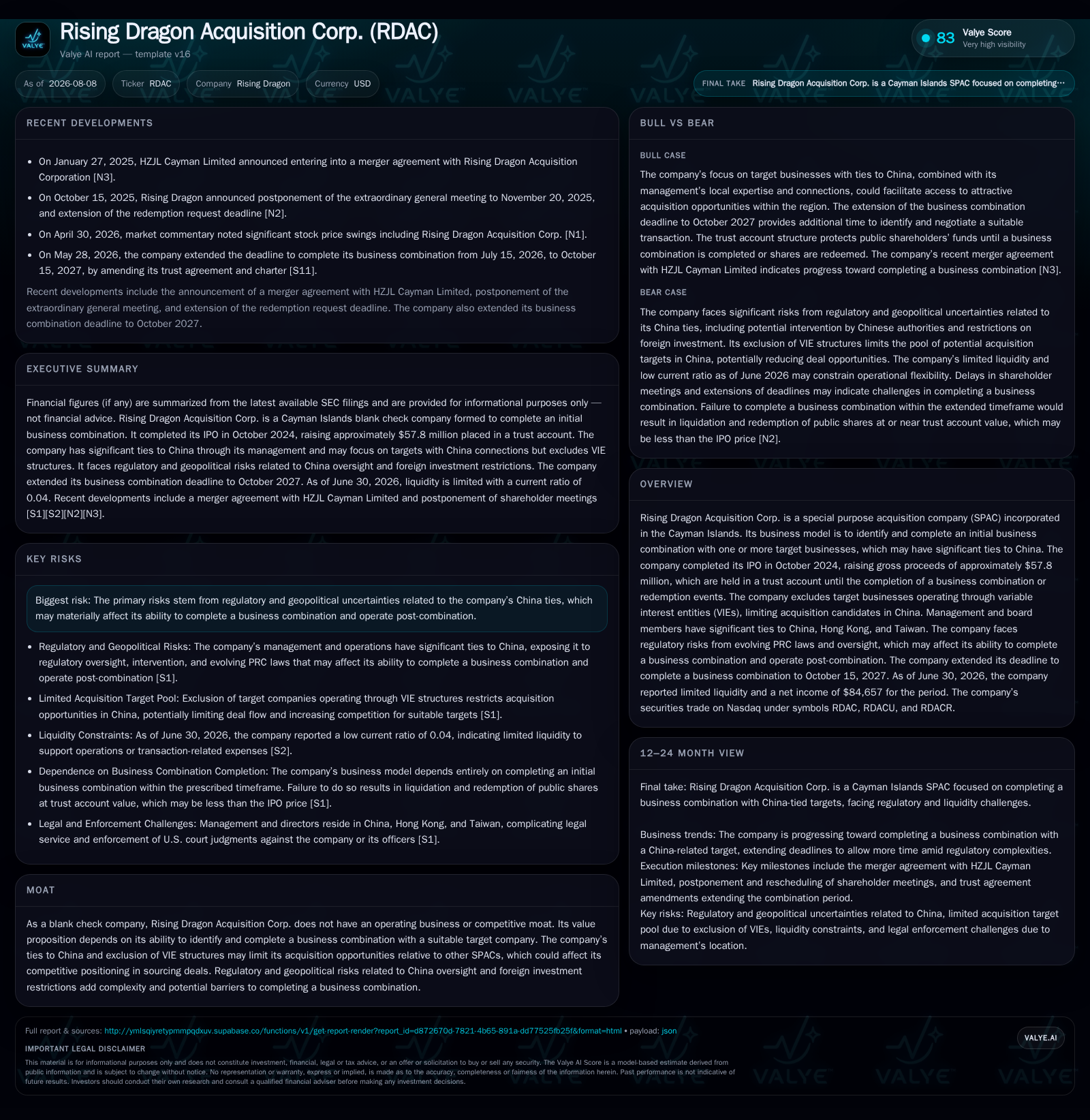
Rising Dragon Acquisition Corp. remains a blank check entity targeting a business combination chiefly with Chinese-tied companies, explicitly excluding variable interest entities (VIEs) due to regulatory uncertainties. The company extended its deadline multiple times through mid-2027, supported by unsecured promissory notes convertible into its units to fund trust account extension fees. However, operational progress is constrained by ongoing regulatory risks in China and a thin capital and liquidity profile. These factors combine to limit deal pipeline visibility and heighten redemption risk, typical of China-focused SPACs in the current geopolitical environment.
Recent Operating Update: Extended Combination Deadline and Funding Actions
Rising Dragon Acquisition Corp. (RDAC) filed its latest quarterly report on August 7, 2026 [S2], confirming that it has extended its deadline for completing an initial business combination from July 15, 2026 to October 15, 2027. This extension follows shareholder approval at a May 28, 2026 general meeting where nearly two million ordinary shares were tendered for redemption [S6]. The extension incurs a monthly fee payable into the trust account amounting to approximately $75,800 per month under agreed terms.
To finance these extension fees without dipping into the trust principal earmarked for shareholders' protection upon deal failure or redemption events, Rising Dragon issued unsecured promissory notes totaling roughly $200,000 across April to July 2026 [S9][S10][S11][S15]. These notes bear no interest and mature upon closing the business combination or upon dissolution. They are convertible into units identical to those issued in the IPO priced at $10 per unit.
These financing maneuvers underscore persistent delays in sourcing and closing a transaction within the initial timeframe while maintaining capital adequacy to honor shareholder redemptions or meet trust obligations.
Business Model: Blank Check Vehicle with China Focus Excluding VIE Structures
As a special purpose acquisition company incorporated in the Cayman Islands, Rising Dragon operates a classic SPAC model—raising funds through an IPO by selling units comprising ordinary shares and warrants. Since its October 15, 2024 IPO which generated gross proceeds near $57.8 million [S1], these funds have been held in a trust account pending consummation of an initial business combination or return if none materializes.
Notably, Rising Dragon explicitly excludes potential acquisition targets that rely on variable interest entity (VIE) structures — commonly used by Chinese companies unable to be directly foreign-owned — due to evolving PRC regulatory scrutiny [S1]. This constraint significantly narrows its potential target universe relative to other China-focused SPACs willing to engage with VIEs but reduces legal and operational uncertainty post-combination.
This tradeoff reflects cautious sponsor strategy balancing deal risk versus pipeline breadth. The company’s management team and board possess deep ties in Greater China and Taiwan regions providing domain insight arguably essential for deal origination in this opaque cross-border environment.
The SPAC’s monetization hinges entirely on completing a successful deal (de-SPAC transaction) that converts private equity value into public market liquidity without a traditional IPO process. Until then, Rising Dragon does not generate operating revenues but incurs recurring administrative costs related to SEC compliance and corporate governance.
Industry Structure: Cross-Border SPACs Facing Elevated Regulatory Risk
Within the broader SPAC ecosystem characterized by short windows (typically 18-24 months) for deal completion and high investor scrutiny around redemption rates and sponsor alignment, Rising Dragon operates amid heightened challenges noticeable among peers targeting Asia or specifically China. Regulatory crackdowns on foreign listing routes including de-SPAC transactions combined with geopolitical tensions elevate deal execution risk substantially.
Peer comparison highlights include Social Capital Hedosophia Holdings which also focus on Asian targets but may differ on acceptance of VIE structures or scope. Furthermore, Rising Dragon’s relatively modest IPO size ($57.8 million) limits scale advantages compared with larger specialized vehicles capable of pursuing bigger deals or absorbing higher sponsor dilution.
Redemption rights granted to public shareholders create financing uncertainty since high redemption levels reduce available merger capital requiring supplemental PIPE financing or sponsor funding. Rising Dragon’s near two-million shares redeemed during its last extension vote exemplify investor caution impacting deal feasibility.
Growth Drivers: Sponsor Expertise and Market Tailwinds Offset Extended Timelines
Despite operational delays stretching beyond initial timelines through multiple extensions approved by shareholders [S6], Rising Dragon benefits from several structural growth factors present in the SPAC sector:
- A continued investor appetite for alternative public listing routes beyond traditional IPOs supports demand for de-SPAC opportunities.
- Sponsor team’s regional expertise and network could facilitate sourcing attractive private companies aligned with evolving market trends emphasizing ESG compliance and tech innovation — stated focus areas per management disclosures [S1].
- Extension agreements enable additional time beyond initial deadlines providing breathing room amid uncertain regulatory regimes governing cross-border deals with Chinese-related firms.
- The convertible promissory notes illustrate flexible capital arrangements that help sustain operations through extended search periods without eroding trust capital licensed for investor protection.
These drivers hinge critically on management's ability to source viable targets excluding VIE-dependent businesses while navigating ongoing PRC oversight developments seemingly prudent but limiting pipeline volume.
Risks and Watchpoints: Regulatory Uncertainties and Liquidity Constraints Remain Critical
Rising Dragon's prospects are tightly coupled with several key risk factors:
- Regulatory risk is paramount given the company's targeted geography excludes VIEs but cannot fully insulate from shifting PRC laws affecting mergers involving foreign-backed entities or technology-sensitive sectors.
- Liquidity challenges emerge starkly from the latest balance-sheet snapshot: as of June 30, 2026 total current assets stand at $55,362 versus current liabilities exceeding $1.38 million resulting in an acute current ratio near 0.04; total debt posted at approximately $100,000 presumably includes promissory notes issued recently [F1]. This mismatch points towards cash burn pressures absent successful transaction closure or further capital raises.
- Redemptions surpassing one-third of outstanding shares highlight price sensitivity among investors reflecting skepticism about management's ability to close deals amid complex macroeconomic conditions [S6].
- Prolonged timeline extensions can erode sponsor credibility versus peers who either complete deals faster or liquidate earlier enhancing reputational risk among stakeholder groups.
As of June 30, 2026, Rising Dragon’s current assets totaled $55,362 compared against current liabilities of $1,382,072, yielding a critically low current ratio near 0.04 [F1]. This imbalance underscores acute liquidity strain making timely access to additional funds crucial.
Total debt stood near $100,000 as of December 31, 2025, largely reflecting unsecured promissory notes issued by sponsors during Q2 and Q3 periods throughout April-July intended expressly for funding trust account fees enabling deadline extensions [F1][S15]. These notes remain interest-free yet are convertible into units post-business combination increasing possible dilution.
Overall financial metrics reflect typical pre-combination SPAC profiles complicated here by protracted timelines extending costs without accruing transaction-related gains placing emphasis on management’s ability to complete a merger before liquidity deteriorates further.
This analysis focuses exclusively on publicly filed information as of August 8, 2026 related to Rising Dragon Acquisition Corp., interpreting operating developments within the contextual framework of blank check companies targeting China-affiliated private firms excluding certain legal structures such as VIEs due to elevated regulatory risk. It underscores how timeline extensions funded through convertible promissory notes display both operational persistence and escalating financial constraints common across similar cross-border SPAC transactions today but does not speculate on specific deal outcomes or valuations absent explicit disclosures. Investors are urged to consider these factors alongside broader industry dynamics when assessing such vehicles’ outlooks.
Disclaimer: This is research-only, informational analysis and not investment advice. It may include AI-generated interpretation and general industry context. Always verify important details using primary sources.

Comments