
Stoneridge's Strategic Focus on Electronics and Brazil Segments Shapes Growth Outlook
Post-divestiture shift enhances Stoneridge’s position in vehicle electronics amid cyclical market dynamics.
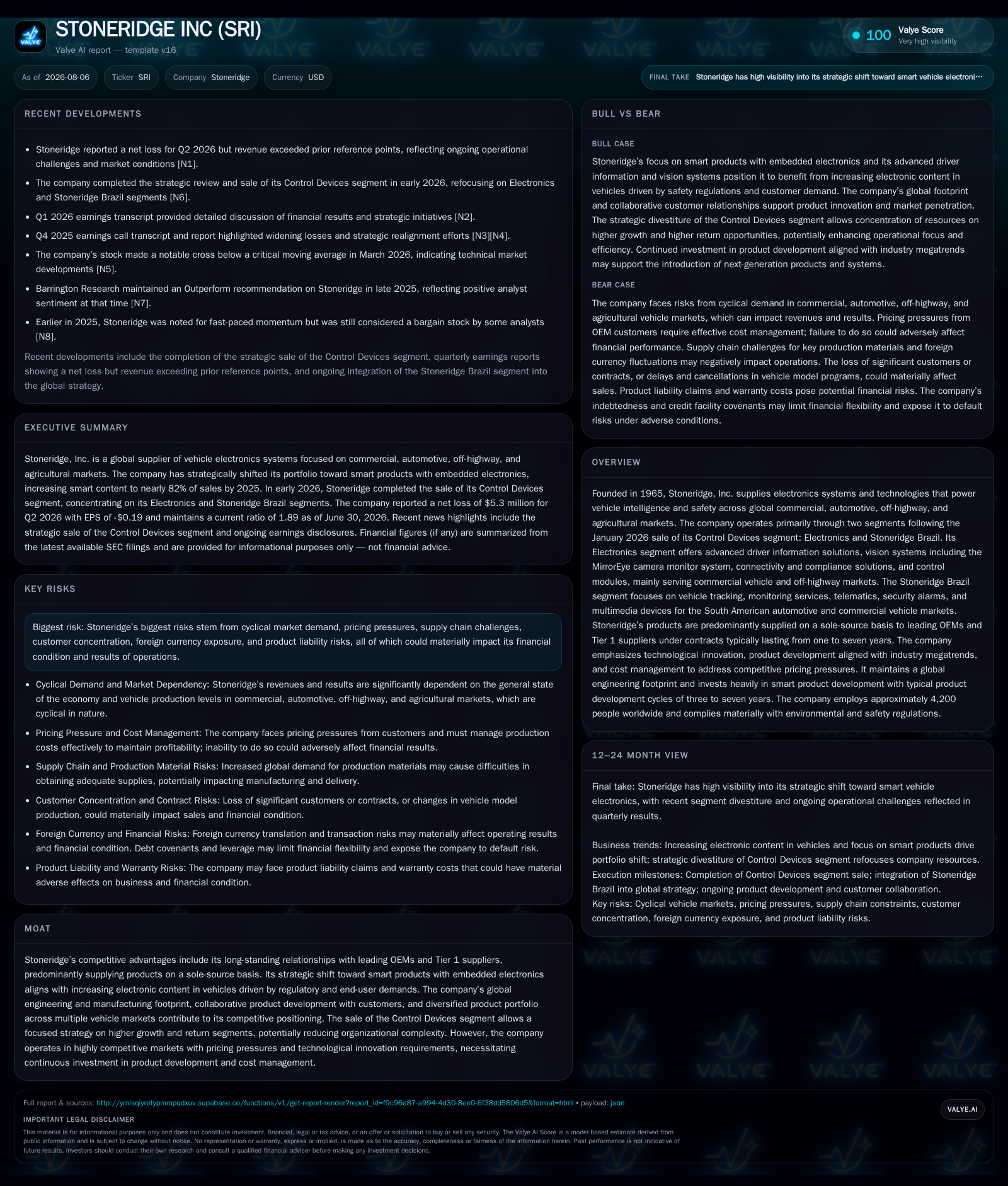
Stoneridge Inc. reported its second quarter 2026 results emphasizing the completed sale of its Control Devices segment in January 2026, enabling a sharper strategic focus on its Electronics and Stoneridge Brazil segments. The company’s revenue remains tied to cyclical vehicle production volumes and increasing electronic content per vehicle, with product relevance in driver information systems, camera monitor solutions like MirrorEye, telematics, and compliance devices. Customer concentration and sole-source contracts underpin revenue stability but also pose risks amid pricing pressures and technological demands. Margins face headwinds from supply chain and currency fluctuations. The company’s financial position reflects manageable liquidity with a current ratio of 1.89 and net debt approximately $109 million. Key growth drivers include regulatory-driven advances in vehicle safety electronics, expansion in telematics services—particularly in South America—and OEM adoption of smart embedded products.
Recent Operating Update
Stoneridge Inc.'s latest quarterly filing for Q2 2026 confirmed the company’s strategic realignment following the January 2026 divestiture of its Control Devices segment. This move completes a multi-year transition toward focusing on smarter electronic products that embed logic and software functionality rather than mechanical components [S2][S3]. The company now reports primarily through two segments: Electronics — providing advanced driver information solutions, vision systems including the MirrorEye® camera monitor system, connectivity solutions, compliance products, and control modules — along with its Stoneridge Brazil segment that delivers telematics, vehicle tracking, security alarms, multimedia devices primarily focused on South American automotive and commercial vehicle markets [S1][S24]. This divestiture reduces organizational complexity allowing capital allocation toward high-return opportunities aligned with growing electronic content trends.
The Q2 release detailed ongoing pricing pressure amid competitive markets but noted sustained demand for key products such as MirrorEye camera monitors in the European and North American commercial vehicle sectors — which recorded record quarterly sales earlier this year [N1][S18]. Nonetheless, overall margins have been impacted by inflationary costs for raw materials sourced globally as well as ongoing currency headwinds related to their Brazil operations. Management highlighted solid operational execution in capacity utilization and new program ramp-ups but acknowledged the cyclical softness impacting the broader commercial vehicle sector during the quarter [N1][S2].
Business Model Analysis
Stoneridge operates predominantly as a Tier 1 supplier serving leading original equipment manufacturers (OEMs) across commercial trucks, automotive passenger vehicles, off-highway machinery, agricultural equipment, and aftermarket channels. The business model centers on designing custom-engineered embedded electronics products sold mostly under sole-source contracts that span multiple years aligned with customers’ vehicle lifecycle programs (typically three to seven years) [S1][S11]. Revenue is thus sensitive both to new vehicle production volumes—highly cyclical based on end-market economic factors—and to incremental electronic content per vehicle driven by regulatory safety mandates (e.g., visibility systems) as well as end-user demands for connectivity and driver convenience [S19][S21].
Within the Electronics segment, product lines include actuators, switches integrated with control logic, sensors essential for emissions or safety systems, advanced driver information displays capturing critical performance data (speed,tire pressure,fuel efficiency), vision products like MirrorEye replacing traditional mirrors with camera monitors enhancing safety through expanded field of view without blind spots or glare issues. Connectivity products support compliance reporting as well as telematics that enable fleet management analytics via embedded cellular or satellite modules. This breadth creates diversified exposure across multiple parts of the value chain while still leveraging long OEM relationships often secured early at new model design stages [S16][S19].
The Stoneridge Brazil segment further extends revenue channels via telematics devices sold directly to fleets and individual consumers plus aftermarket distribution networks supported with services such as real-time vehicle tracking or alarm monitoring relevant under regional security considerations [S16]. The comprehensive portfolio thus spans hardware manufacturing tightly coupled with ongoing service revenue streams providing some recurring component alongside transactional OEM sales
Industry Structure and Competitive Context
The broader Vehicle Electronics & Safety Systems industry is typified by lengthy product development cycles tailored around OEM platform life spans—generally several years ahead of public launches—and tight integration between supplier engineering teams with OEM design groups early in development phases to meet stringent quality,safety,and cost benchmarks. Competitors range from large diversified suppliers such as Aptiv PLC, Denso Corporation, Visteon Corporation, Gentex Corporation (notably in vision systems) to specialized telematics-focused entities like Garmin Ltd., each addressing different facets of embedded electronics content demand.
The niche Stoneridge targets — particularly commercial truck advanced driver information systems coupled with integrated vision solutions — requires continuous R&D investment to maintain parity or leadership given rapid technological evolution including increased sensor sophistication,camera calibration algorithms,and digital signal processing capabilities supporting driver assistance technologies. Price competition is intense driven by OEM cost constraints while legacy contract commitments moderate short-term switching but heighten risk upon program redesign decisions.
Geographic diversification through its Brazilian operations provides exposure to emerging market growth though adds complexity related to foreign currency volatility and evolving local regulatory frameworks influencing product requirements. Product liability risks also loom given safety-critical system usage requiring robust quality control backed by warranty reserves or insurance coverage.
Growth Drivers
Key growth vectors for Stoneridge are anchored in:
- Increasing electronic content per vehicle caused by tightening global safety regulations mandating driver visibility enhancement technologies like MirrorEye which substitute traditional mirror assemblies with camera-based monitors reducing blind spots.
- Expanding adoption of telematics-based fleet monitoring driven by commercial operators demanding improved asset utilization,safety compliance reporting,and security especially within Latin American markets where urban theft risk is significant.
- Ongoing transitions by OEMs towards integrated smart cab architectures where multiple control modules,numerous sensors,and connectivity endpoints replace legacy mechanical controls; this amplifies per-vehicle unit content.Stoneridge’s focus on embedding intelligence into actuators,switches,and sensors positions it advantageously here.
- Aftermarket demand for replacement parts plus monitoring services supports more stable mid-cycle revenue less sensitive to new model production cycles [N1][S16].
- Leveraging full ownership stake in Stoneridge Brazil enables global engineering collaboration benefiting quality,cost,and innovation throughput amidst localized market customization requirements.
Monitoring production backlog awards (future sourced sales estimates) alongside new program wins will be key leading indicators confirming expansion sustainability given exposed customer contract terms lacking firm binding volume commitments beyond estimated life-of-model forecasts [S1]
Risks and Growth Constraints
Multiple structural challenges constrain growth resiliency:
- Heavy dependence on a concentrated set of major OEM customers (top five accounted for over 57% of net sales) exposes vulnerability should any experience production delays or change sourcing strategies abruptly[S1][S11].
- Cyclicality tied explicitly to commercial truck,new automotive,and off-highway equipment demand magnifies revenue volatility as macroeconomic weakness diminishes production volumes impacting order intake proportionally[S12].
- Pricing pressures intensify due to highly competitive supplier landscapes requiring ongoing cost optimization initiatives; failure here compresses margin profiles despite volume gains.[S21]
- Supply chain constraints for semiconductors,memory chips,and other key electrical components exacerbate lead times raising inventory carrying costs alongside potential fulfillment delays.[S15]
- Foreign exchange risk arising from Brazilian operations can erode dollar-reported results especially when local currency weakens amid inflationary pressures.[S12]
- Product liability suits or warranty claim spikes could impose unexpected costs undermining customer confidence especially given stringent safety system performance requirements.[S13][S28]
- Long product development cycles mean substantial upfront investments precede revenues sometimes over multiple years increasing operating leverage risks if programs are cancelled mid-cycle.[S21]
What to Watch Next
Investors should monitor:
- Quarterly backlog disclosures providing insight into future awarded sales visibility reflecting new program wins or cancellations [S1].
- Execution progress against planned cost reductions offsetting pricing pressures evident from margin trends highlighted at next earnings calls [N1].
- Market penetration rates for MirrorEye camera monitor system including rollout success across European and North American commercial truck platforms where regulatory endorsements would enhance adoption.
- Expansion momentum within the Stoneridge Brazil telematics business measured via active device counts or contract renewals indicative of recurring revenue resilience.
- Currency translation impacts on reported revenues/margins tightly linked to BRL/USD movements alongside management responses around hedging strategies.
- R&D expenditure rates as a percentage of sales signaling commitment levels toward sustaining technology differentiation critical under competitive industry dynamics.[S21]
- Industry-wide commercial vehicle production trends acting as leading macro drivers influencing new orders hence revenue cycles.
Financial Profile Discussion
The company's ability to comply with amended credit covenants through improving EBITDA generation will be crucial for maintaining financial flexibility moving forward [S27]. Free cash flow trends post restructuring along with disciplined capex aligned closely to high-growth segments may improve financial steadiness enabling potential reinvestment or shareholder return options over time.
This analysis synthesizes public SEC filings through August 2026 together with contextual industry insights to outline Stoneridge Inc.'s strategic transformation emphasizing higher-content electronics aligned with megatrends driving vehicle electrification,safety,and connectivity. While attractive secular tailwinds exist,the company must manage cyclicality,pricing pressures,and execution risks inherent in a capital intensive environment where OEM relationships critically influence financial outcomes.
This document is prepared solely for informational purposes without any investment research view or endorsement.
Disclaimer: This is research-only, informational analysis and not investment advice. It may include AI-generated interpretation and general industry context. Always verify important details using primary sources.

Comments