
International Media Acquisition Corp.'s Strategic Merger with VCI Highlights SPAC Execution Challenges
IMAQ advances its business combination with a complex foreign merger while facing tight deadlines and liquidity pressures.
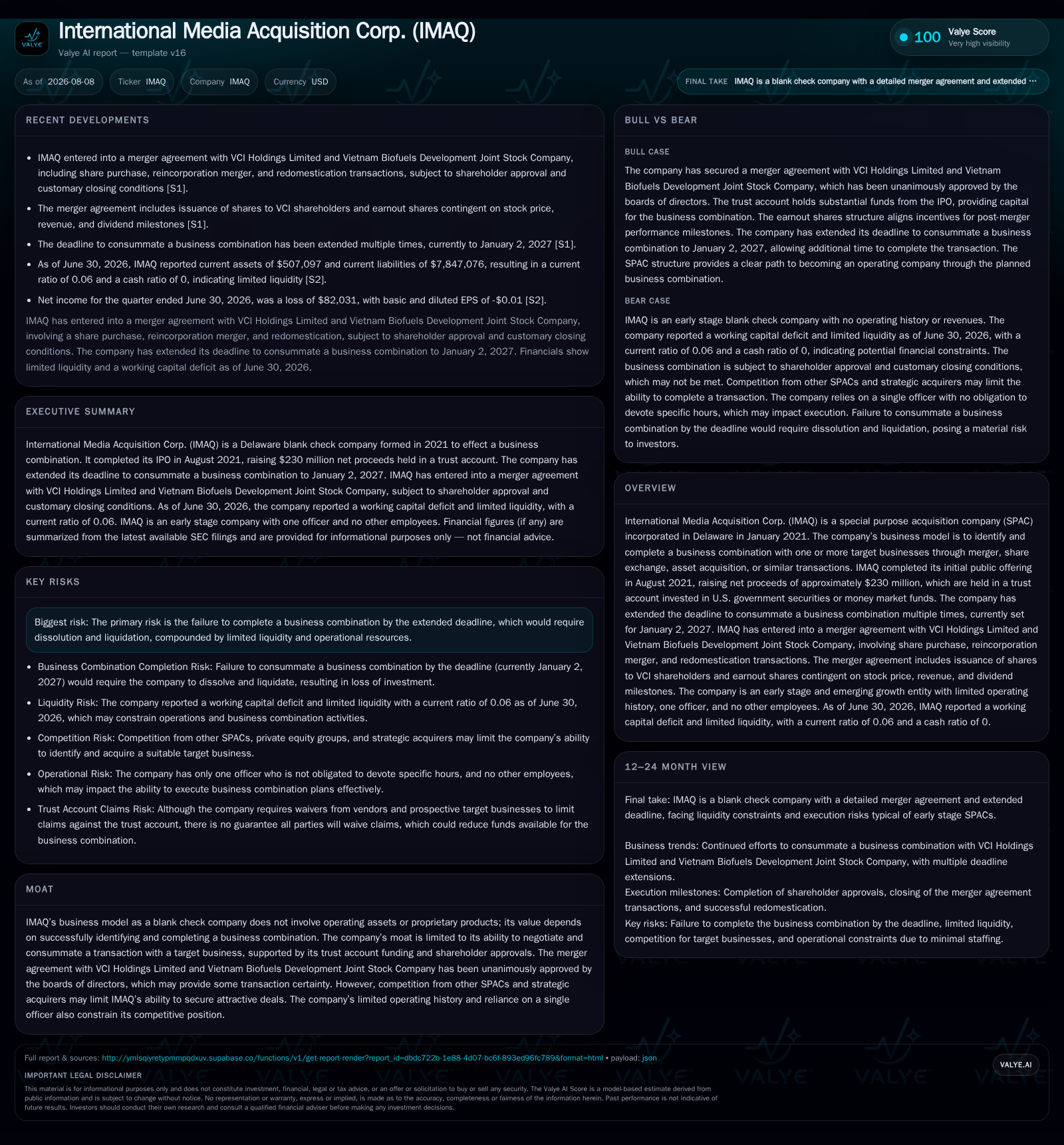
International Media Acquisition Corp. (IMAQ) is a Delaware-based blank check company that raised approximately $230 million through its 2021 IPO, held in a trust account invested primarily in U.S. government securities. As of Q2 2026, it remains focused on completing a business combination with VCI Holdings Limited and Vietnam Biofuels Development Joint Stock Company, involving multi-jurisdictional merger and redomestication transactions. Multiple deadline extensions, now set for January 2, 2027, reflect the operational and regulatory complexities typical of SPACs targeting foreign entities. IMAQ faces execution risks related to limited liquidity outside the trust, sponsor concentration, regulatory uncertainty, and competitive pressures within the SPAC ecosystem.
Recent Operating Update
International Media Acquisition Corp. (IMAQ) reaffirmed in its August 7, 2026 quarterly report (10-Q) that there have been no material changes to its risk factors while maintaining focus on completing its business combination with VCI Holdings Limited and Vietnam Biofuels Development Joint Stock Company [S2]. This transaction involves a share purchase combined with reincorporation merger and redomestication steps across Delaware, British Virgin Islands (BVI), and Vietnamese jurisdictions [S17], [S19]. The company has incrementally extended the deadline to consummate this combination from August through September 2026 to now January 2, 2027 [S20], [S22]. These repeated extensions underscore the execution challenges inherent in cross-border SPAC mergers involving private foreign companies.
Business Model Analysis
IMAQ operates as a blank check company that raised net proceeds of approximately $230 million through its August 2021 IPO by issuing units composed of common stock and warrants [S1]. These proceeds are held in a trust account invested primarily in short-duration U.S. government securities or money market funds to preserve capital until deployment [S1], [F1]. Unlike traditional operating companies, IMAQ generates no revenue streams pre-combination; value accrual depends entirely on management’s ability to identify an attractive target and close a business combination within mandated timelines.
The SPAC structure provides investors downside protection via trust account capital preservation if no deal closes but introduces dilution risk from warrants and earnout share issuances contingent on future equity price or financial performance milestones post-merger [S19]. Operating losses continue due to administrative expenses including legal compliance, advisory fees, and proxy solicitation costs.
Industry Structure and Competitive Position
SPACs serve as financial intermediaries facilitating faster public listings for private companies compared to traditional IPOs but operate under strict time constraints—usually two years from IPO to deal completion before forced liquidation. Larger peers such as Pershing Square Tontine Holdings (PSTH) benefit from substantial sponsor backing and high-profile deal flow, whereas IMAQ’s emerging growth profile coupled with a focused sponsor team places it at relatively higher execution risk.
Targeting foreign private companies adds layers of complexity due to jurisdictional regulatory limitations. For example, SEC guidance highlights restricted inspection rights over Chinese or certain foreign audits under laws like China’s Article 177, limiting transparency for U.S. investors [S1]. IMAQ’s pending acquisition of BVI-registered VCI Holdings and Vietnam ethanol producers exemplifies these cross-border challenges that can extend diligence timelines and complicate approvals.
Sponsor concentration with primary decision-making vested in one officer further constrains competitive agility compared to more diversified SPAC management teams capable of broader deal sourcing.
Growth Drivers
IMAQ’s growth is predicated on successfully closing its business combination within the currently extended deadline. Key drivers include:
- Timely Deal Closure: Avoiding liquidation enables transformation into an operating public company with potential equity appreciation.
- Sponsor Deal Sourcing: Ability to secure high-quality foreign assets positioned in emerging markets like Vietnam's ethanol sector could enhance post-merger appeal.
- Regulatory Success: Navigating multi-jurisdictional approvals efficiently reduces uncertainty around transaction timing.
- Shareholder Support: Positive vote outcomes provide validation critical for transaction completion.
- Post-Merger Capital Access: Availability of PIPE financing could support growth scaling after closing.
These factors align with broader industry trends where SPACs respond to private company demand for alternative public listing routes amid evolving market conditions.
Risks and Watchpoints
Investors should carefully monitor several key risks:
- Deadline Risk: Failure to finalize the merger by January 2, 2027 triggers liquidation of trust proceeds less expenses—yielding no operating assets or strategic upside.
- Liquidity Constraints: With current assets of approximately $507 thousand against current liabilities near $7.8 million as of June 30, 2026, operational cash is severely limited outside the trust account [F1].
- Jurisdictional Regulatory Limitations: Foreign ownership structures limit SEC oversight capabilities, raising due diligence complexity.
- Sponsor Concentration: Overlapping fiduciary duties may constrain aggressive deal sourcing or introduce conflicts [S1].
- Market Sentiment & Dilution: Investor skepticism toward warrant dilution and earnout share contingencies can pressure valuation post-merger.
- Competitive Landscape: Other financially stronger SPACs or strategics may outbid or disrupt target acquisitions.
- Regulatory Environment: Heightened scrutiny over SPAC structures could delay approvals or restrict financing terms post-closing.
These variables present significant execution risks that can materially affect transaction outcomes.
What To Watch Next
Critical near-term milestones include:
- Shareholder Vote Results: Approval rates will indicate investor confidence ahead of closing.
- Regulatory Clearance Progress: Timely approvals from authorities across involved jurisdictions validate deal feasibility.
- Merger Closing Date Updates: Any deadline changes signal negotiation dynamics or emerging risks.
- Post-Merger Equity Performance: Market reception relative to trust values informs investor sentiment.
- PIPE Financing Announcements: Additional capital commitments post-merger will influence growth prospects.
Upcoming proxy filings and special shareholder meetings will be pivotal information sources for these developments.
Financial Profile Discussion
While IMAQ retains substantial capital within its trust account (~$230 million net IPO proceeds), its reported current assets total roughly $507 thousand against current liabilities near $7.8 million as of June 30, 2026—reflecting tight operational liquidity beyond the trust vehicle [F1]. Total debt approximates $3 million per the latest available data [F1], suggesting modest leverage levels relative to overall capitalization but notable given limited operating cash flow. Persisting net losses reflect continuing pre-combination expenditures without revenue generation [F1]. This financial snapshot highlights the narrow runway management faces to consummate the business combination before incurring critical liquidity stress.
In conclusion, International Media Acquisition Corp. typifies a smaller-scale SPAC navigating complex cross-border merger execution amid extended deadlines, sponsor concentration risks, liquidity constraints, and regulatory challenges specific to foreign targets. Its trajectory hinges on successful closure within narrow timeframes balanced against evolving external uncertainties—a dynamic emblematic of many contemporary blank check vehicles striving for constructive public market entry through alternative capital formation mechanisms.
This analysis synthesizes disclosures from IMAQ's SEC filings through August 7, 2026 ([S1], [S2], [S3]) combined with sector norms applicable to SPAC industry dynamics without offering investment advice or forecasts. It emphasizes structural factors fundamental for understanding SPAC transaction mechanics amid heightened regulatory scrutiny and geopolitical complexities inherent in targeting emerging-market energy assets.
Disclaimer: This is research-only, informational analysis and not investment advice. It may include AI-generated interpretation and general industry context. Always verify important details using primary sources.

Comments