
RF Acquisition Corp II Advances Asia Deep Tech De-SPAC with Nanyang Biologics Merger
RF Acquisition Corp II progresses toward closing its targeted business combination in Asia’s deep technology sector marked by a strategic merger agreement with Nanyang Biologics.
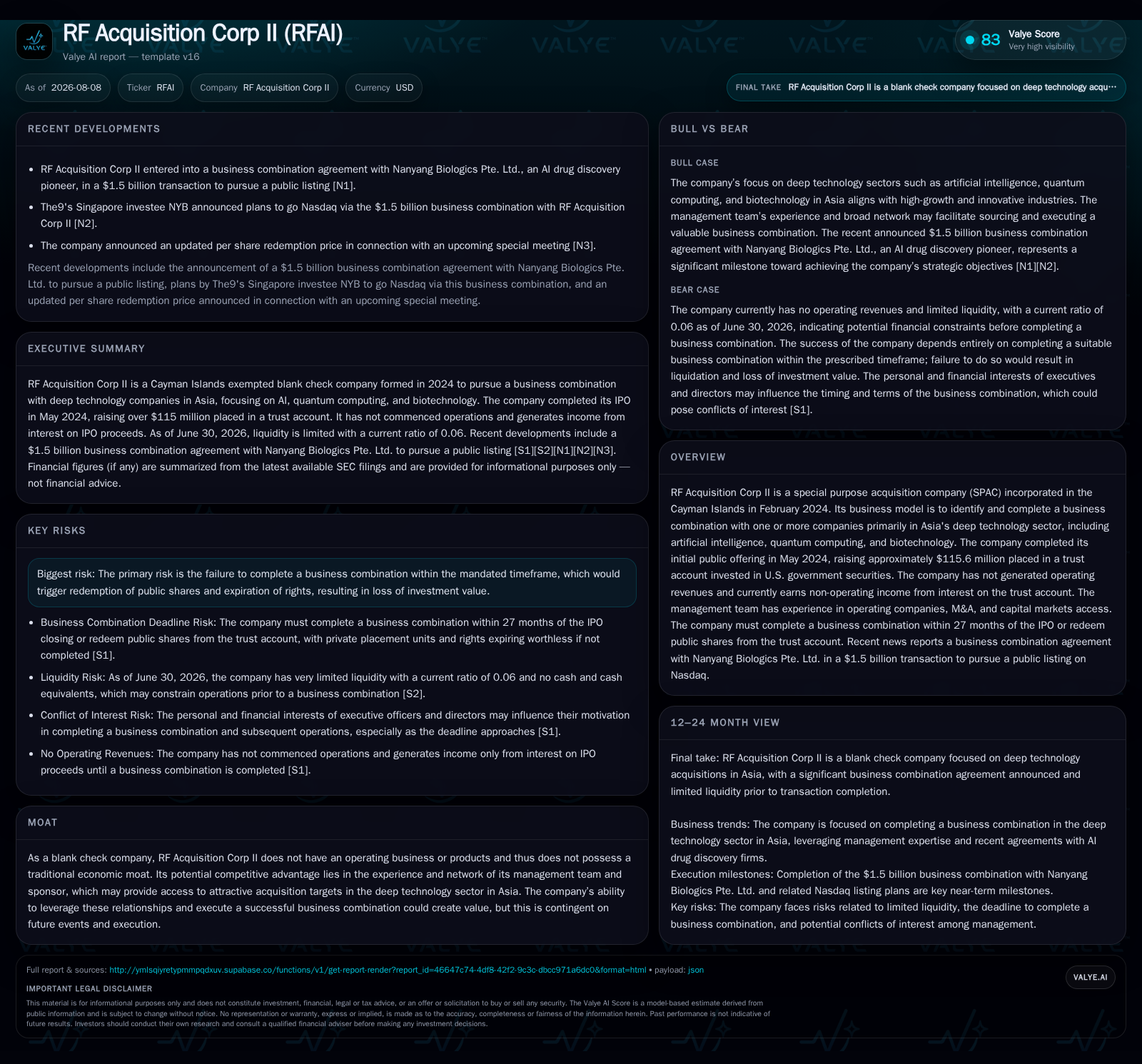
RF Acquisition Corp II, a Cayman Islands-based SPAC focusing on deep tech businesses in Asia, notably AI, quantum computing and biotech, is moving closer to completing a business combination through an agreement to merge with Nanyang Biologics. The SPAC raised approximately $115.6 million in its May 2024 IPO, placing proceeds into a trust account earning interest as its primary income to date. Following shareholder approval to extend the deadline for combination completion, the company is on track to finalize its de-SPAC transaction. Key risks remain around timing and shareholder redemption, but management’s operational experience and sector focus provide a defined pathway toward value creation.
Recent Operating Update
RF Acquisition Corp II’s latest quarterly filing dated August 7, 2026 confirms critical progress toward consummating its initial business combination through a merger agreement executed on October 2, 2025 with NYB Holdings Limited (PubCo) and Nanyang Biologics Pte. Ltd., a Singapore-based biopharmaceutical enterprise focused on deep technology applications within biotechnology [S2][S1]. This agreement contemplates RF Acquisition Corp II merging into PubCo, followed by an amalgamation of PubCo’s wholly owned subsidiary with Nanyang as the surviving entity. The resultant combined entity aims to leverage RF Acquisition's capital market access to bring scale and public market liquidity to the target.
Notably, shareholders approved multiple extension rights in an extraordinary general meeting held November 10, 2025 allowing for up to nine one-month extensions beyond the mandatory 27-month de-SPAC period at inception, substantially reducing risk of forced liquidation due to deadline expiry [S1]. Concurrently, redemption activity saw holders of approximately 6.67 million shares exercise redemption rights against the trust account leading to $71.6 million withdrawal from trust funds which previously held $115.6 million post-IPO proceeds minus fees—this capital dynamic shapes the deployment and working capital available for post-combination operations [S23][S8].
The company has no operating revenues as expected for a blank check vehicle; all income through December 31, 2025 stemmed from interest earned on the trust account ($4.62 million) net of operational costs ($1.26 million), resulting in net positive income driven primarily by passive interest income on protected cash holdings [F1][S12]. The balance sheet reflects negligible cash outside the trust ($0 as of June 30, 2026), limited current assets relative to liabilities (current ratio ~0.06), emphasizing the centrality of trust account proceeds for liquidity during this phase [F1].
Business Model
As a Special Purpose Acquisition Company (SPAC), RF Acquisition Corp II operates as a blank check entity purpose-built to raise funds via IPO and subsequently acquire or merge with a private company—in this case targeting businesses operating within Asia's burgeoning deep technology sectors (AI, quantum computing, biotech). The monetization strategy hinges entirely on successfully effecting this business combination wherein public shareholders receive share exchange consideration backed by funds held in trust plus equity stake in merged enterprise.
Revenue generation is currently non-existent pending de-SPAC completion; income arises solely from interest accrued on invested IPO proceeds secured under strict regulatory provisions protecting shareholder capital pre-merger [S1][S12]. The company bears acquisition-related expenses for target evaluation including due diligence meetings with management teams of prospective targets, financial analysis, travel, legal fees, and deal structuring costs—all funded by balances outside the trust account sourced from sponsor contributions or advances
Post-merger metrics such as operating revenues and margins will depend entirely on the target company's profile—in this context Nanyang Biologics operates within biotechnology where product pipelines and R&D cycles are lengthy but offer high barriers to entry and aggregation synergies. Operational leverage post-acquisition can arise through enhanced production capabilities or new product development enabled by combined financial strength.
Industry Structure and Competitive Position
Within the SPAC ecosystem focused on Asian deep technology sectors—which blend frontier scientific research with scalable commercial applications—RF Acquisition Corp II occupies a niche characterized by high technical complexity. Competitors include other blank check vehicles such as Churchill Capital Corporation IV or Social Capital Hedosophia which have also targeted innovative industries and geographic adjacency but differ in scale of proceeds raised, management pedigree, or target subsector specificity.
SPACs play an intermediary role bridging private firms desiring accelerated public market access without traditional IPO challenges against investor appetite for high-growth tech exposure via liquid instruments. Differentiation constraints here hinge heavily on management team expertise—the ability to source proprietary deals leveraging existing networks within Asian tech hubs—and execution capability amid regulatory scrutiny.
RF Acquisition's explicit exclusion of China-based variable interest entity (VIE) structures addresses structural compliance risks increasingly scrutinized by U.S. regulators—a notable strategic filter compared with peers less restrictive on geographies [S1][S9]. This focus aligns with heightened market caution around complex cross-border ownership structures while concentrating on Singapore-headquartered or regionally headquartered firms like Nanyang Biologics.
Growth Drivers
Key growth drivers lie principally in successful deal consummation unlocking access to high-potential Asian tech innovators in AI/quantum/biotech verticals backed by rising regional R&D investments and favorable population demographics endorsing biotech demand growth. Management explicitly emphasizes leveraging their operational expertise paired with sponsor-backed deal sourcing networks as competitive advantages forming a pipeline of promising acquisition candidates [S1].
Investor interest in alternative public listing mechanisms bolsters liquidity prospects for SPACs pursuing niche sectors overshadowed by conventional IPO volatility—consistent regulatory acceptance of SPAC frameworks further underpins transactional feasibility.
Dilution risk exists stemming from founder shares (~2.88 million) issued at nominal cost prior to IPO along with private placement units—a common SPAC structure potentially diluting pro forma equity stakes notwithstanding lock-up agreements voted favorably by insiders ensuring alignment during initial governance phases [S13][S28]
Regulatory risk also persists especially related to potential future SEC interpretations affecting SPAC structures broadly including accounting treatment or disclosure obligations that might alter perceived economic fairness or operational transparency.
Market volatility may affect share prices triggering unpredictable redemption rates complicating deal financing scenarios if investor confidence wavers post-announcement.
Post-merger integration risks include aligning corporate cultures between US-listed entities and Asian operational subsidiaries managing complex technologies requiring sustained R&D investment alongside commercialization resource prioritization—a challenge relevant given biotechnology’s long gestation cycles.
What To Watch Next
Milestones crucially center upon securing final shareholder approvals if any voting is pursued (discretionary per management), completion of definitive merger steps with regulatory bodies across involved jurisdictions—Singapore authorities relating to Nanyang Biologics as well as Nasdaq compliance—and effective deployment of remaining trust proceeds as working capital plus potential follow-on acquisitions enhancing growth trajectories.
Key demand markers will include ongoing updates regarding due diligence outcomes particularly whether any material adverse findings emerge delaying merger signing or closing schedules.
Monitoring redemption rates leading up to transaction closure offers insights into investor sentiment; elevated redemptions could pressure renegotiations or financing arrangements impacting equity distribution ratios.
Management communications evidencing progress on operational integration planning post-close signal readiness levels distinguishing quality deal execution poised for sustainable long-term shareholder value creation versus speculative merger announcements common among SPAC peers.
Financial Profile Discussion
Net income reported as positive primarily derives from earned interest income offsetting operating costs related strictly to administrative offices and due diligence activities supporting prospective acquisitions; no revenue stream exists pending business combination completion consistent with standard SPAC profiles prior to de-SPAC events [F1][S12]
The company carries no debt reflecting conservative capital structure historically preferring equity-funded progression toward merger milestones; deferred underwriting fees remain part of outstanding liabilities servicing transaction cost obligations but anticipated settlement correlates with eventual business combination closing [F1]
Management’s prudent cost control evidenced by sub-$2 million annual operating expenses relative to locked-in funds supports an extended runway sustaining ongoing acquisition search efforts without immediate recourse to dilutive capital raises or debt issuance absent unforeseen contingencies.
Disclaimer: This is research-only, informational analysis and not investment advice. It may include AI-generated interpretation and general industry context. Always verify important details using primary sources.

Comments