
Impact BioMedical's Merger Reshapes Clinical Innovation Amid Liquidity Challenges
Impact BioMedical's reverse merger with Dr Ashleys Limited aims to expand its R&D pipeline and innovation capabilities, but the company faces significant liquidity constraints that pose operational risks.
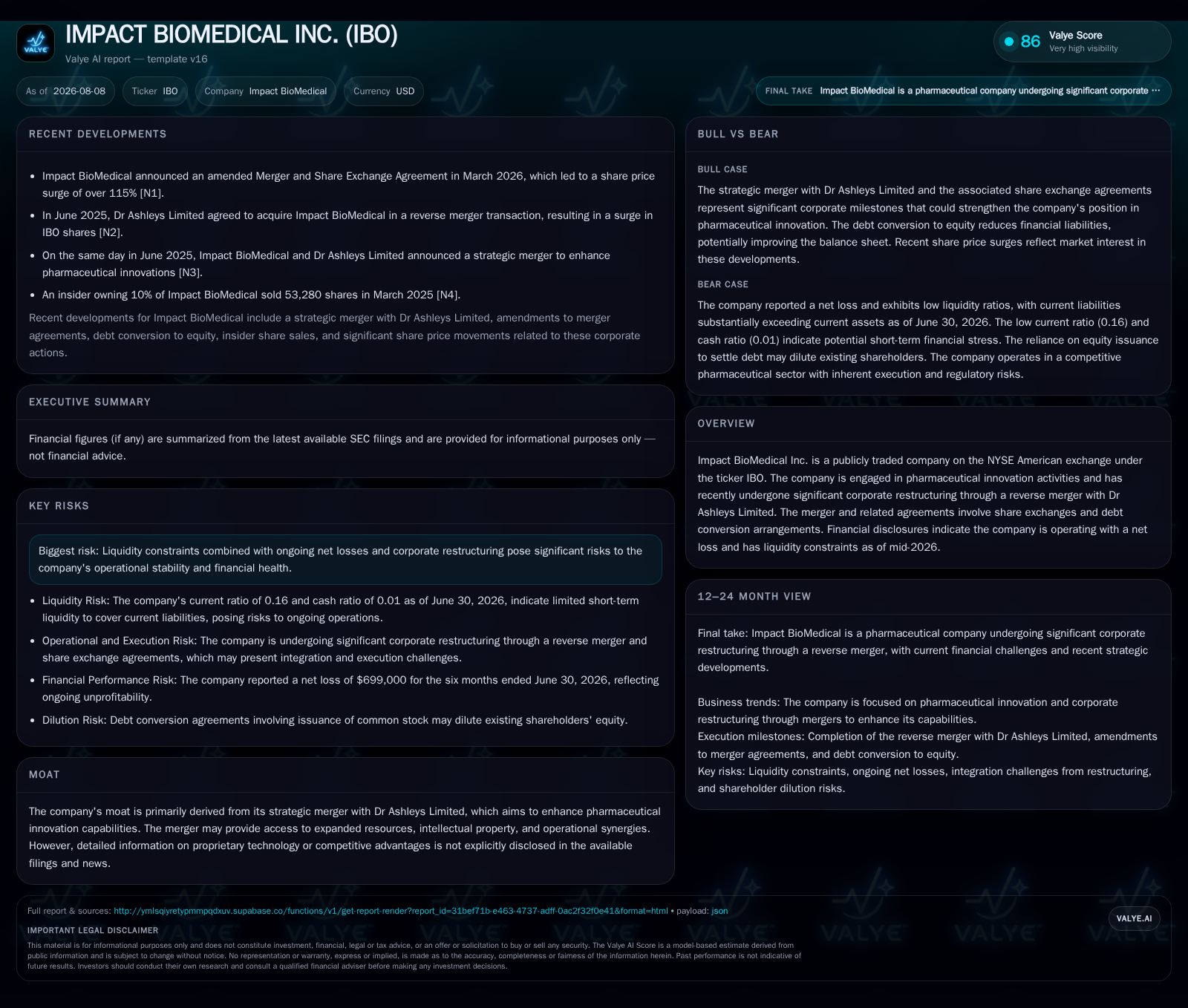
Impact BioMedical's 2026 Q2 filing details a strategic merger with Dr Ashleys Limited designed to enhance its pharmaceutical innovation platform and pipeline depth. Despite this, the company continues to grapple with severe liquidity pressures, reflected in a current ratio of 0.16 and persistent net losses, typical challenges for mid-stage biotech firms reliant on capital-intensive clinical development. Growth hinges on clinical milestone achievements and regulatory approvals, but execution risks remain elevated amid financial strain and integration complexities.
Operational Transformation Following the Dr Ashleys Merger: Implications for R&D Pipeline Expansion
Impact BioMedical’s August 2026 quarterly report highlights a pivotal operational shift resulting from its reverse merger with Dr Ashleys Limited completed in 2025 [S1][S2]. This transaction integrates Impact’s existing research infrastructure with Dr Ashleys’ intellectual property portfolio and operational assets within pharmaceutical innovation. Such consolidation is a strategic move common among mid-stage biotechnology firms seeking to deepen their R&D pipelines and diversify therapeutic candidates to accelerate drug development efforts. While specific proprietary technologies remain undisclosed publicly, this expanded platform likely increases the number of active clinical trials and broadens the scope of therapeutic targets under investigation.
Governance restructuring accompanying the merger includes share exchanges and board realignments that reflect a material change in corporate control [S21][S22]. These changes are designed to align management incentives with the enlarged organization’s innovation objectives. However, limited disclosure on pipeline quality or clinical stage progression constrains definitive assessment of competitive positioning. The company’s ability to integrate merged assets efficiently while maintaining R&D productivity will be critical for realizing expected synergies common in peer biotech mergers.
Financial Strain and Liquidity Risk: Current Ratios and Cash Burn Pressures Capping Growth Potential
As of June 30, 2026, Impact BioMedical reported current assets of approximately $320,000 against current liabilities exceeding $2 million, yielding a critically low current ratio of 0.16 indicative of significant short-term solvency risk [F1]. The reported cash & equivalents balance was minimal at $20,000 as of March 2026 [F1], underscoring an urgent dependence on external financing sources or milestone-triggered payments for sustaining expensive multi-year clinical programs. Without fresh capital infusion or effective cost management strategies, there is heightened risk that critical pipeline advancement could be delayed or curtailed. These liquidity pressures also increase vulnerability to restructuring risks that may disrupt operational continuity [S11].
R&D Investment Focus during Limited Revenue Streams: Understanding Impact BioMedical’s Innovation Economy
Operating as a typical clinical-stage biotech firm, Impact BioMedical relies predominantly on continuous R&D expenditure rather than product sales revenue at this stage. According to annual disclosures [S1], the company’s revenue streams are largely milestone-based—dependent on achieving key developmental milestones or entering licensing agreements with commercial partners. Such monetization is contingent upon successful regulatory approvals but generally unfolds over extended timelines.
This model requires sustained upfront investment in activities ranging from preclinical toxicology studies through multiple phases of clinical trials aimed at securing FDA approval. Success is measured by increasing numbers of active trials progressing through preclinical to late-stage phases alongside regulatory submission achievements—milestones that can materially improve valuation and investor confidence.
Competitive Context: Positioning Within Mid-Stage Biotech Players Leveraging M&A Strategies
Impact BioMedical’s merger-driven growth approach situates it within a competitive landscape where mid-sized biotech companies augment internal pipelines via acquisitions to maintain innovation momentum amid lengthening R&D cycles. Larger peers such as Amgen exemplify how mergers can supplement internal discovery with external assets effectively.
Nonetheless, integration risks such as talent retention issues, intellectual property alignment complexities, and cost overruns are significant concerns explicitly acknowledged in the company’s risk disclosures [S5]. Unlike larger industry players capable of absorbing such risks through scale advantages, Impact faces tighter capital constraints that amplify operational sensitivity until its combined pipeline demonstrates commercial viability.
Critical Growth Catalysts: Clinical Trial Progression, Regulatory Milestones, and Licensing Visibility
Near-term value creation depends heavily on advancing merged pipeline candidates through clinical stages while securing necessary regulatory approvals [S2]. Achieving these milestones enables milestone payment inflows that can alleviate cash flow pressures and reduce reliance on dilutive financing rounds. Establishing licensing collaborations further supports non-dilutive funding avenues and expedites market access.
Industry standards underscore frequent milestone achievements as pivotal valuation drivers; thus stakeholders should closely track announcements regarding trial initiations or completions alongside FDA submission progress [S1][S2]. Although disclosure clarity remains limited currently, forthcoming regulatory filings will provide enhanced visibility into development trajectory
Threats Along the Path: Restructuring Risks Coupled with Regulatory and Funding Uncertainties
Impact BioMedical confronts multiple risk factors impacting its fragile operating condition. Its extensive risk disclosures highlight potential consequences from fluctuating cash availability leading to program delays or downsizing; regulatory setbacks including non-approvals; intellectual property disputes; litigation exposures; and market acceptance challenges post-commercialization [S4][S5][S11]
Additionally, recent merger-related integration complexities—including share conversion arrangements and debt-to-equity swaps finalized in mid-2025—pose execution risks that could strain management bandwidth [S20][S26]. Failure to manage these factors effectively could exacerbate existing funding shortages compounded by minimal cash reserves documented into early 2026 [F1].
What Comes Next: Key Indicators to Monitor in Pending Approvals, Financial Management, and Deal Execution
For investors tracking Impact BioMedical’s progress, several upcoming events warrant close attention:
- Clinical trial readouts providing evidence of efficacy or safety progression,
- Receipt of milestone payments linked to licensing deals or partnership agreements,
- Announcements regarding new capital raises or refinancing efforts enhancing liquidity,
- Updates on regulatory filings such as IND (Investigational New Drug) applications or NDA (New Drug Application) submissions,
- SEC disclosures detailing progress on completing merger integration or additional restructuring actions [S2][S1]. These indicators collectively offer insights into whether the company can sustain its innovation momentum amid financial headwinds.
Financial Profile Discussion: Supporting Analysis of Balance Sheet Health and Operating Losses
Financially, Impact BioMedical’s position reflects typical challenges for early-stage biopharma without steady product revenues. The severely depressed current ratio (0.16) signals immediate solvency concerns given short-term obligations over $2 million against modest liquid assets totaling roughly $320,000 including about $20,000 cash equivalents as of March 2026 [F1]. Effective cash management alongside timely achievement of developmental milestones triggering payments is essential for extending operational runway.
This analysis synthesizes Impact BioMedical’s recent filings highlighting a transformative merger designed to bolster its pharmaceutical innovation capacity juxtaposed against pronounced financial vulnerabilities typical within high-risk biotech sectors. The company’s future trajectory hinges on successfully leveraging combined R&D assets while navigating tight liquidity constraints through imminent operational milestones.
The foregoing content is based solely on public data available as of August 2026 without constituting investment advice.
Disclaimer: This is research-only, informational analysis and not investment advice. It may include AI-generated interpretation and general industry context. Always verify important details using primary sources.

Comments