
Cytek Biosciences Advances High-Dimensional Cell Analysis with Strong Quarterly Revenue Amid Ongoing Investment
Q2 results highlight growing adoption of Cytek’s spectral cytometry instruments powered by proprietary fluorescence profiling technology, balanced by margin pressures from R&D and supply chain challenges.
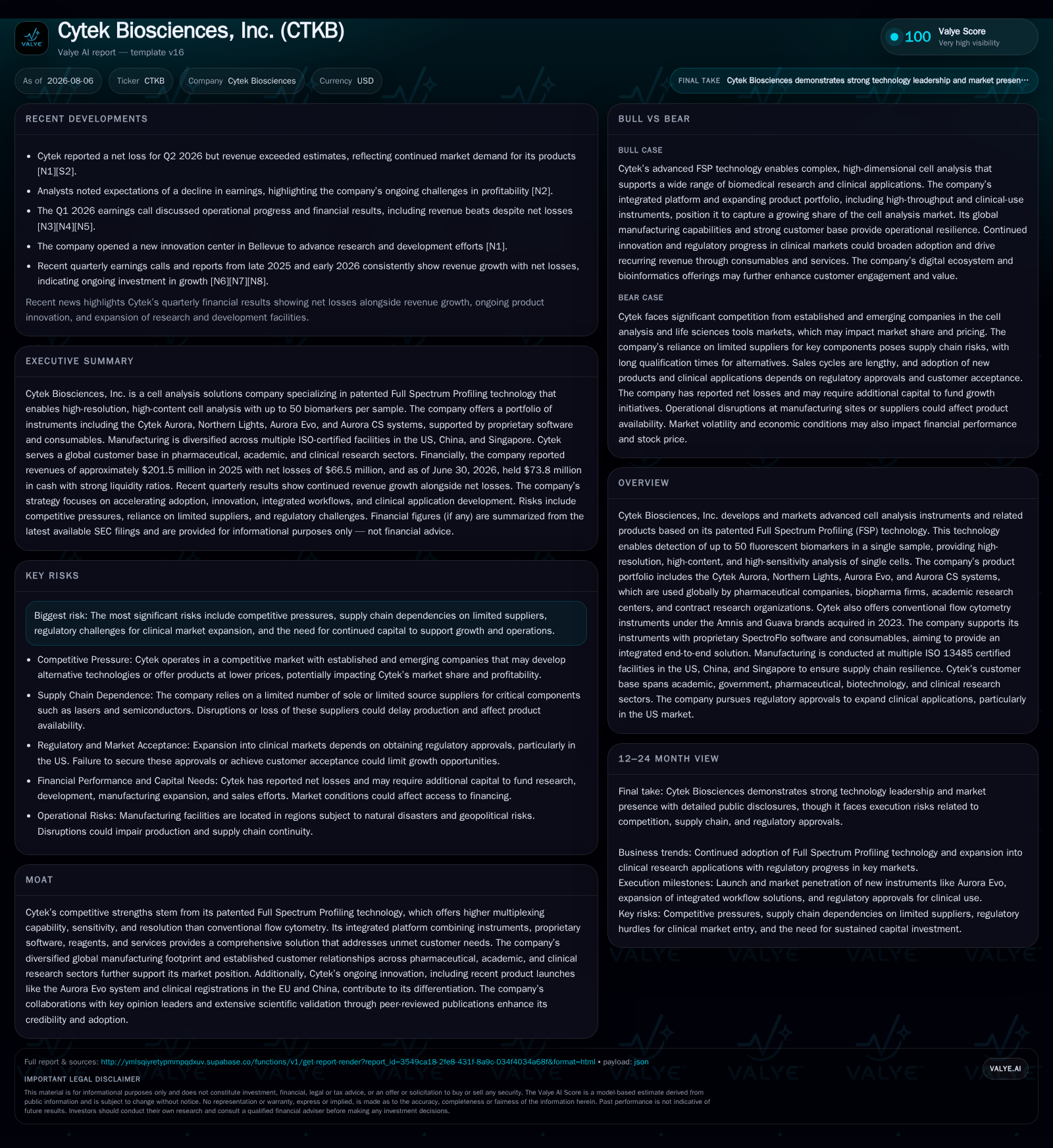
In Q2 2026, Cytek Biosciences exceeded revenue expectations driven by robust sales of its Full Spectrum Profiling-based cytometry instruments. Despite this growth, the company reported a net loss due to elevated research and development spending and supply chain cost pressures affecting margins. Cytek’s integrated platform approach, combining advanced instrumentation with proprietary software and consumables, supports expanding recurring revenue streams across pharmaceutical, academic, and clinical research segments. Key execution risks include regulatory complexities, competitive intensity from established incumbents, elongated institutional sales cycles, and capital requirements for scaling manufacturing and global expansion.
Q2 2026 Performance Reflects Growing Demand for Advanced Spectral Cytometry
Cytek Biosciences’ Q2 2026 disclosures confirm robust revenue growth driven by heightened demand for its flagship cell analysis instruments employing patented Full Spectrum Profiling (FSP) technology [S2], [S3], [N1]. While specific revenue figures are not detailed here, the company’s ability to exceed market expectations underscores accelerating adoption among pharmaceutical developers, biopharma companies, academic research labs, and contract research organizations (CROs). This installed base growth is critical in this sector as it lays the foundation for recurring revenue from consumables and software licenses.
Despite top-line strength, Cytek reported operating losses reflecting substantial investments in research and development alongside margin pressures stemming from supply chain cost increases and shifts in product mix [S2]. This financial profile aligns with an innovation-driven business model prioritizing platform enhancement and application breadth. The tension between driving rapid growth while managing near-term profitability is characteristic of emerging life sciences instrumentation firms.
Proprietary Full Spectrum Profiling Technology Drives Differentiation
Cytek’s core technological advantage lies in its patented FSP approach that captures the full spectrum of fluorescence emissions via a compact detector array optimized for sensitivity and resolution [S1]. This design enables simultaneous measurement of up to 50 fluorescent biomarkers within a single sample tube—far exceeding the multiplexing capacity of traditional flow cytometers that typically handle fewer parameters with reduced sensitivity. Such high-dimensional capability is crucial for complex single-cell analyses including immunophenotyping rare populations and biomarker discovery.
The hardware platform is complemented by Cytek’s proprietary embedded SpectroFlo software which facilitates assay development, data acquisition, and sophisticated high-dimensional data analytics [S1]. This integrated ecosystem creates a competitive moat by coupling instrument sales with recurring revenues from reagent consumables and ongoing software updates—enhancing customer retention through increased switching costs.
Diversified Multi-Segment Customer Base Navigates Extended Sales Cycles
Cytek serves a broad set of customers including pharmaceutical companies focused on drug discovery, biopharma firms developing biologics, academic institutions conducting basic biological research, and CROs providing outsourced services [S1], [S2]. Each segment exhibits distinct procurement behaviors that contribute to lengthy sales cycles characteristic of capital equipment in the life sciences industry.
Though protracted approval processes can delay revenue recognition over multiple quarters, serving diverse end markets mitigates concentration risk. Pharmaceutical clients prioritize high multiplexing capability to accelerate immunotherapy pipelines; academics contribute incremental demand growth through expanded reagent consumption tied to existing installed bases.
Supply Chain Dependencies Pose Near-Term Operational Risks
The company identifies reliance on certain single or sole source suppliers for critical components as a key operational risk impacting manufacturing scalability and gross margins [S1]. While Cytek maintains ISO 13485-certified manufacturing facilities across multiple locations—ensuring adherence to quality standards required for clinical market access—the dependence on limited suppliers introduces potential bottlenecks that could disrupt order fulfillment or elevate input costs.
Addressing these vulnerabilities is essential to sustaining growth momentum; potential mitigation strategies include qualifying alternate suppliers or increasing inventory buffers, albeit at the expense of working capital efficiency.
Innovation Pipeline and Market Expansion Underpin Growth Prospects
Cytek continues to expand its product portfolio beyond the original Aurora system with recent introductions such as the Aurora Evo platform designed for higher throughput applications [S1]. Concurrently, clinical registrations achieved in regulated markets including the European Union and China mark significant steps toward penetrating diagnostic segments where reimbursement frameworks can support durable revenue streams.
Geographic diversification reduces dependency on any singular market while tailoring products to comply with varying regulatory regimes. These initiatives complement organic growth drivers by enabling entry into emerging life sciences hubs globally.
Regulatory Certifications Enhance Clinical Adoption Potential
Compliance with FDA regulations along with international quality management standards such as ISO 13485 underscores Cytek’s commitment to rigorous manufacturing controls foundational for medical device commercialization [S1]. These certifications facilitate market access while raising barriers to entry against competitors.
Navigating complex regulatory pathways entails upfront costs but positions the company favorably as industry trends shift toward integrating diagnostic applications alongside traditional research uses. Successful clearances can broaden total addressable markets through enhanced clinical adoption.
Competitive Landscape and Execution Risks Remain Material Challenges
Despite technological leadership via FSP innovation, Cytek confronts intense competition from established incumbents like BD Biosciences and Thermo Fisher Scientific offering comprehensive flow cytometry platforms supported by extensive reagent portfolios [S4], [S5]. These competitors benefit from entrenched customer relationships that may slow switching despite Cytek’s superior technical capabilities.
Additional risks include extended institutional sales cycles requiring sustained selling expenses; regulatory uncertainties potentially delaying product launches; dependence on capital markets for funding growth initiatives; intellectual property litigation common amid evolving instrument technologies; supply chain fragility; plus geopolitical factors such as tariffs impacting international operations.
Financial Profile Discussion: Strong Liquidity Supports Growth Investments
As of June 30, 2026, Cytek held $73.8 million in cash and equivalents against nominal total debt of approximately $246 thousand—reflecting a net cash position that provides ample liquidity to fund ongoing operations and strategic initiatives [F1]
Reported losses align with a growth-stage profile emphasizing R&D expansion and building out sales infrastructure necessary for international market penetration [S2]. Monitoring cash burn relative to revenue growth will remain critical alongside efforts to improve gross margins via supply chain optimization and expansion of higher-margin recurring revenue streams tied to consumables and software subscriptions.
This analysis synthesizes Cytek Biosciences’ most recent quarterly disclosures within the context of its differentiated spectral cytometry platform business model serving pharmaceutical, academic, biopharma, CROs, and clinical diagnostics segments. The company exemplifies typical life sciences instrumentation dynamics balancing innovation-led top-line growth against investment-driven margin pressures amid a complex competitive environment dominated by legacy players. Key execution risks include managing elongated institutional sales cycles, mitigating supplier concentration risks in manufacturing, navigating evolving regulatory landscapes especially for clinical applications, defending intellectual property rights amid industry litigation trends, and securing sufficient capital resources during scale-up phases. Investors should monitor metrics such as instrument unit volumes sold, consumable uptake rates indicating recurring revenue traction, geographic expansion progress particularly clinical approvals outside the US, gross margin trends reflecting easing supply constraints or improved product mix economics, plus pipeline advancement milestones or strategic partnerships enhancing sustainable differentiation.
Disclaimer: This is research-only, informational analysis and not investment advice. It may include AI-generated interpretation and general industry context. Always verify important details using primary sources.

Comments