
TriCo Bancshares Fortifies Growth and Tech Adaptation with Strong Q2 Amid Merger Plans
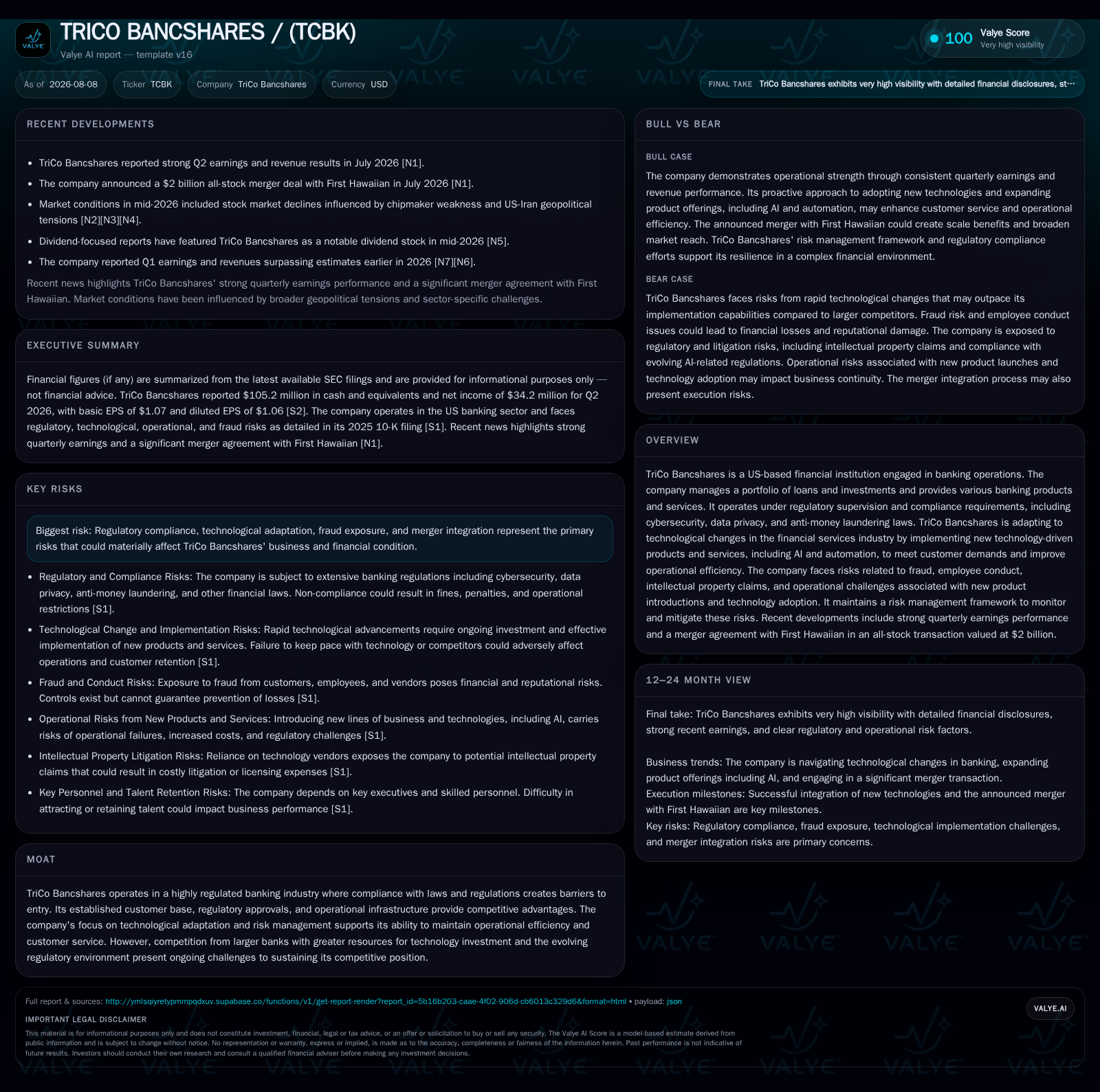
TriCo Bancshares reported robust second-quarter results reflecting sound loan growth and operational resilience while preparing for a $2 billion all-stock merger with First Hawaiian.
TriCo Bancshares delivered solid earnings and revenue in Q2 2026, benefiting from disciplined credit underwriting, steady deposit expansion, and effective cost management. The regional bank is actively investing in digital innovation to enhance customer experience and operational efficiency amid competitive pressures. Its pending merger with First Hawaiian positions it for increased scale in regional banking. Key risks include regulatory compliance, cybersecurity, and integration challenges as the company navigates evolving banking dynamics.
Recent Operating Update
TriCo Bancshares reported strong results for the second quarter ended June 30, 2026. Earnings surpassed market estimates, benefitting from continued loan portfolio expansion which rose from $6.77 billion at year-end 2025 to over $7.11 billion most recently [S2]. This growth was supported by disciplined credit underwriting focused on commercial real estate segments as well as agriculture loans. The company maintained a net interest margin (NIM) near 3.89%, indicating controlled funding costs despite a competitive deposit environment [S2]. Deposit balances grew to approximately $8.26 billion from $8.09 billion at the end of 2025, supporting loan growth while preserving liquidity ratios [S2]. These robust operating fundamentals underscore TriCo's ability to deliver profitable growth from core lending activities combined with stable interest income.
Additionally, TriCo disclosed its intention to merge with First Hawaiian Bank in an all-stock transaction valued at around $2 billion. This planned merger aims to enhance scale and market reach across the western U.S., leveraging First Hawaiian’s Hawaiian market presence alongside TriCo’s California base [S3], [N2]. While creating opportunities for cost synergies and cross-selling financial products, integration complexity poses near-term execution risk.
Business Model and Revenue Mechanics
TriCo Bancshares primarily generates revenue through net interest income derived from its loans portfolio balanced against interest paid on deposits and borrowings. The company extends various loans including commercial real estate (owner-occupied and non-owner occupied), agriculture loans, multifamily housing loans, and consumer loans secured by residential properties or home equity lines [S2]. Revenue rises when loan volumes increase or when net interest margins expand due to favorable funding costs or repricing.
Fee income supplements earnings via deposit account services, wealth management fees, and ancillary banking products. The branch network comprising traditional branches along with in-store locations acts as a critical distribution channel allowing personal relationships that support deposit gathering and loan referrals [S1]. Loan production offices extend outreach into key counties, intensifying origination efforts especially for commercial loans.
Cost structure includes personnel expenses linked to branch operations plus technology spend vital for maintaining competitive digital platforms. To cater to evolving customer behavior favoring online channels, TriCo is investing in automated banking tools including AI-driven services intended to reduce transaction costs over time while enhancing accessibility [S1]. Maintaining efficiency ratio below peer averages is central as the company balances legacy branch costs against digital innovation initiatives.
Industry Structure and Competitive Position
TriCo operates in the US regional banking industry concentrated on retail and commercial banking primarily within California’s diverse economy. Regional banks like TriCo act as intermediaries between local depositors and borrowers offering personalized services not always replicated by national banks or fintech entrants. However, competition is intense especially regarding pricing on both deposits and loans due to ample liquidity in the sector.
Peers such as Umpqua Holdings or Western Alliance Bancorporation compete on similar service breadth but often possess larger capital bases allowing heavier technology investment or M&A firepower. TriCo’s moderate scale limits rapid tech deployment but its well-distributed branch footprint combined with digital enhancements helps retain customer engagement.
Regulatory oversight imposes stringent capital requirements, anti-money laundering protocols, cybersecurity regulations, and disclosure mandates that shape operational risk frameworks across the industry [S4], [S12]. Maintaining compliance without sacrificing agility creates a strategic balancing act particularly as new laws around data privacy could necessitate additional system changes causing incremental expense.
Growth Drivers
Loan demand growth in California remains a key driver supported by stable economic conditions in its served counties which include large metropolitan centers such as Los Angeles, San Francisco, Sacramento plus agricultural communities like Fresno County [S1]. Diversified commercial real estate exposure benefits from ongoing urban development trends despite some cyclical real estate headwinds nationally.
Digital transformation investments underpin operational efficiency improvements enabling TriCo to attract younger customers preferring mobile-first banking while controlling branch network costs via selective consolidation or restructuring initiatives if needed [S1]. The recent acceleration of AI applications promises further gains in cost-to-serve reduction.
The pending merger with First Hawaiian constitutes a major strategic growth lever by expanding customer base geographically and product capabilities. Cross-selling opportunities post-merger could enhance fee income streams beyond traditional interest margins while providing scale benefits that lower per-unit cost of funds.
Furthermore, stable capital levels backed by strong internal cash flow generation allow continuation of dividend payouts and opportunistic share repurchases enhancing shareholder value under regulatory constraints. This capital flexibility supports measured organic growth alongside M&A activity [S6], [F1].
Risks and Watchpoints
Credit risk tied to borrower defaults remains a perennial concern especially given potential localized economic downturns affecting sectors like agriculture and commercial property. Though asset quality metrics are currently favorable with low non-performing assets ratios reported, any deterioration would pressure provisions impacting earnings negatively [S2], [S1].
Regulatory compliance risk is pronounced given evolving cybersecurity laws following TriCo’s cyber incident in early 2023 that temporarily disrupted systems and triggered legal inquiries. Failure to adapt promptly could result in fines or reputational damage that might impair funding access or customer trust long term [S4], [S12].
Technology adoption risk arises from competition wherein larger banks deploy advanced fintech-enabled platforms that raise customer expectations rapidly; lagging behind could cause erosion of deposit bases or slower loan originations contrasted with more digitally savvy rivals.
The complexity inherent in the announced merger with First Hawaiian carries integration risk encompassing cultural alignment, systems harmonization, retention of key personnel/customers, plus unexpected transaction costs that could dilute near-term financial performance.
Lastly, liquidity fluctuations driven by deposit mix changes or increased wholesale borrowing costs can influence net interest margins substantially given intensified competition for low-cost deposits within regional banking peers.
What To Watch Next
Primary focus will be on execution progress related to the First Hawaiian merger including regulatory approvals timeline, initial integration milestones such as leadership appointments, platform consolidation plans, cost synergy realization estimates provided by management during subsequent quarterly updates.
Operationally, monitoring credit quality indicators such as delinquency rates especially in commercial real estate fragments alongside actual versus expected loan loss provisions will provide early warning signals on credit stress.
In addition, tracking funnel metrics for new account openings via digital channels will help evaluate success of technology deployments aimed at capturing younger demographics shifting away from traditional branches.
Financial guidance updates incorporating merger-related expenses and synergy ramp-up will be critical to recalibrate earnings expectations versus prior standalone company forecasts detailed in recent filings [S3], [N1].
Financial Profile Discussion
TriCo Bancshares maintains strong liquidity evidenced by cash & equivalents totaling approximately $105 million as of June 30, 2026 — adequate for normal operating needs including potential incremental merger-related expenditures [F1]. Capital ratios exceed regulatory minima supporting dividend distributions without stress while reflecting prudent capital management practices ingrained since acquisitions completed earlier this decade have been successfully integrated leading to improved efficiency ratios near 57% — a modest improvement signaling disciplined expense management balanced against ongoing technology outlays [S6], [S2].
Disclaimer: This is research-only, informational analysis and not investment advice. It may include AI-generated interpretation and general industry context. Always verify important details using primary sources.

Comments