
Calumet Navigates Commodity Volatility With Diversified Specialty and Renewable Fuels Platform
Recent Q2 results highlight operational resilience amid feedstock price pressures and ongoing focus on de-leveraging.
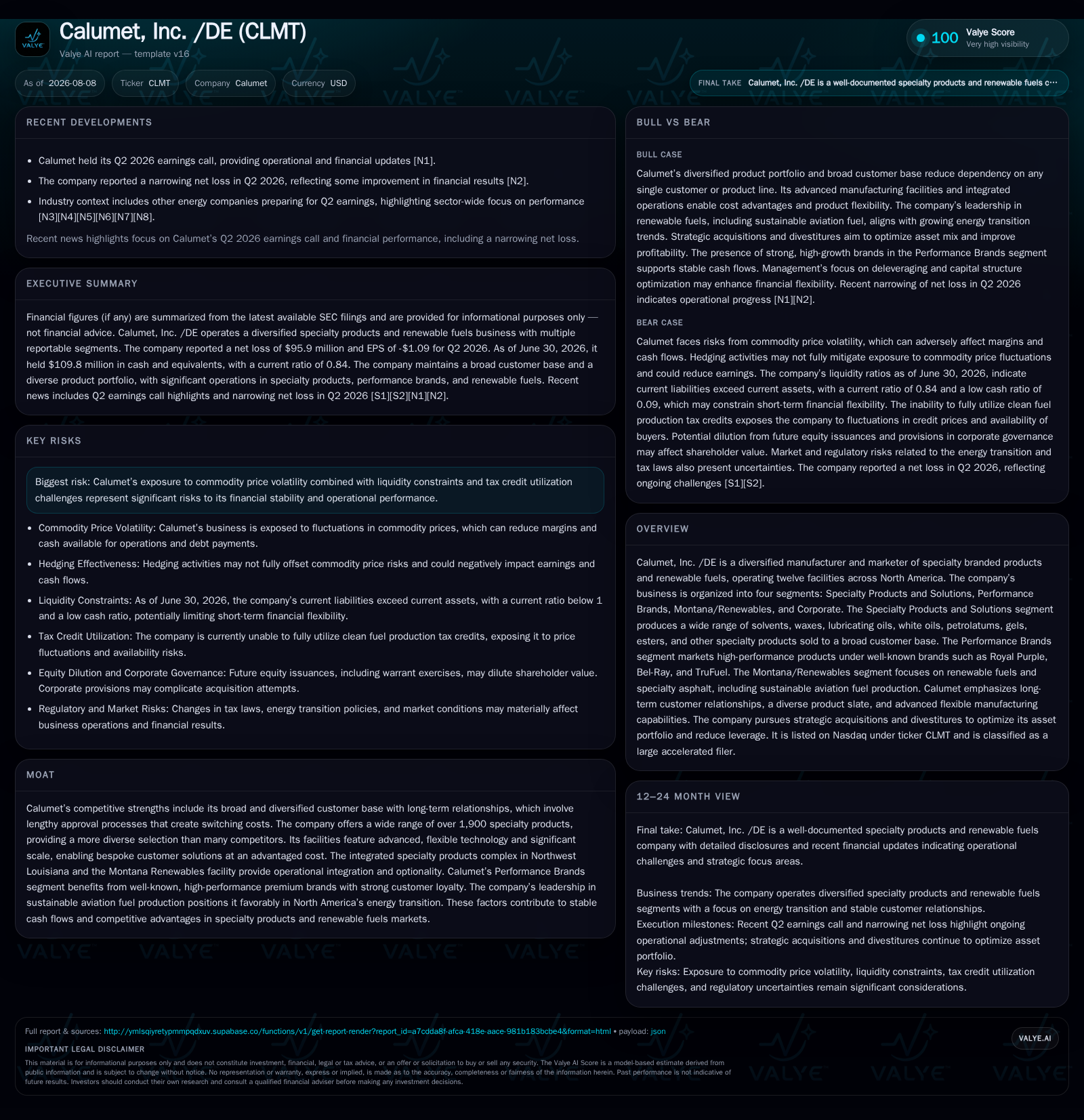
Calumet, Inc. reported second-quarter 2026 results reflecting the challenges of commodity price volatility yet benefiting from diversified product lines across specialty chemicals, branded lubricants, and renewable fuels. The company leverages its advanced manufacturing flexibility and long-established customer relationships to maintain stable cash flows despite cyclical headwinds. With a substantial debt load and a current ratio below 1.0, Calumet is prioritizing deleveraging while investing selectively in growth projects like sustainable aviation fuel expansion. Risks remain around feedstock cost fluctuations and tax credit utilization but its integrated asset base and market position in North American specialty products and renewables provide competitive strength.
Recent Operating Update Highlights
In the quarter ended June 30, 2026, Calumet reported operational pressures consistent with the broader specialty chemicals and renewable fuels sectors facing elevated commodity feedstock prices. While net losses narrowed versus prior periods, margins remained constrained by increased input costs that are only partially recoverable through pricing adjustments given contractual mixes [S2], [N1]. The company's release underscored continued efforts to optimize throughput performance at its specialty products units, which reached record annual production levels in prior years pre-Q2. Cost reductions totaling approximately $100 million year-over-year through improved asset reliability initiatives also contributed to relative resilience amid volatile market conditions [S1].
The Montana Renewables segment stands out as a strategic pillar in Calumet's portfolio, processing geographically advantaged renewable feedstocks into renewable diesel and sustainable aviation fuel (SAF), both growing end markets underpinned by evolving policy support. Despite challenging commodity dynamics, throughput ramp and planned capacity expansions aim to capture incremental demand in Western North America [S26]
Business Model Specificity
Calumet operates a complex vertically integrated manufacturing landscape spread over twelve North American facilities organized into four distinct business units:
Specialty Products & Solutions: Produces an extensive range of over 1,900 specialty chemicals including solvents, waxes, lubricating oils, white oils, petrolatums, esters, gels sold primarily to commercial and industrial customers requiring technical customization. Revenue arises predominantly from volume-based sales with embedded pricing pass-through mechanisms to mitigate feedstock cost exposure [S1]. Long-term customer relationships fostered through lengthy product approval cycles generate significant switching costs that protect retention rates. This segment represented about 40.6% of gross profit in 2025
Performance Brands: Markets branded high-performance lubricants and additives under names like Royal Purple and Bel-Ray targeting automotive aftermarket customers emphasizing premium formulation quality and brand loyalty. This segment depends more on brand strength than commodity exposure but still faces competitive pressures from other established consumer-grade lubricant marketers [S1].
Montana/Renewables: Focused on producing renewable diesel fuels including SAF using renewable natural gas and propane inputs alongside naphtha streams for energy markets. Customers here include regulated fuel distributors pursuing decarbonization mandates. Revenue tends toward long-term supply contracts incentivizing steady volumes though margins are sensitive to potential delays or lower tax credit realizations [S26]
Corporate: Central support functions including administration absorbed here.
The business model benefits from operational synergies within integrated complexes such as Northwest Louisiana facilities pooling feedstocks flexibly across product lines and renewables assets optimized for low-carbon output. This enhances Calumet’s ability to custom-tailor products while controlling production costs compared to less diversified peers.
Industry Structure & Competitive Position
Calumet sits within the midstream specialty chemicals and renewable fuels manufacturing sector characterized by capital-intensive operations exposed to cyclical commodity pricing yet supported by differentiated products with technical value-adds. Competitors span several categories: specialty chemical manufacturers with narrower product range; renewable fuel producers typically focused solely on fuels without specialty chemical diversification; industrial lubricant companies competing on brand; as well as integrated refiners participating in fuels markets.
Against this backdrop, Calumet’s competitive moats include its broad customer base (~2,400 clients), portfolio diversity exceeding most competitors (unique ability to produce across six key specialty product types), flexible manufacturing capabilities allowing rapid feedstock input shifts or product switching in response to market signals, and vertically integrated renewables foothold leading sustainable aviation fuel Canadian-American markets. This aggregation provides insulation against single-segment downturns or spot commodity shocks while enabling leverage of regulatory tailwinds tied to energy transition policy incentives [S1], [S26].
Growth Drivers
Renewable fuels represent the primary structural growth lever with expanding regulatory incentives—specifically policies supporting low carbon intensity fuels like sustainable aviation fuel—poised to increase demand materially over the medium term. Calumet's Montana Renewables complex is uniquely positioned geographically for western markets where these trends are strongest.
Simultaneously, growing industrial applications of specialty chemicals driven by environmental regulations encouraging substitution of traditional solvents or additives with lower-toxicity alternatives foster expansion potential within the Specialty Products & Solutions segment.
Performance Brands benefit from consumer trends favoring premium lubricants supporting incremental sales volume growth despite competitive pressures.
Operational growth involves raising capacity utilization—currently not explicitly disclosed but inferable from production records—and improving product mix towards higher-margin branded products or renewables output benefiting from tax credits.
Portfolio optimization through accretive acquisitions aligned with core competencies is considered but calibrated cautiously given deleveraging priorities stated by management [S1].
Risks & Watchpoints
Key risks revolve around intrinsic volatility in commodity feedstock prices impacting gross margins if cost pass-through is delayed or incomplete. The capital-intensive nature of facility operations amplifies fixed-cost leverage making downturns particularly sensitive.
Tax credit utilization constraints associated with renewable fuel programs introduce financial performance uncertainty concentrated in the Montana Renewables segment limiting free cash flow stability under adverse regulatory shifts or timing delays.
Customer concentration risk is mitigated by a diversified client base but switching costs do not fully eliminate competition nor new entrants leveraging alternative technologies or lower-cost production geographies.
Liquidity constraints evident from a current ratio below unity (0.84) alongside significant net debt ($2.19 billion) amplify refinancing risk especially if market tightening increases borrowing costs or restricts covenant flexibility absent ongoing deleveraging execution [F1]
Operational risks including plant downtime or maintenance issues inherent in specialized manufacturing could disrupt supply chains critical to long-term customer contracts.
Regulatory uncertainties relating to environmental compliance and changing government policies around renewable energy incentives must be monitored closely given their outsized impact on renewables economics.
What To Watch Next
Important near-term indicators will include:
- Capacity utilization rates reported per segment signaling demand traction versus industry cycles.
- Feedstock cost trends relative to realized pricing metrics assessing margin pass-through efficacy.
- Progress on Montana Renewables expansion projects notably SAF output ramp milestones relevant to energy transition bets.
- Improvements in liquidity ratios or reductions in gross/net leverage highlighting balance sheet strengthening.
- Updates on tax credit claim realizations affecting renewables segment cash flow stability.
- Strategic portfolio adjustments via minor acquisitions or divestitures reflecting management’s capital allocation discipline.
- Customer retention rates or contract renewal data confirming long-term relationship durability amidst rising competition.
Financial Profile Discussion
As of June 30, 2026, Calumet held $110 million in cash equivalents against total debt approximating $2.3 billion resulting in net debt near $2.19 billion with a current ratio of 0.84 reflecting short-term liquidity tightness relative to current liabilities dominating current assets balance sheet composition [F1]. Operating income was reported at approximately $109 million for calendar year-end 2025 though a net loss of $33.8 million for the period reflected residual expenses amid challenging commodity environments exacerbated by non-cash items including derivative losses related to crack spread hedges embedded within their refining-related supply agreements [F1], [S1].
Management emphasizes ongoing deleveraging aligned with stabilizing cash flows—targeting balance sheet flexibility conducive for future prudential capital market access—to fund selective investments prioritized towards enhancing throughput reliability at existing facilities alongside renewables capacity expansions offering higher-margin growth avenues [S1]. This financial strategy aims at balancing cyclical exposures inherent to commodity-linked inputs while pursuing defensive profitability improvements through improved operating efficiency gains achieved over recent years estimated at $100 million annually compared to preceding periods.
Overall leverage remains elevated but manageable conditional on continued margin recovery supported by operational flexibility, diversified revenue streams across segments exhibiting varying cyclicality profiles plus anticipated tailwinds from policy-supported clean fuel mandates driving renewables volumes higher progressively beyond mid-decade horizons.
This analysis is based solely on disclosed company filings and reputable public sources without any investment research view implied.
Disclaimer: This is research-only, informational analysis and not investment advice. It may include AI-generated interpretation and general industry context. Always verify important details using primary sources.

Comments