
Take-Two Interactive Accelerates Digital Monetization Amid Platform Growth Uncertainty
The latest quarterly filing reveals Take-Two’s commitment to leveraging premier IP and live services while contending with platform dependency risks.
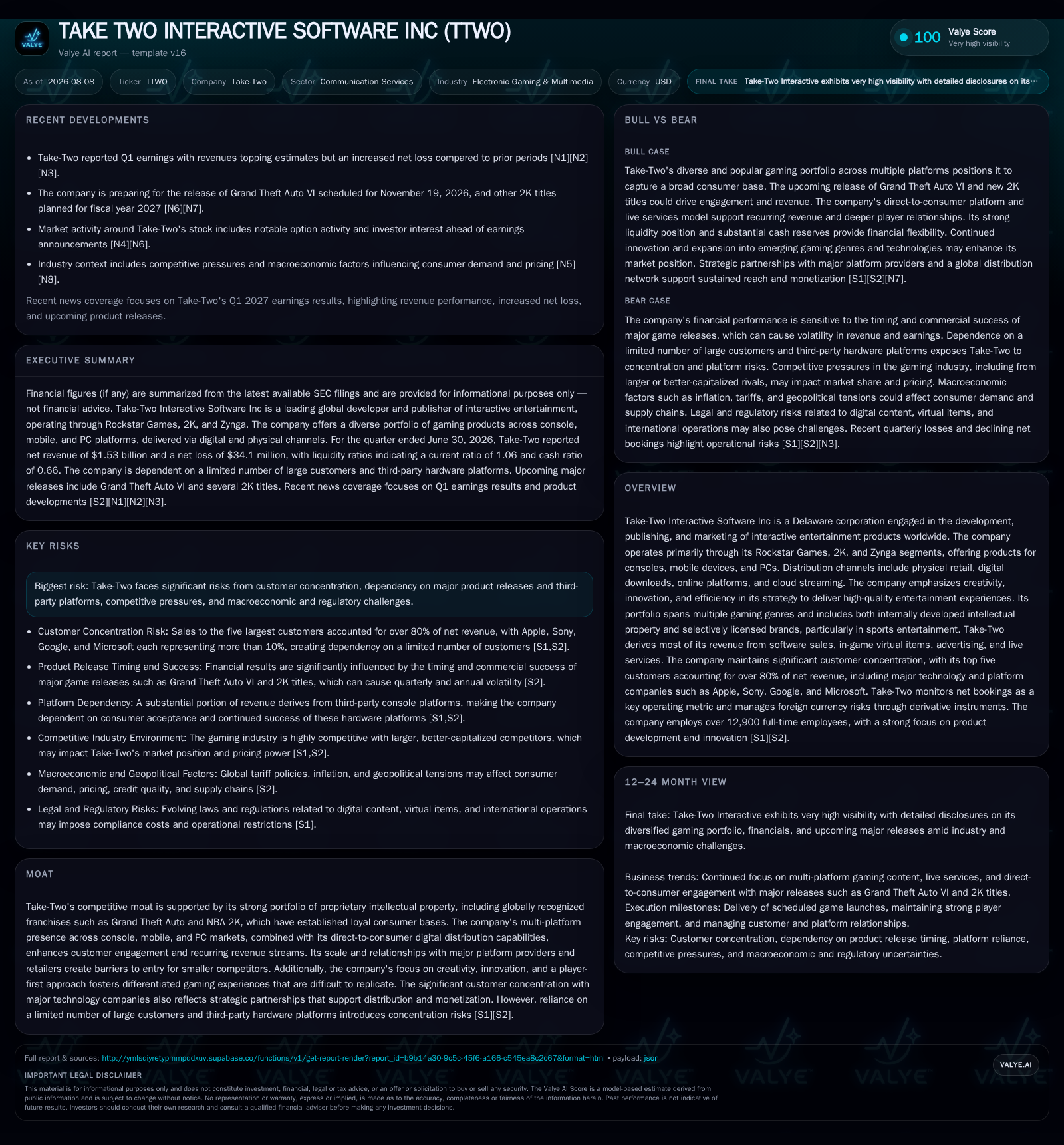
Take-Two Interactive continues to emphasize quality over quantity in its Rockstar Games segment, focusing on long-lived franchises that drive recurring revenue through digital monetization such as virtual currency and in-game purchases. Console platforms accounted for nearly 42% of revenue in the recent quarter, underscoring both the strength and risks of dependence on hardware manufacturers amid mature installed bases and macroeconomic pressures. The company’s multi-channel distribution model, spanning physical, digital, mobile, PC, and cloud streaming platforms, supports diverse consumer engagement and margin expansion. Increasing contributions from live services and advertising within mobile gaming complement the core publishing business. Key operational metrics like MAU and ARPU will be critical indicators of sustained monetization momentum given competitive dynamics and platform concentration.
Rockstar’s Strategic Focus Drives Quality Franchise Longevity with Digital Monetization Upside
Take-Two’s August 2026 quarterly report reaffirms the strategic approach at Rockstar Games of concentrating efforts on a smaller slate of critically acclaimed titles characterized by long market lifecycles. These franchises—including Grand Theft Auto, Red Dead Redemption, Max Payne, and others—are internally developed and positioned as leaders in the action/adventure category [S2][S1]. This focus is significant because it shifts the revenue model from one reliant on upfront game sales to a hybrid structure where robust virtual currency sales, downloadable content (DLC), and ongoing microtransactions generate recurring revenues beyond initial release periods. Such incremental monetization tends to increase average revenue per user (ARPU) sustainably while mitigating volatility tied to new title launches.
This model also aligns Take-Two with peers like Activision Blizzard who have similarly capitalized on live service offerings within franchise frameworks. However, sustaining player engagement through regular content updates and maintaining healthy monthly active user (MAU) metrics will be vital confirmation points for this thesis [N1]. Any deterioration or stagnation in these KPIs could challenge the durability of Take-Two’s ARPU growth projections.
Console Platform Dependency Challenges during Industry Installed Base Maturity
The company disclosed that video game consoles manufactured by third parties accounted for 41.8% of net revenue during the first quarter ended June 30, 2026 [S2]. While this confirms the entrenched role of console platforms in Take-Two’s monetization ecosystem, it simultaneously underscores material platform concentration risk. The installed base growth of these consoles has reached maturity levels typical in late product cycle stages across major markets.
This situation is compounded by global macroeconomic factors including inflationary pressures and tariff policies which have previously caused supply chain constraints or affected consumer hardware demand patterns. Given that Take-Two derives substantial revenue through licensing arrangements embedded within these third-party ecosystems—where revenue shares can be significant—any contraction or stagnation in console adoption directly caps potential top-line growth and compresses margins.
Thus, monitoring new console shipment trends, adoption rates for next-gen platforms (PlayStation 5/Xbox Series X|S), and consumer spending behavior within these ecosystems will be essential leading indicators for operating performance sustainability.
Portfolio Reach Through Multi-Channel Distribution Enhances Consumer Engagement
Take-Two operates a diversified distribution network combining traditional physical retail outlets with a rapidly growing digital download presence alongside emerging online platforms and cloud streaming services targeting consoles, PCs, and mobile devices [S1][S2]. The ongoing shift towards digital sales carries dual benefits: higher gross margins relative to physical channels due to lower fulfillment costs, and enhanced direct-to-consumer relationships allowing for more effective marketing precision and faster deployment of downloadable content or live-service updates.
This transition mirrors industry-wide trends where digital storefronts like Steam or Epic Games Store have assumed greater market share compared to brick-and-mortar retailers. Among peers such as Electronic Arts or Ubisoft, digital sales mix is a key lever improving overall profitability through operating leverage gains as fixed overheads are better absorbed.
While physical retail remains meaningful especially for blockbuster releases or specific regions with lower broadband penetration, Take-Two’s ability to increase its digital versus physical sales ratio consistently would validate enhanced margin profile sustainability.
Growth Opportunities Anchored in Live Services and Mobile Gaming Expansion
Live services represent an increasingly important pillar within Take-Two’s business model. Beyond the core Rockstar Games action/adventure titles, Zynga’s mobile segment offers diversified sources of recurring revenues primarily through advertising integrated within social and casual games as well as sustained virtual currency purchases [S1]. This not only complements Take-Two’s console/PC publishing but broadens total addressable market reach into demographic segments less engaged by traditional games.
Incremental growth within mobile advertising revenues suggests rising ARPU potential in this channel owing partly to improving ad monetization efficiency. This trend parallels developments observed at pure-play mobile-focused entities like Zynga itself or industry peers who emphasize freemium models combining free gameplay with microtransactions supported by ad placements.
These dynamics suggest that successful execution here may help partially offset slower top-line growth elsewhere due to hardware saturation or elevated competitive intensity.
Risks from Customer Concentration, Platform Revenue Shares, and Regulatory Uncertainty
A salient risk highlighted across disclosures is the high customer concentration inherent in Take-Two’s revenue base. Its top five customers collectively account for a substantial portion exceeding 40% of quarterly net revenues—all representing major technology companies controlling key platform ecosystems such as consoles or digital stores [S24]. This concentration presents vulnerability to shifts or renegotiations around distribution agreements, pricing policies, or platform prioritization.
Additionally, evolving regulatory regimes pose emerging challenges to monetization strategies centered around virtual goods. Laws targeting loot boxes or enhancing data privacy protections may constrain certain interactive features or require costly compliance adaptations potentially impacting live service economics [S22].
While such regulations affect the broader video gaming industry uniformly, their timing and enforcement intensity vary across jurisdictions requiring constant monitoring.
Key Metrics Signal User Engagement Trends and Monetization Effectiveness
Although detailed hard metric disclosures remain limited for this quarter, qualitative commentary alongside secondary sources indicate that maintaining robust MAU figures alongside upward ARPU trajectories is central to sustaining momentum in live-service revenues [N1][S2]. Shifts in in-game transaction volumes provide early signals on player willingness to spend beyond initial game purchases.
Relative improvements versus peer benchmarks such as Activision Blizzard’s multi-platform live services performance would reinforce confidence in Take-Two’s ability to translate its IP portfolio into sustained monetization streams amidst intense competition.
Conversely, any softness here could presage margin pressures given high fixed R&D outlays necessary for continuous content refreshment.
What To Watch: Pipeline Updates, Operating Milestones, Customer Diversification Efforts
Future sensitive milestones include announcements regarding release cadence changes at Rockstar Games or 2K branded titles which historically act as meaningful demand drivers influencing quarterly variability [S2][S3]. Progress against strategic initiatives aimed at diversifying customer base beyond prominent technology partners remains another watchpoint given concentration risks.
Subsequent quarterly filings are expected to supplement clarity on operational KPI trends including MAU progression across platforms alongside advances in advertising-driven revenues from mobile assets.
Financial Profile Discussion: Capitalized Development Costs, Debt Structure, Liquidity
Take-Two carried approximately $2.4 billion in capitalized software development costs as of June 30, 2026—a sizable investment underpinning future content rollouts integral to long-term growth prospects [S2]. These assets reflect significant committed capital toward maintaining pipeline vitality across major IP franchises.
On the liability front, short-term debt maturing within one year aggregates roughly $630 million alongside convertible notes due by December 2026; total reported net debt stands near $535 million after accounting for about $1.36 billion in cash and equivalents—yielding a moderate current ratio around 1.06 indicating near-term liquidity sufficiency [F1][S2]. Interest payments for recently completed quarters were approximately $37.6 million consistent with outstanding senior notes obligations.
The balance sheet posture appears calibrated to support ongoing content investments while managing interest burdens effectively; however heightened R&D funding requirements will keep cash conversion sensitivity under scrutiny going forward.
This analysis synthesizes Take-Two Interactive's most recent disclosures emphasizing operational strategy execution around its flagship IP portfolio anchored by robust digital monetization practices but tempered by structural risks related to platform dependency and concentrated customer relationships. Monitoring key engagement metrics along with pipeline developments will be crucial for assessing how well the company navigates evolving market conditions amid intensifying regulatory oversight.
Disclaimer: This is research-only, informational analysis and not investment advice. It may include AI-generated interpretation and general industry context. Always verify important details using primary sources.

Comments