
Art Technology Acquisition Corp. Advances SPAC Capital Vehicle Model with Strong Liquidity and Experienced Management
A Cayman Islands-based blank check company, ARTC is positioned to leverage its $253 million IPO trust for a technology and art-focused acquisition.
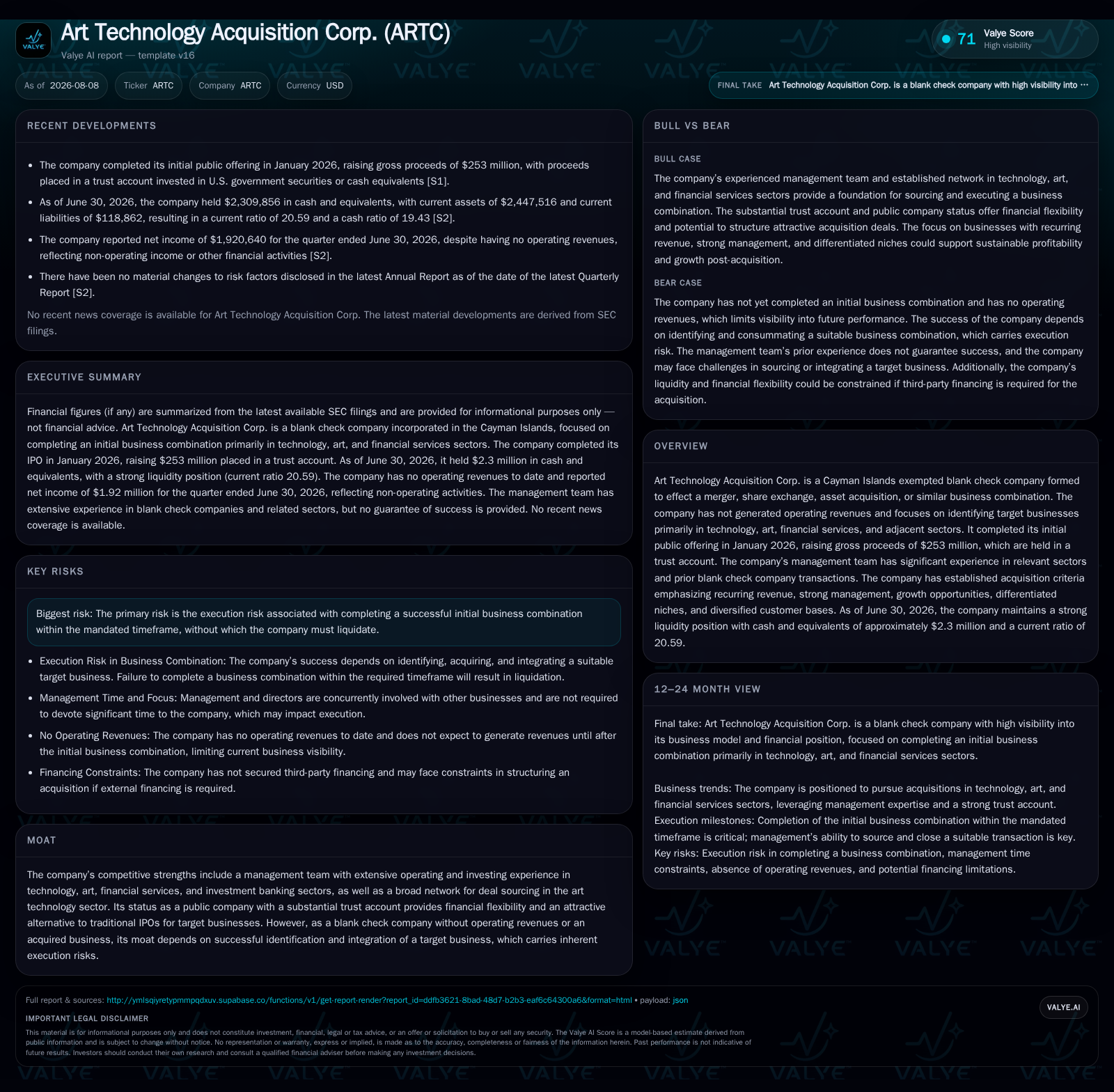
Art Technology Acquisition Corp. (ARTC), a Cayman Islands exempted blank check company, completed a $253 million IPO in January 2026, establishing a trust account as the basis for its initial business combination. The company targets mergers within technology, art, financial services, and adjacent sectors, with an experienced management team emphasizing recurring revenue and diversified customer bases. As of June 30, 2026, ARTC maintains robust liquidity and faces typical SPAC execution risks, including the critical timeline to finalize an acquisition or face liquidation. Its structured acquisition criteria and sponsor network position it favorably, though success depends on sourcing and integrating a suitable target within mandated windows.
Recent Operating Update
From incorporation through December 31, 2025, ARTC incurred formation and administrative expenses totaling approximately $117,000 without generating any operating revenue or income [F1][S1]. The company’s gross IPO proceeds of $253 million were predominantly deposited into a trust account invested conservatively in short-term U.S. Treasury securities or money market funds per regulatory requirements [S1]. This structure protects public investor capital until the completion of a qualifying business combination.
Business Model
ARTC operates as a Special Purpose Acquisition Company (SPAC), which raises capital via an IPO to facilitate the acquisition or merger of one or more private companies. Revenue generation is contingent upon successfully completing this de-SPAC transaction; prior to that event, ARTC generates no commercial revenues beyond interest earned on trust assets. Monetization after combination includes equity appreciation of acquired entities alongside transaction fees linked to underwriting and advisory roles.
The company’s monetization is structured around deferred underwriting commissions payable upon transaction completion and sponsor promote shares that incentivize successful deal closure [S1].
Management targets acquisition candidates characterized by recurring revenue streams—indicating stable cash flow—proven executive leadership capable of scalable growth, differentiated market positioning that reduces commoditization risk, and diversified customer bases mitigating concentration risk [S1][S25]. This disciplined focus aims to ensure post-merger entities have durable demand profiles suited for public markets.
Industry Structure and Competitive Position
Within the crowded SPAC landscape emphasizing technology and financial services sectors with art-technology thematic elements, ARTC distinguishes itself through substantial capitalization and an experienced sponsor network with deep ties across investment banking and sector-specific verticals. Its Cayman Islands exempted status affords governance flexibility common among SPACs while strict regulatory adherence regarding trust account investments mitigates principal risk for public shareholders [S1].
However, absent an identified acquisition target or operating history thus far, ARTC’s competitive advantage hinges on management’s ability to source proprietary deals amid increasing regulatory scrutiny impacting SPAC structures generally. Market conditions influencing sponsor promote valuations also shape post-merger value creation prospects.
Growth Drivers
ARTC’s growth trajectory depends heavily on executing its initial business combination within the prescribed timeframe—typically 18-24 months post-IPO—before mandatory liquidation would return trust proceeds to investors without premium. Achieving this milestone unlocks liquidity events for private companies aligned with ARTC’s sector focus.
Additional drivers include heightened demand from private companies seeking alternative public listing routes that may offer less volatility than traditional IPOs. Robust valuations in technology innovation spaces underpin favorable deal economics post-merger while institutional investor interest in tech-art crossover investments enhances sector attractiveness.
PIPE financing arrangements serve as supplementary capital sources when redemption elections by public shareholders reduce funds available from trust accounts at merger time—a critical metric signaling investor confidence or skepticism.
Risks and Watchpoints
Execution risk dominates: failure to consummate an acquisition within the mandated period triggers liquidation of trust funds at par value without upside participation [S1]. Redemption risk at shareholder votes may reduce available capital for acquisitions requiring supplemental financing potentially dilutive to existing shareholders.
Dilution stemming from sponsor promotes and warrants could pressure post-merger valuations if accretive deal execution falters. Regulatory developments affecting disclosure obligations or fee structures elevate compliance costs indirectly impacting margins.
The absence of operating revenues pre-combination underscores reliance on deal closure for value creation while resolved historical litigation involving key executives presents limited reputational risks currently [S4].
What To Watch Next
Investors should monitor announcements regarding definitive agreements for initial business combinations—key indicators of managerial progress against looming deadlines. Subsequent disclosures providing audited financials of prospective targets will shed light on acquisition quality.
Redemption rates ahead of shareholder votes will reveal external validation levels influencing deal funding sufficiency; elevated redemptions may necessitate PIPE financing. Monitoring timing around release of deferred underwriting fees tied to transaction closings will clarify cost absorption impact on net proceeds.
Regulatory changes affecting SPAC operational frameworks warrant attention given their potential effect on sponsor incentives and structural dynamics shaping future deal activity.
Financial Profile Discussion
As of June 30, 2026, ARTC reported approximately $2.31 million in cash and cash equivalents with total current assets near $2.45 million against current liabilities around $119 thousand—translating into a robust current ratio exceeding 20x indicative of conservative liquidity management focused on covering ongoing operational expenses pre-acquisition [F1]
Net results reflect pre-operating losses driven by formation costs approximating $117K through year-end 2025 with no recorded operating revenues since inception [F1][S1][S2]. Deferred underwriting commissions near $10.78 million remain contingent liabilities payable upon successful de-SPAC transaction completion adding complexity to future financial modeling.
Overall balance sheet positioning aligns with standard SPAC profiles prior to business combination—prioritizing fiduciary protection of IPO proceeds while leaving value creation dependent on forthcoming merger execution outcomes.
This analysis is based exclusively on facts disclosed in official SEC filings through August 7, 2026 ([S1], [S2]) supplemented by industry context regarding SPAC structures without speculative assertions concerning unidentified targets or projections absent direct evidence.
Disclaimer: This is research-only, informational analysis and not investment advice. It may include AI-generated interpretation and general industry context. Always verify important details using primary sources.

Comments