
Cardio Diagnostics Confronts Commercialization Hurdles as Nasdaq Delisting Risk Looms
Cardio Diagnostics advances its AI-driven cardiovascular tests amid reimbursement delays and continuing operating losses.
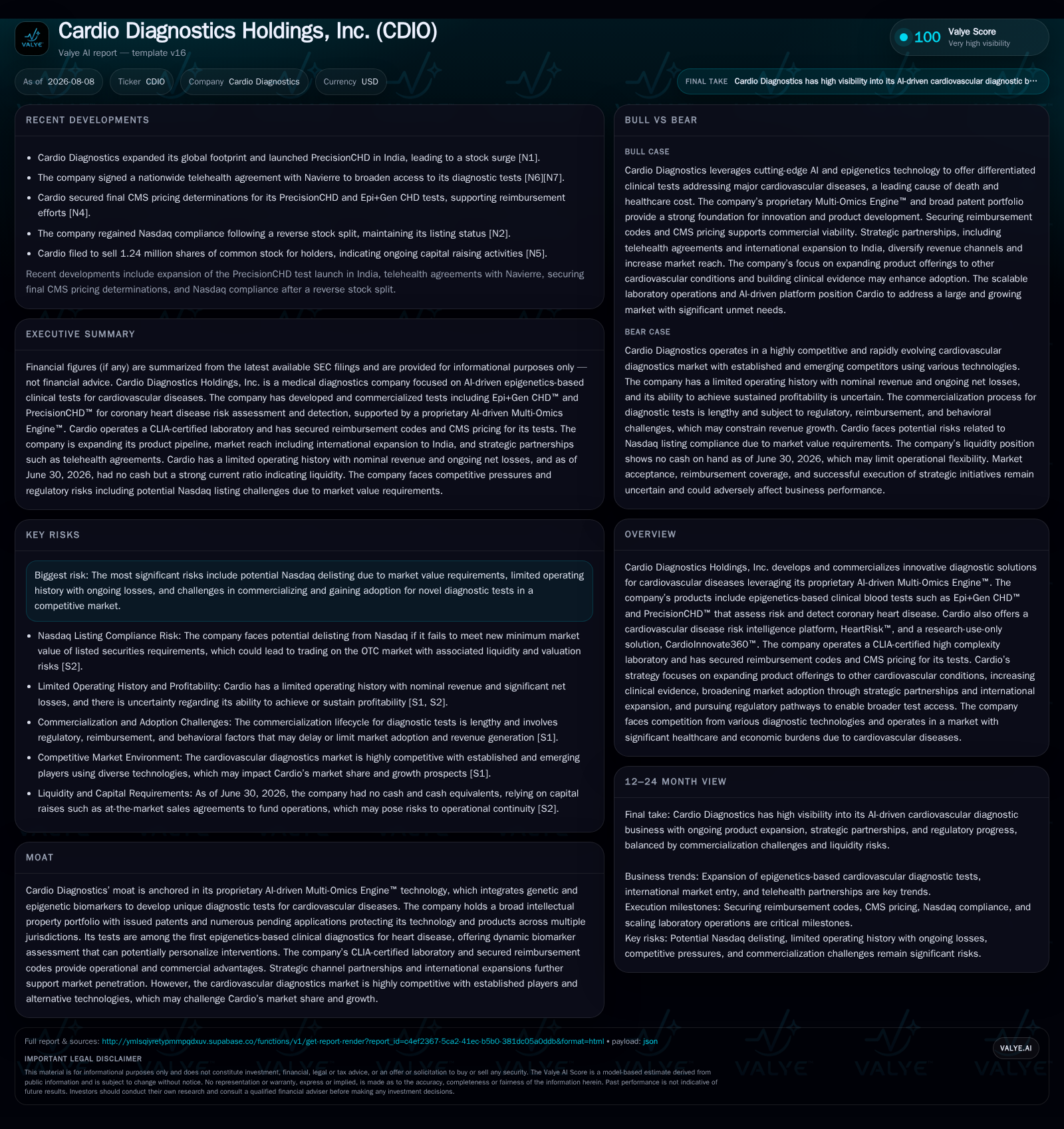
Cardio Diagnostics Holdings, Inc. continues to develop and commercialize epigenetics-based cardiovascular diagnostic tests leveraging its proprietary AI-driven Multi-Omics Engine™, targeting coronary heart disease and other conditions. Despite securing CPT PLA codes and CMS gapfill pricing for its tests, the company’s revenue remains minimal with substantial operating losses, reflecting typical prolonged commercialization cycles in molecular diagnostics. Cardio faces significant risks, including Nasdaq listing challenges due to low market value and the inherent uncertainties in regulatory approval, reimbursement expansion, and clinical adoption. Growth hinges on expanding payer coverage, broadening clinical evidence, strategic partnerships, and international market penetration.
Quarterly Operating Update Highlights
compounds the operational hurdles as Cardio works to scale adoption.
Business Model Overview
Cardio Diagnostics specializes in developing proprietary AI-driven multi-omics-based clinical diagnostic tests focusing exclusively on cardiovascular diseases. The firm leverages its patented Multi-Omics Engine™, which integrates genetic markers (SNPs) with epigenetic signals (such as DNA methylation patterns), enabling dynamic biomarker assessment that current genomic-only competitors do not offer [S1][S14]. The company generates revenue primarily by selling diagnostic testing services through blood assays processed in its CLIA-certified high-complexity laboratory—a prerequisite for clinical trustworthiness and insurance reimbursement.
Sales channels include direct orders from healthcare providers spanning primary care practices to health systems, employers managing population health programs, payors evaluating cost-effectiveness of preventive testing, and strategic partnerships with insurers and life companies interested in risk stratification capabilities [S1][S5]. Pricing mechanics revolve around fee-for-service test billing supported by AMA CPT codes (0440U for PrecisionCHD™ and 0439U for Epi+Gen CHD™) paired with CMS Medicare fee schedules set near $850 per test after gapfill processes. However, broader third-party payor coverage including Medicare remains limited or under negotiation—restricting volume growth potential substantially given healthcare provider reliance on reimbursement policy when ordering novel tests [S19].
Margins are expected to improve modestly as volumes grow due to laboratory fixed-cost absorption and scale efficiencies realized by automation improvements underway [S20]. Nonetheless, the company's current financial profile is heavily weighed by ongoing R&D expenditures typical for advanced molecular diagnostics firms expanding their test menu and building robust clinical evidence bases.
Industry Structure and Competitive Context
The cardiovascular molecular diagnostics market sits at the nexus of precision medicine innovation but faces common sector headwinds: protracted regulatory review cycles for new biomarkers or platforms; extensive payer negotiations that become gatekeepers for physician ordering behavior; slow integration into standard-of-care guidelines; and competition from entrenched genomic testing vendors such as Myriad Genetics and Invitae who have broader panels covering multiple conditions.
Cardio’s moat primarily rests on its unique integration of AI-driven multi-omics technology combining genetic predisposition data with reversible epigenetic markers that reflect environmental or lifestyle influences—allowing potentially more actionable insights into dynamic cardiovascular risk profiles than static gene variants alone [S1][S14]. The company's intellectual property portfolio protects this engine along with its products across regulatory territories.
Nonetheless, competitors in adjacent spaces offer liquid biopsies (Guardant Health) or advanced genetic sequencing (Exact Sciences) supported by larger capital bases and established sales infrastructures. Cardio operates a leaner scale platform laboratory focusing on targeted cardiovascular applications rather than broad oncology or rare disease panels common among peers.
Crucially, Cardio’s success depends on navigating reimbursement complexity—a significant barrier faced industry-wide. As other molecular diagnostic firms demonstrate, obtaining durable Medicare coverage catalyzes commercial adoption since private payors typically follow CMS policies. Delays in such coverage can stall volume scaling by years even after technological advancement.
Growth Drivers
Several secular tailwinds underpin Cardio’s long-term growth prospects:
- Rising Cardiovascular Disease Burden: With projections estimating nearly half of Americans affected by CVD by 2035, demand for precise risk stratification tools is structurally expanding [S19].
- Technological Innovation: Advances in AI-enabled biomarker discovery support increasingly personalized diagnostics embodying precision medicine trends favoring proactive screening over reactive interventions.
- Broadening Reimbursement Footprint: While currently constrained, successful Medicare coverage approval would represent a critical inflection point accelerating clinician ordering behavior due to lowered financial barriers.
- Strategic Channel Expansion: Partnerships with employers offering population health management programs create unique B2B channels beyond traditional provider-centric models; international expansions notably into India seek untapped large market opportunities mitigated by local manufacturing aims [S5].
- Product Pipeline Diversification: Ongoing development of tests targeting stroke, congestive heart failure, diabetes-related cardiovascular risks along with launch of HeartRisk™ analytics platform broaden addressable markets beyond CHD alone.
These factors combined suggest structural growth drivers but realize them depends heavily on timely payer acceptance and effective clinician education given novelty of epigenetic diagnostics.
Risks and Constraints
Despite technological differentiation and emerging products, Cardio faces multifaceted risks:
- Nasdaq Listing Risk: The stock price decline has resulted in sub-$5 million market value of listed securities exposing the company to potential immediate delisting without cure periods under recent SEC rules once enforced—potentially limiting access to public equity capital essential for funding operations beyond existing cash resources which were essentially zero at mid-2026 though modest working capital exists via current assets exceeding payables significantly suggesting some runway flexibility [F1][S2].
- Slow Commercial Adoption: History shows complex sales cycles where payors often require substantial clinical validation evidence before expanding coverage; provider reliance on workflow integration delays routine uptake particularly given entrenched incumbents [S1].
- Regulatory Uncertainty: While currently classified as Laboratory Developed Tests (LDTs) under CLIA compliance exempting them from FDA premarket review following recent legal vacaturs of FDA LDT enforcement attempts; pending legislation like the VALID Act could alter this landscape suddenly requiring costly submissions or modifications impacting availability or claims made about the tests [S11][S22].
- Competition from Larger Players: Established molecular diagnostic firms command significantly greater resources to invest in marketing pushouts while offering multi-indication panels creating pressure on Cardio’s niche positioning.
- Intellectual Property Challenges: Broad licensing agreements carry risk that university licensor may grant competing licenses limiting exclusivity while open-source software dependencies pose cybersecurity vulnerabilities impacting product integrity [S7][S8][S24].
- Capital Raising Needs: Continuous cash burn tied to R&D pipeline advancement plus sales/marketing expansion require future financing which could dilute existing shareholders or limit operational agility if unfavorable terms are required [S17].
What to Watch Next
Key upcoming milestones include:
- Progress toward securing broader Medicare coverage decisions which would unlock critical access to patient populations nationwide.
- Follow-up feedback from FDA engagements concerning regulatory pathways which could redefine commercial approaches especially if FDA oversight intensifies.
- Evidence generation updates including clinical studies presented at major cardiology conferences validating utility beyond initial coronary heart disease detection use cases such as non-obstructive forms or mortality prediction enhancements [S19].
- Expansion activity notably international rollout effectiveness including India partnership validation showing early market uptake patterns.
- Developments regarding Nasdaq MVLS rule final adoption timing plus Cardio’s share price trajectory impacting listing status stability.
- Any strategic partnerships or acquisition announcements supporting horizontal or vertical integration across cardiac care continuum enhancing competitive standing.
Monitoring operational KPIs such as number of tests performed growing quarter-over-quarter, average revenue per test improvement via reimbursement expansion, laboratory utilization rates reflecting scale economics progress alongside customer acquisition costs will provide practical insight into commercialization momentum.
Financial Profile Discussion
As of June 30, 2026, Cardio Diagnostics held no cash or equivalents but reported nearly $6.16 million in current assets against modest current liabilities near $360 thousand resulting in a strong current ratio above 17x indicating manageable short-term liquidity absent immediate cash burn spikes though practical operational runway depends critically on imminent financing or improved incoming revenue streams [F1]. Net losses persisted with an operating deficit exceeding $6.4 million in calendar year 2025 highlighting continuing negative free cash flows typical for early commercial-stage molecular diagnostic enterprises actively investing in their test pipeline development, marketing channels expansion, lab automation upgrades, and payer engagement activities. This financial profile underscores an urgent capital requirement narrative intertwined with ongoing clinical validation efforts prior to achieving sustainable profitability thresholds commonplace among peer companies like Exact Sciences during their nascent stages.
This analysis presents an integrated view based on the latest SEC filings through August 2026 supported by financial data as of mid-year 2026. It prioritizes evidence-based insights into Cardio Diagnostics' rich AI-powered technology foundation balanced against typical sector challenges related to clinical adoption speed, reimbursement landscapes, regulatory uncertainty surrounding LDTs classification change potentialities, competitive pressures from established genomic diagnostic firms with deeper pockets as well as precarious Nasdaq listing status due to evolving new minimum market value standards. Observers would benefit from closely watching payor engagement outcomes coupled with incremental sales traction indicators fueling scaled lab utilization necessary for margin improvements.
Disclaimer: This is research-only, informational analysis and not investment advice. It may include AI-generated interpretation and general industry context. Always verify important details using primary sources.

Comments