
EverCommerce Advances Integrated SaaS Growth Amid Modest Near-Term Headwinds
A leading provider of vertical-specific SaaS platforms for SMB service sectors reports moderate revenue growth yet faces competitive pressures and integration challenges.
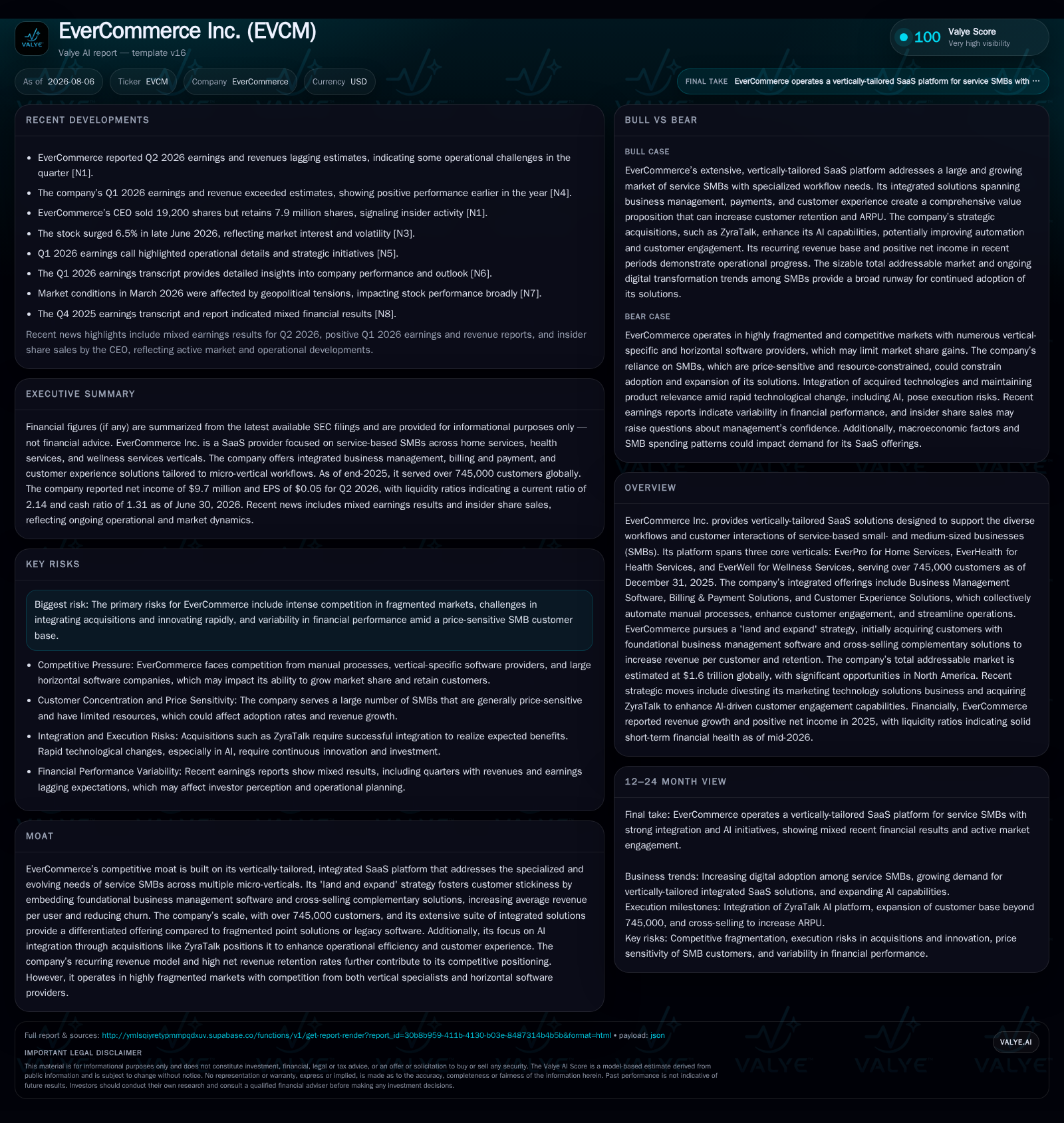
EverCommerce Inc. reported Q2 2026 results showing sustained but decelerating revenue growth due to a price-sensitive SMB customer base and ongoing integration of AI-powered acquisitions like ZyraTalk. The company’s ‘land and expand’ model anchors on business management software across three core verticals—Home, Health, and Wellness Services—leveraging cross-selling of billing, payment, and customer experience solutions. Despite achieving over 745,000 customers as of end-2025 with high net revenue retention, EverCommerce contends with fragmented competition across specialized micro-verticals, macroeconomic uncertainties weighing on SMB spending, and execution risks in acquisition integration. Monitoring customer churn trends, ARPU expansion, and successful AI rollout will be key to the durability of its growth trajectory.
Recent Operating Update
EverCommerce’s latest quarterly filing (Q2/2026) revealed continued revenue gains yet highlighted decelerations compared to prior periods attributable primarily to a price-sensitive small- and medium-sized business (SMB) customer base facing lingering macroeconomic pressures [S2][N1]. The company reported roughly stable operating income margins despite incremental technology investments including amortization tied to its recently acquired AI assets. While no explicit guidance revisions were disclosed in the August event filing [S3], the operating environment reflects tightening demand dynamics among service SMBs.
This backdrop underscores the need to deepen penetration within an installed customer base exceeding 745,000 at FY-end 2025 across three distinct vertical SaaS suites—EverPro for Home Services, EverHealth for Health Services, and EverWell catering to Wellness Services—spanning numerous specialized micro-vertical markets such as home improvement contractors, medical specialty practices, and salon/spa operators [S1]
Business Model and Strategic Positioning
EverCommerce generates revenue principally via subscription fees supplemented by transaction-based billing volumes from its integrated payments ecosystem aligned with its verticalized SaaS platform stack [S1][S17]. This model hinges on launching foundational Business Management Software tailored for specific service workflows as a land-grab tool. Subsequent cross-selling opportunities target adjacent workflow-enhancing modules for billing automation, payment processing (supporting credit cards, ACH), and customer experience management—including reputation management and real-time Voice of Customer analytics—to increase revenue per user (ARPU) and improve net revenue retention.
The company emphasizes a ‘land and expand’ approach that binds customers into an increasingly integrated ecosystem rather than fragmented point solutions prevalent in the SMB services space [S20]. This multi-module bundling seeks to raise switching costs while driving operational efficiencies for clients managing complex scheduling, invoicing, lead generation, compliance tracking or regulatory documentation.
EverCommerce’s acquisition strategy complements organic development by filling niche capability gaps or expanding vertical coverage. For instance, the September 2025 ZyraTalk acquisition introduced AI-driven conversational virtual assistant capabilities aimed at automating prospect engagement within the Home Services vertical initially but planned for broader deployment across other segments [S11]. Such integrations strengthen differentiation against competitors lacking proprietary AI offerings or seamless multi-workflow platforms.
Industry Structure and Competitive Landscape
The sector serving service-based SMBs is notably fragmented: competitors include vertically specialized SaaS providers focusing narrowly on sub-segments (for example ServiceTitan in home services or Zocdoc in health appointment management), horizontal SaaS giants like Salesforce offering CRM functions across industries, payment processors like Square addressing transactional needs broadly, alongside legacy manual or homegrown administrative tools commonly still used by many SMB operators [S14].
Price sensitivity among SMB customers imposes limits on annual contract escalations and introduces churn risks amid competing lower-cost alternatives or commoditizing technologies [N1][S1]. Additionally, the breadth of customization required across diverse micro-vertical workflows challenges scalability. EverCommerce’s moat rests on delivering deeply integrated vertical-specific solutions combining front-office marketing functions through back-office automation within a single platform supported by embedded AI capabilities
Growth Drivers
Increasing digital adoption within traditionally underserved SMB service sectors constitutes the core structural growth engine. Demand for consolidated platforms replacing ad hoc tools coupled with rising uptake of subscription-based billing/payment automation fuels recurring revenue predictability. Expansion into underpenetrated micro-verticals within home services (e.g., security alarm installations), health practices diversifying telehealth offerings, or wellness specialists seeking patient engagement technology broadens TAM.
Cross-selling dramatically increases customer lifetime value (LTV) by layering functionality atop initial acquisitions of business management solutions. Moreover, strategic integration of AI-driven tools like ZyraTalk's autonomous agents promise productivity enhancements that can translate into superior client ROI claims.
Geographic expansion beyond U.S.-centric footprints represents an incremental avenue although the company currently reports only about one-third international presence among its customers [S14].
Risks & Watchpoints
Primary operational risks include intense competitive pressures fragmenting wallet share despite scale advantages. High acquisition activity raises integration complexity risks that could disrupt product consistency or inflate operating expenses if synergies fail to materialize timely. Pricing power remains constrained given end-user cost sensitivity amid SMB budget pressure due to inflationary macroeconomic trends [N1][S15]. The company must successfully evolve its sales motions balancing new client acquisition costs versus retention without eroding gross margins.
Regulatory compliance particularly around data privacy/security adds further cost layers, and any lapse could impair brand equity crucial for retaining trust among SMB clients reliant on reliable digital platforms. Debt leverage near half a billion USD necessitates consistent free cash flow generation to sustain interest coverage ratios without compromising strategic investments [F1][S4]
Monitoring meaningful KPIs such as net revenue retention rate will provide ongoing insight into cross-sell success enabling margin expansion; similarly tracking ARPU changes will signal whether ‘land & expand’ effectively grows per-customer monetization amidst competitive pricing environments.
What to Watch Next
Markets should observe upcoming quarterly updates for evidence that AI integration concretely boosts retention or attracts new customers willing to pay premium subscription bundles. Customer churn trends vis-à-vis pricing changes or competitor campaigns will test stickiness claims intrinsic to EverCommerce's flywheel approach. Continued operating margin improvements post-integration cost normalization would support durable profitability expansion.
Strategic acquisitions announced or closed subsequent to ZyraTalk may illustrate capital allocation discipline enhancing product breadth without diluting operational focus. Additionally, geographic expansion outcomes beyond the U.S would gauge international scalability potential.
Financial Profile Discussion
As of June 30, 2026, EverCommerce held $133 million in cash against approximately $524 million in total debt translating into a net debt position near $390 million with a strong current ratio above 2x reflecting ample short-term liquidity relative to obligations [F1]. Recent amendments have extended loan maturities out to mid-2031 while slightly lowering interest margins supporting refinancing flexibility under current market conditions [S4][S7].
Capital investments continue prioritizing software development alongside selective acquisitions such as ZyraTalk ($36 million cash consideration) which are central to enhancing future competitive positions via automated workflows powered by AI agents. Cash flows from operations remain positive but sensitive to collection cycles inherent in SMB dynamics.
Overall leverage metrics warrant monitoring given macro uncertainties yet existing liquidity cushions provide runway for continued strategic investments paired with prudent capital management inclusive of board-authorized share repurchase programs providing optionality for shareholder return mechanisms contingent on market conditions [S10][F1]
This analysis synthesizes publicly available SEC filings and industry context without offering investment advice. It aims to clarify EverCommerce’s nuanced operating landscape shaped by evolving SaaS trends within fragmented SMB service markets alongside corporate financing considerations.
Disclaimer: This is research-only, informational analysis and not investment advice. It may include AI-generated interpretation and general industry context. Always verify important details using primary sources.

Comments