
International Paper Advances Separation Strategy Amid Operational Headwinds and Rising Maintenance Costs
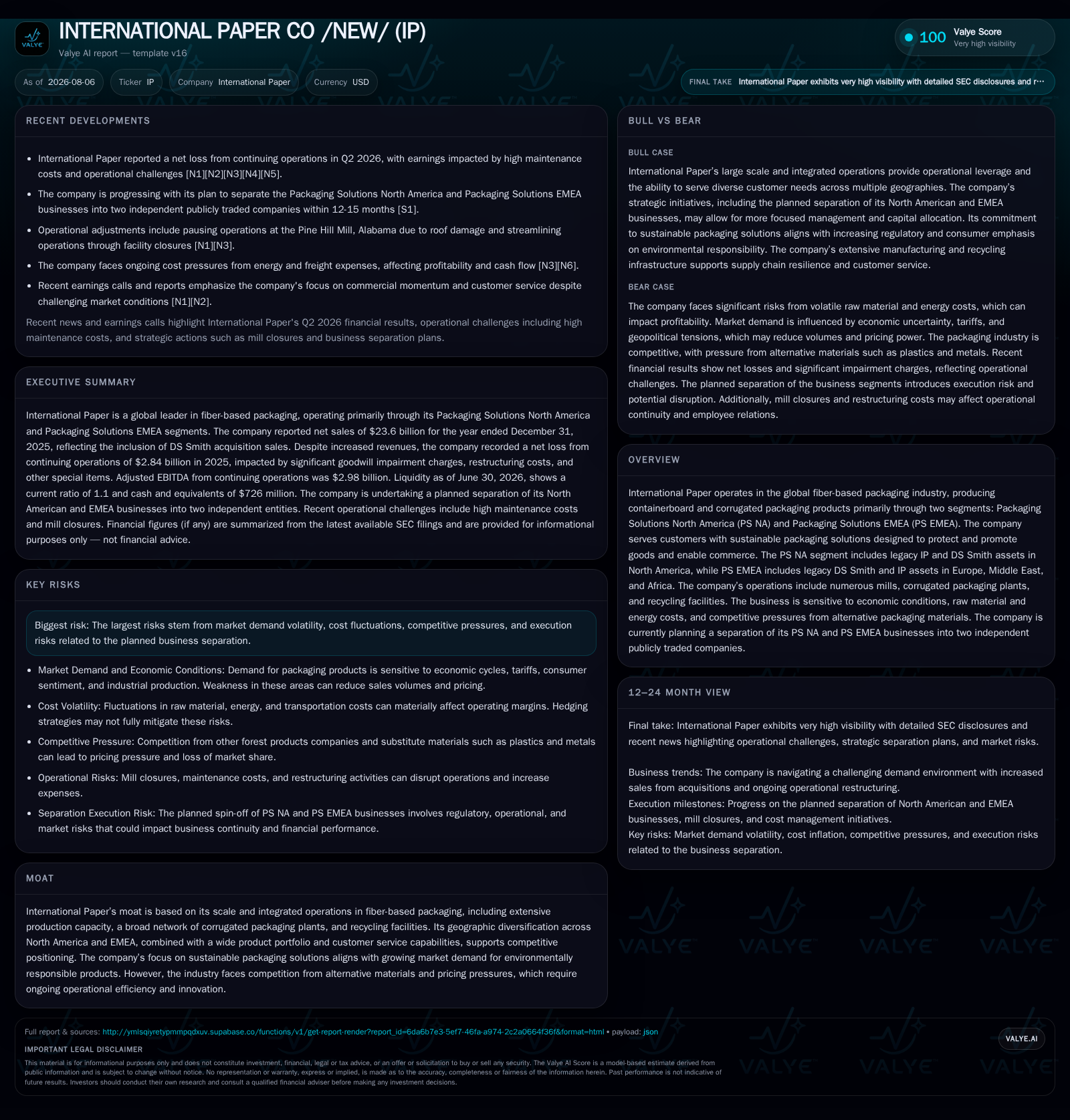
International Paper’s Q2 2026 results reveal margin pressures from elevated maintenance and energy costs alongside progress toward splitting its North American and EMEA packaging businesses.
The Q2 2026 10-Q shows International Paper grappling with rising maintenance expenditures that compressed operating margins despite steady volume in its fiber-based packaging operations. The company remains on track with its strategic separation of Packaging Solutions North America and Packaging Solutions EMEA, aiming to unlock value through distinct geographic and commercial dynamics. While integrated operations provide scale and sustainability advantages, near-term cost inflation and execution risks linked to the pending split present operational challenges. Monitoring upcoming capacity utilization trends, order intake, and cost control efforts will be critical to assessing management’s ability to navigate this transition.
Margins under strain from maintenance spikes: latest quarterly insights
International Paper's Q2 2026 10-Q filing highlights a sharp rise in maintenance expenses that pressured operating margins despite relatively stable demand across its packaging segments [S2]. Management commentary in recent earnings calls echoes this dynamic, noting that although commercial momentum remains healthy, elevated energy costs combined with intensified maintenance activity raised the cost per unit of production [N1][N3]. This margin compression reflects common industry stress points where capital-intensive asset bases require periodic upkeep that can disrupt capacity utilization rates temporarily. Tracking these volatility factors will be crucial to discern if cost controls improve post-quarter or if margin headwinds persist longer term.
Integrated business model supporting both scale efficiencies and sustainability
International Paper operates as a vertically integrated fiber-based packaging manufacturer, encompassing fiber sourcing from virgin pulp and recycled inputs, containerboard production via pulp and paper mills, corrugated converting plants, and supporting recycling facilities [S1]. This integration enables tighter control on raw material costs—traditionally one of the largest expense components—and supports sustainable packaging solutions demanded by regulatory trends and customer preferences. The company’s scale across complementary assets underpins its economic moat by allowing efficient capital deployment over a broad footprint while facilitating innovation in eco-friendly products. Delivering consistent quality through this value chain is vital for maintaining pricing power during commoditized product categories.
Geographic segmentation shaping competitive exposures in North America vs. EMEA
IP's Packaging Solutions segments are distinctly organized: PS NA comprises legacy International Paper and DS Smith assets serving the North American market; PS EMEA similarly integrates DS Smith with IP's European operations [S1][S2]. These divisions face differing macroeconomic landscapes—North American demand has been subdued due to issues like tariffs, industrial slowdowns, and consumer sentiment weakness; European markets grapple with trade uncertainty and geopolitical tensions [S1]. Each segment displays unique commercial momentum supported by tailored go-to-market strategies yet faces shared challenges including pricing pressure from alternative materials. The planned public separations aim to unlock value by aligning each segment’s strategic focus more tightly with its regional customer base and operational profile [S3].
Growth drivers amidst evolving plastic-to-fiber shifts and e-commerce demand
The fiber-based packaging industry benefits from secular growth drivers including accelerated e-commerce requiring protective shipping materials, rising substitution of plastic packaging driven by environmental concerns, and evolving regulations favoring recyclability [S1]. International Paper leverages these trends through innovation in sustainable packaging solutions that meet both consumer goods clients’ requirements and regulatory mandates for circularity. Expansion into emerging markets constitutes another avenue for volume growth given industrialization trajectories. Operational improvements enhancing capacity utilization also underpin incremental gains amid market demand volatility. However, the commoditized nature of containerboard markets means these drivers must be balanced against ongoing price competition.
Risks centered around execution of business separation and raw material volatility
The execution of International Paper’s planned split into distinct PS NA and PS EMEA companies introduces substantial operational complexity risks including potential disruptions to supply chain coordination, IT systems segregation, workforce realignments, and capital allocation decisions [S1][S2]. Ensuring seamless continuity without eroding customer relationships or inflating costs will test management capabilities over coming quarters. Concurrently, volatility in raw material prices—especially cellulose fibers sourced globally—and energy expenditures directly affect per-unit production costs given the energy intensity of pulp/paper manufacturing [S1]. Failure to adequately pass through cost increases or offset them through efficiency gains may further compress margins.
Near-term indicators: what to watch as separation proceeds
Key metrics to monitor include quarterly announcements on capacity utilization rates which reveal how effectively production assets are deployed post-maintenance spikes [S2][N1]. Sustained high utilization would indicate operating leverage resilience despite inflationary headwinds. Order backlog strength or deteriorations provide insight into segment-level commercial momentum amid competitive pressures. Any updates on separation milestones such as regulatory approvals or capital structure adjustments communicated via filings or press releases will be critical to gauge progress against stated timelines. Management guidance revisions reflecting changing market conditions or separation-related expenditures will offer further directional signals.
Financial Profile Discussion: liquidity balance amid elevated capex commitments
As of June 30, 2026, International Paper held approximately $726 million in cash and equivalents with current assets at about $8.24 billion versus current liabilities near $7.51 billion yielding a current ratio around 1.1 [F1][S2]. While free cash flow generation is challenged temporarily by increased maintenance outlays discussed earlier, the company maintains adequate liquidity buffers enabling continued investment in capital projects aligned with its sustainability agenda. Ongoing cash flow discipline will be essential during the separation phase to avoid tightness given competing operational demands.
International Paper stands at a strategic inflection point where its size, integrated operations, and commitment to sustainable fiber-based packaging confer competitive advantages amidst ongoing industry commoditization risks. The planned segregation of North American and EMEA businesses reflects thoughtful portfolio management aimed at unlocking distinct regional growth profiles. However, near-term margin pressures exacerbated by maintenance spikes underscore the capital-intensive nature of the sector that requires finely tuned operational execution alongside proactive cost management. Peers such as WestRock and DS Smith face analogous pressures while navigating their own regional restructurings indicating this transitional phase is typical across large integrated players competing against alternative materials suppliers.
Investors should watch forthcoming quarterly updates for progression in maintenance stabilization, capacity utilization recovery, clear articulation of separation milestones, and evidence of commercial order strength supporting sustained volume growth. Additionally, raw material price trends coupled with demonstrated pricing discipline will determine margin recovery trajectory over time. International Paper’s ability to leverage its scale while managing operational complexity during this transitional period will define its medium-term competitive positioning.
This report is for informational purposes only; it does not contain investment research views or valuations related to International Paper Company or any other securities.
Disclaimer: This is research-only, informational analysis and not investment advice. It may include AI-generated interpretation and general industry context. Always verify important details using primary sources.

Comments