
ZoomInfo Technologies Transforms Go-To-Market Power with Pricing Innovation and AI Precision
ZoomInfo’s Q2 2026 update spotlights a strategic shift to hybrid pricing amid restructuring, with AI-driven platform strengths shaping growth and risk dynamics.
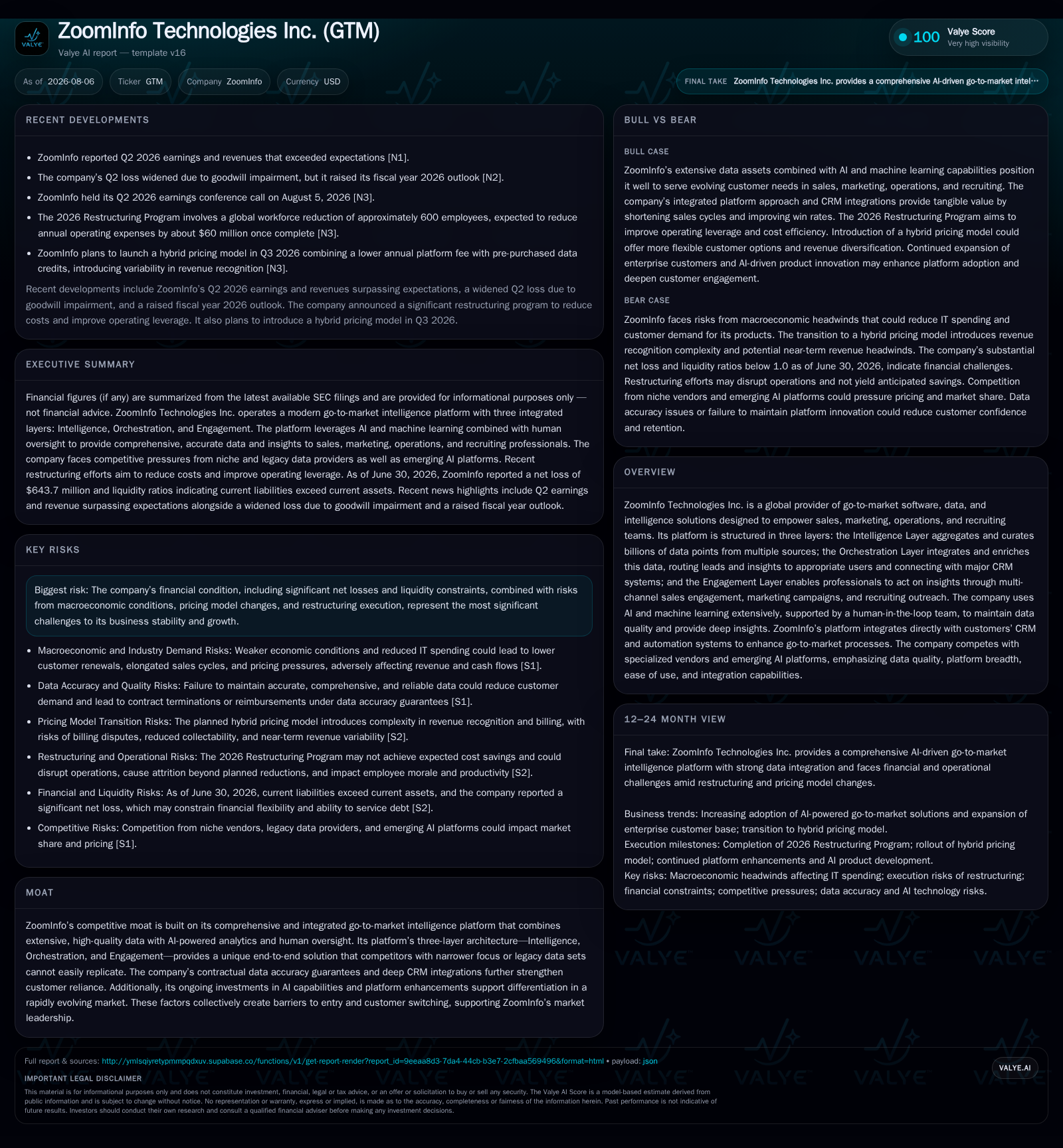
In its August 2026 quarterly filing, ZoomInfo outlined the imminent rollout of a hybrid pricing model combining lower annual platform fees with pre-purchased data credits, signaling a pivotal shift from traditional seat-based licensing. This transition introduces near-term revenue recognition complexity and billing risks, while underscoring the company's commitment to innovation through its tri-layer Intelligence-Orchestration-Engagement platform powered by AI and human-in-the-loop data governance. Despite operational headwinds and macroeconomic pressures, ZoomInfo continues expanding enterprise adoption and usage, albeit amidst challenges from extended sales cycles and restructuring costs. Monitoring adoption rates and financial metrics will be key to assessing long-term growth sustainability.
Q2 Operational Highlights Reveal Pricing Model Shift Impact
but burdened by upfront severance expenses influencing short-term margins [S5][N1].
How ZoomInfo’s Tri-Layer Platform Reinforces Competitive Moat
Fundamental to ZoomInfo’s market positioning is its three-tier platform architecture: the Intelligence Layer aggregates rich datasets from myriad sources encompassing firmographic details, contact profiles, buying intent signals, and financials; the Orchestration Layer enriches and routes data fused into customers’ CRM ecosystems enabling automated assignment of leads and actionable insights; finally, the Engagement Layer empowers end-users across sales, marketing, operations, and recruiting teams with multi-touch campaigns, coaching tools, and candidate outreach workflows [S1]. This comprehensive integration differentiates ZoomInfo from competitors who often offer more fragmented or legacy-focused products. The continuous use of AI/ML combined with human-in-the-loop quality assurance boosts data accuracy—a key competitive lever that supports contractual data guarantees enhancing customer trust and retention [S27]. As such, ZoomInfo occupies a critical value chain role bridging raw business data aggregation and tactical CRM-driven customer engagement.
Navigating Complexity: Transitioning to Hybrid Pricing Amid Billing Risks
Industry Positioning Through Integration Depth and AI-Enhanced Data Quality
ZoomInfo competes against an array of go-to-market data providers ranging from focused niche vendors to CRM giants like Salesforce or LinkedIn Sales Navigator offering adjacent capabilities. What strengthens ZoomInfo’s defensibility is deep integrations into leading CRM platforms allowing seamless ingestion and orchestration of their intelligence directly into existing sales/marketing workflows—a feature that raises switching costs significantly [S1][S27]. In tandem with AI-fueled accuracy improvements enforced through dedicated research analyst teams (human-in-the-loop), this fosters strong customer loyalty evidenced in historically healthy gross retention and low churn proxies cited in prior filings though precise current figures are undisclosed post-pricing change [S27]. This combination elevates ZoomInfo beyond mere data vendor status into being an embedded intelligence partner critical for client go-to-market efficiency gains.
Unlocking Growth: Enterprise Customer Expansion and Usage Uptake Dynamics
ZoomInfo continues focusing on scaling its enterprise customer base where longer sales cycles entail greater up-front CAC but yield higher lifetime value via expanded user seats and cross-product adoption [S1][N1]. Growth levers now increasingly emphasize driving adoption of usage-based features—specifically pre-purchased data credits—that allow monetization beyond static seat counts reflecting richer customer engagement profiles. Early indications from management suggest this dual fee model could facilitate upsell motions while tailoring price-to-value better during economic uncertainty periods when budget discipline intensifies [N2]. However, this strategy requires precise alignment of sales incentives and robust analytics to identify and react to shifts in usage patterns swiftly. Efficient conversion hinges on reducing average sales cycle times which remain longer than more transactional SaaS peers due to complex contract negotiations typical for GTM intelligence platforms serving large enterprises.
Risks Highlighted: Macroeconomic Sensitivity, Pricing Transition Challenges, and Execution Hurdles
ZoomInfo openly acknowledges risks magnified by macroeconomic downturns where IT spend contraction can delay renewals or reduce upgrade frequency undermining revenue momentum [S7][S21]. The structural shift in pricing injects uncertainty into revenue recognition quality exposing the company also to elevated billing disputes or regulatory scrutiny given increased usage-based complexity [S16]. Furthermore, restructuring efforts targeting approximately $60 million in run-rate expense reductions come with execution risk including potential employee attrition beyond targeted layoffs impacting morale and productivity [S28]. Failure to realize anticipated operating leverage gains could prolong pressure on profit margins. Lastly regulatory risks related to data privacy compliance remain ever-present given the vast personal/business information processed by the platform across global jurisdictions requiring costly safeguards.
What to Watch: Upcoming Execution Milestones and Demand Signals From Pricing Adoption
Key forthcoming indicators include quarterly progress reports on how quickly customers adopt the hybrid pricing model starting Q3/Q4 2026 alongside early net retention trends reflecting combined effects of product mix changes [N2][S3][S23]. Management commentary regarding effectiveness of restructuring actions in delivering promised cost savings without impairing growth capacity will also be critical. Monitoring deferred revenue movements alongside accounts receivable aging metrics will provide transparency on whether usage billing nuances materially affect working capital dynamics. Current assets totaled approximately $398 million against current liabilities of about $611 million, resulting in a current ratio near 0.65, indicating tight short-term liquidity relative to obligations [F1]. Total debt stood near $1.33 billion as of December 31, 2025, with net debt around $1.18 billion after accounting for cash reserves [F1]. The anticipated $45-$60 million charges associated with workforce reductions during H2 weigh heavily on near-term profitability though intended to drive sustainable operating leverage beyond 2026 [S5]. Effective management of leverage amid macroscopic uncertainties coupled with successful execution on billing transitions will be paramount for achieving consistent free cash flow conversion critical for deleveraging over time.
Disclaimer: This is research-only, informational analysis and not investment advice. It may include AI-generated interpretation and general industry context. Always verify important details using primary sources.

Comments