
Fast Casual Concepts Advances AI-Driven Marketing Pivot Amid Tight Liquidity
FCCI’s August 2026 quarter confirms its strategic repositioning as a marketing services provider leveraging AI analytics, while liquidity constraints pose operational challenges.
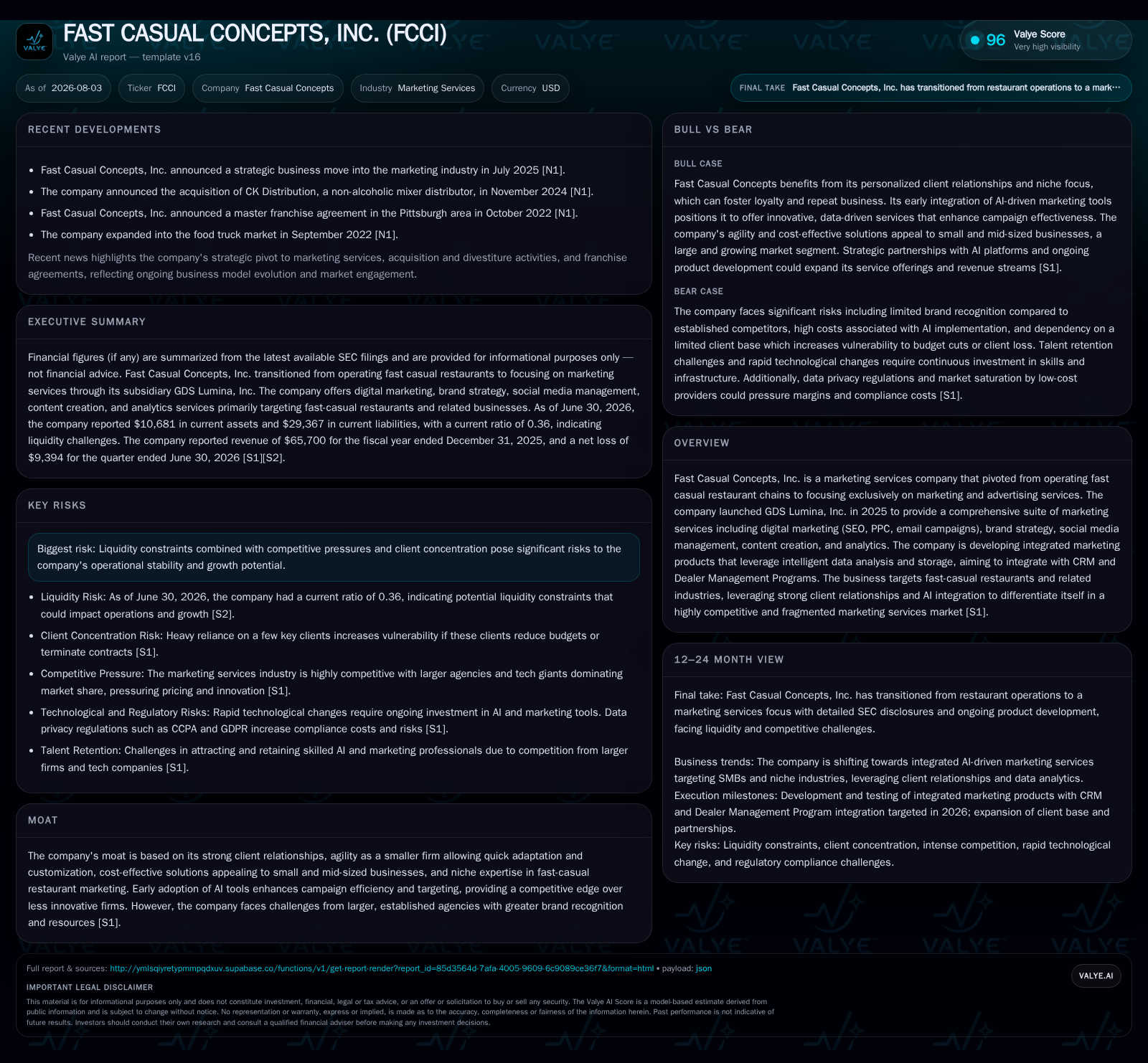
Fast Casual Concepts, Inc. (FCCI) has fully transitioned from fast casual restaurant operations to offering specialized digital marketing solutions focused on the fast-casual sector. The latest quarterly filing highlights ongoing investments in AI-enhanced campaign analytics through its GDS Lumina platform, aiming to improve client ROI and retention. However, a stretched liquidity profile with a current ratio of approximately 0.36 limits FCCI’s financial flexibility in a competitive market dominated by larger, better-capitalized agencies. Key performance indicators such as client retention, billings per client, and digital engagement metrics will be critical to validate FCCI’s ability to scale and sustain margins amid pricing pressures and technology-driven competition.
Quarterly Update: Marketing Services Pivot Reinforced during Financial Constraints
Fast Casual Concepts’ Q2 2026 filing solidifies its strategic shift away from legacy restaurant operations toward a focused marketing services business delivering integrated digital solutions via the GDS Lumina platform [S2]. While this transition opens new growth avenues through AI-driven campaign analytics and CRM integration, the company’s liquidity position poses a significant operational constraint. As of June 30, 2026, current assets stood at roughly $10.7K versus current liabilities near $29.4K, resulting in a current ratio around 0.36—a level that restricts FCCI’s ability to invest aggressively or absorb unexpected expenses without external capital support [F1].
The company reported operating losses near -$30.8K for the twelve months ended December 31, 2025, underscoring the cost intensity associated with launching new service lines and scaling technology infrastructure while revenues remain modest at $65.7K [F1]. This reflects typical early-stage commercialization dynamics where investment in product development and client acquisition precedes meaningful margin expansion.
Business Model Evolution: From Restaurant Operator to Digital Marketing Specialist
Originally operating multiple fast casual dining brands with plans for franchising, FCCI completed its pivot by forming GDS Lumina in 2025—a marketing services entity providing comprehensive offerings including SEO, pay-per-click advertising campaigns, brand strategy consulting, social media management, content creation, and AI-powered analytics tailored to fast-casual restaurant clients [S1]
The company’s revenue model combines recurring retainer contracts that provide predictable cash flow with project-based engagements driven by specific client campaign needs. This hybrid approach balances steady income streams with opportunities for upselling based on demonstrated campaign ROI measured through advanced KPIs such as conversion rates and attribution models enabled by AI integration.
Key value propositions rest on leveraging artificial intelligence to enhance targeting precision and automate workflows—differentiating FCCI from smaller competitors reliant on manual processes while addressing fast-casual chains’ need for scalable yet customized marketing solutions integrated tightly with clients’ CRM and dealer management systems.
Competitive Landscape: Niche Agility Versus Large Agency Scale
The marketing services industry is fragmented but features dominant players such as Ignite Visibility and Merkle that leverage scale economics alongside substantial technology investments in AI-driven personalization platforms [S1]. These incumbents benefit from broad client rosters and deep R&D budgets enabling continuous innovation.
FCCI competes primarily as a niche specialist focused on fast-casual restaurants where its agility allows faster customization and more intimate client relationships compared to larger agencies. However, this advantage comes with trade-offs including limited pricing power and vulnerability to margin compression amid aggressive discounting by better-capitalized competitors.
To sustain competitive positioning, FCCI must cement long-term retainer contracts enhancing revenue visibility while continuously advancing its AI-enabled analytics capabilities to justify premium pricing relative to commoditized agency offerings.
Growth Drivers: Leveraging AI and Sector-Specific Demand Tailwinds
FCCI’s commitment to embedding AI into its digital marketing services addresses increasing client demand for data-driven decision-making tools that improve campaign ROI—particularly critical in the fast-casual restaurant segment where marketing budgets are shifting toward measurable digital channels [S1].
The broader industry trend toward multi-channel marketing automation encompassing SEO optimization through PPC bidding adjustments powered by real-time algorithms creates opportunities for FCCI to expand service scope.
Success will hinge on demonstrating improved billings per client—indicating enhanced pricing power—and stable or rising client retention rates reflecting satisfaction with integrated offerings.
Risks and Watchpoints: Financial Flexibility and Market Dynamics
Liquidity remains the most pressing risk given the company’s working capital deficit with current liabilities outweighing liquid assets substantially [F1][S2]. This financial tightness limits FCCI’s capacity to invest in talent acquisition or technology upgrades essential for maintaining competitiveness amid rapid industry evolution.
Client concentration risk also looms large; reliance on a narrow base increases vulnerability to abrupt contract terminations or reduced spending patterns common among boutique agencies lacking diversified portfolios [S1].
Pricing pressures from large incumbents equipped with extensive proprietary platforms threaten margin sustainability if FCCI cannot differentiate sufficiently or expand contract lengths through superior service delivery.
Regulatory compliance around data privacy further complicates CRM integration efforts necessary for effective campaign measurement.
Key Performance Indicators: Metrics Critical for Monitoring Execution
Tracking client retention rate is crucial as it underpins recurring revenue stability beyond volatile project work [S1][S2]. High retention signals strong relationship management capabilities—a core asset for FCCI.
Digital engagement metrics such as click-through rates (CTR) or conversion ratios provide direct feedback on campaign effectiveness supporting arguments for premium pricing or contract expansions.
Average contract length offers insight into revenue stickiness; longer durations reduce churn risk and enhance cash flow predictability.
Future quarterly disclosures highlighting new client wins or geographic/vertical expansion will serve as tangible evidence of successful growth strategy execution post-pivot.
Financial Profile Discussion: Tight Liquidity Restricts Operational Flexibility
At quarter-end June 30, 2026, Fast Casual Concepts reported current assets of approximately $10.7K against $29.4K of current liabilities resulting in a constrained current ratio near 0.36 indicative of limited short-term liquidity headroom [F1]. This condition elevates operational risk by reducing buffers against unforeseen costs or delayed payments absent additional financing sources.
Total debt remains around $62K based on the latest available data from end-2024; combined with working capital challenges this underscores an overall tight financial profile requiring disciplined capital allocation [F1]
Operating losses near -$30.8K during fiscal year 2025 reflect ongoing investment phases typical of companies executing strategic pivots involving new product launches and market development efforts [F1]
Maintaining financial discipline while accelerating high-return client acquisition initiatives will be vital to achieving sustainable profitability moving forward.
Disclaimers: This analysis is based solely on publicly available filings as cited. It does not constitute investment advice or research views.
Disclaimer: This is research-only, informational analysis and not investment advice. It may include AI-generated interpretation and general industry context. Always verify important details using primary sources.

Comments