
Talen Energy’s PJM Market Performance Reflects Rising Capacity Prices and Regulatory Constraints
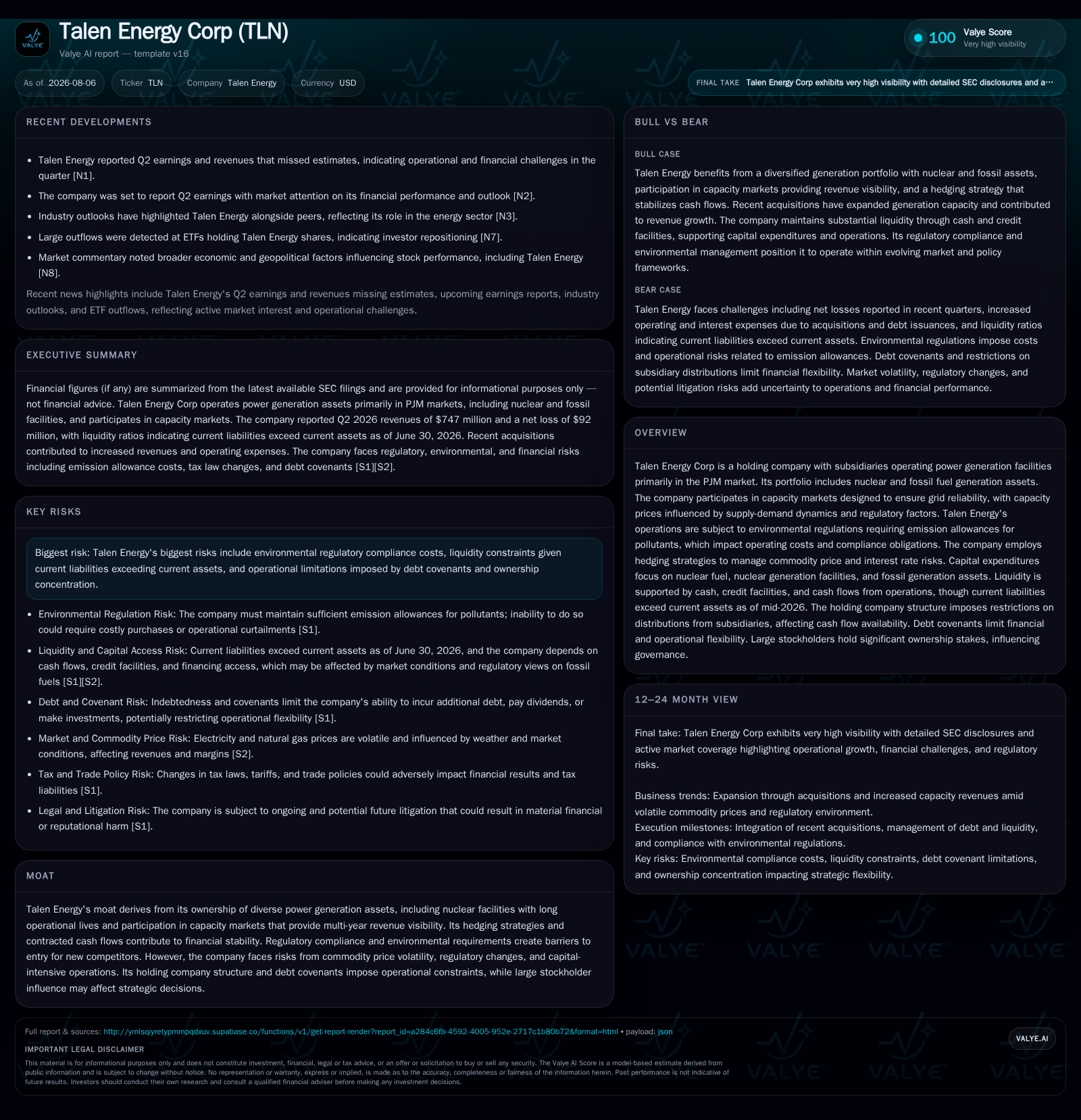
Talen Energy’s latest quarterly report highlights the interplay between increased capacity market prices, rising emission allowance expenses, and liquidity pressures shaping its operational outlook.
In Q2 2026, Talen Energy benefited from higher PJM wholesale electricity and capacity prices driven by weather-induced demand spikes, yet faced margin pressure from escalating emission allowance costs. The company’s diversified asset base—balancing nuclear facilities with fossil generation—provides some operational stability but exposes it to regulatory-driven cost inflation. Delays in PJM capacity auctions have reduced revenue visibility, complicating capital planning amid a tight liquidity position underscored by debt leverage exceeding $9 billion and a current ratio below one. Hedging strategies partially mitigate commodity price volatility but cannot fully offset structural risks tied to environmental regulations and capital intensity.
Stronger Capacity Pricing Collides with Regulatory Expense Pressures in Q2 Results
Talen Energy’s second-quarter 2026 operating results underscore a complex environment where improved power market conditions clash with rising regulatory costs. On-peak day-ahead power prices at the PJM West Hub climbed to $65.58/MWh, a nearly 25% increase from $52.71/MWh in the same quarter last year [S2]. This surge was driven largely by periods of above-average temperatures which spiked electricity demand, corroborating how weather volatility continues to influence short-term pricing dynamics in regional wholesale markets such as PJM.
Forward-looking indicators show even more pronounced improvement: PJM West Hub forward prices averaged $71.08/MWh for July–December 2026 compared to $49.52 last year, while forward spark spreads — a critical metric combining power prices minus fuel costs — jumped from $28.86 to $50.04/MWh [S2]. This wider spark spread reflects stronger profitability potential around natural gas-fired generation despite natural gas prices trending lower ($2.15/MMBtu vs $2.47 prior year). However, these gains are partly offset by rising emission allowance costs necessary for fossil operations under EPA regulations.
The confluence of these factors reveals a margin squeeze: higher revenues from strong capacity pricing counterbalanced by elevated operating expenses linked notably to emission allowances required for sulfur dioxide, nitrogen oxides, and carbon dioxide compliance [S1]. The increasing price and tighter supply of allowances raise the cost threshold for burning fossil fuels profitably within Talen’s portfolio. Confirming this dynamic requires consistent measurement of emission allowance usage and related expense trends alongside spark spreads.
The Fuel Mix Balancing Act: Nuclear Reliability Versus Fossil Emissions Costs
Talen’s generation mix features both nuclear units with high plant availability factors and fossil-fuel plants facing growing regulatory cost pressures [S1][F1]. Nuclear assets provide a stable operational backbone due to their sustained output reliability and multi-decade operational life cycles. Such characteristics enhance predictability of cash flows since these units are less affected by fluctuating commodity or emission allowance costs.
Conversely, fossil generation brings exposure to sharp swings in fuel prices and significant compliance burdens arising from regulated emissions frameworks including new EPA Good Neighbor Plans and GHG rules impacting facilities like Colstrip [S1]. Additionally, asset retirement obligations (AROs) related to legacy coal waste disposal create long-term financial commitments that compound cost structures.
This duality shapes Talen’s capital allocation priorities: investing in nuclear fuel management and maintenance ensures preservation of steady output capacity while fossil plants require ongoing investment to meet evolving environmental mandates or face curtailments. Monitoring plant availability factors alongside emission-related capital outlays will validate management's allocation effectiveness.
Capacity Market Timing and Auction Delays Impact Revenue Visibility
PJM’s Reliability Pricing Model is designed to secure capacity commitments about three years ahead via annual base residual auctions (BRA) held each May [S2]. For Talen, timely auctions underpin multi-year revenue visibility critical for investment decisions in capital-intensive generation assets.
However, recent PJM auction delays have compressed lead times between capacity commitments and delivery years — resulting in less than three years’ advance notice [S2]. This reduction hampers Talen’s ability to confidently forecast revenues across its fleet, particularly nuclear units requiring extended capital planning horizons.
In practice, delayed auction timing could increase risk premiums demanded by market participants or prompt conservative capacity offers that pressure achievable pricing levels for incumbent generators like Talen. The situation reinforces the importance of near-to-medium term operational flexibility to navigate regulatory changes while optimizing dispatch based on spot market signals.
Hedging Strategies Cushion Commodity Volatility but Don’t Resolve Structural Risks
Talen employs commodity hedging focused on first-lien based programs granting counterparties security interest aligned with senior secured debt collateral [S8]. This arrangement limits margin calls typical of exchange-traded hedging instruments, reducing liquidity strain during volatile market price movements.
Despite this prudence, hedging cannot fully insulate against systemic risks such as sustained increases in emission allowance prices or interest rate hikes that inflate debt service costs.
In contrast, fossil plant capex projections are somewhat larger ($150 million) but carry greater uncertainty linked to potential retrofits mandated by environmental compliance or possible accelerated retirements.
Liquidity constraints complicate this balancing act [F1]. As of June 30, 2026, Talen reported only $231 million in unrestricted cash against total debt approaching $9.7 billion and a current ratio below one (0.78) indicating more short-term liabilities than assets
Pending litigation concerning the EPA's 2024 Effluent Limitation Guidelines (ELG) rule introduces uncertainty about allowable fuel use timelines or retrofit requirements at affected plants.
These regulatory developments may force premature unit retirements or require expensive pollution control technology investments — outcomes that could materially elevate compliance costs beyond current provisioning assumptions.
The extended timeline for resolution implies ongoing ambiguity that could impact both near-term operating flexibility and long-term asset valuation metrics; progress in adjudicating these cases will be crucial paralleled by tracking allowance cost trends within operational reporting frameworks.
Financial Profile Discussion: Debt Leverage, Liquidity Gaps, and Capital Structure Constraints
Talen Energy reported total debt near $9.7 billion as of mid-2026 alongside just $231 million cash holdings yielding net debt around $9.46 billion at quarter-end [F1]
These constraints reduce tactical flexibility needed for opportunistic capital deployment or smooth dividend policies under volatile earnings conditions.
Rising interest expense totaling an additional ~$120 million cash outflow linked mainly to newly issued unsecured notes also weighs on free cash flow generation capacity [S23]. Combined with sizeable capital expenditure profiles focused on sustaining core nuclear assets plus necessary fossil compliance investment demands, these factors reinforce tight financing margins capable of influencing future strategic decisions around asset sales or refinancing initiatives.
Outlook Indicators: Auction Schedules, Regulatory Clarifications, and Contract Renewals to Watch
Key near-term milestones include forthcoming PJM capacity auction schedules which will restore greater multi-year revenue visibility following recent delays; these will be pivotal for affirming capacity value assumptions inherent in planning models [S2]. Concurrently unresolved EPA regulatory matters impacting emission allowances will dictate compliance cost trajectories imperative for accurate long-run financial forecasting.
Lastly, contract renewal statuses—especially power purchase agreements tied to larger load customers such as AWS post-co-location PPA amendments—bear directly on contracted versus spot revenue mix ratios influencing overall margin stability [S1][S3]. Close monitoring of these variables through public disclosures will serve as leading performance indicators providing clarity on both operational sustainability and financial resilience moving forward.
This analysis integrates Talen Energy’s most recent quarterly disclosures with broader industry context highlighting the delicate balance between improving capacity market economics and mounting regulatory/financial burdens common among power producers with mixed-generation portfolios active in competitive grid markets like PJM. The interplay between physical asset reliability metrics such as plant availability factors and structural constraints arising from environmental compliance complexities remains central when assessing future earnings quality and capital allocation discipline within Talen’s business framework.
Disclaimer:
This report is an independent analyst interpretation based solely on publicly available SEC filings and does not constitute investment advice or an offer to transact securities.
Disclaimer: This is research-only, informational analysis and not investment advice. It may include AI-generated interpretation and general industry context. Always verify important details using primary sources.

Comments