
COPT Defense Properties Strengthens Specialized Government-Adjacent Real Estate with High Retention and Development Momentum
COPT Defense Properties advances its niche REIT strategy with solid occupancy, strong tenant retention, pre-leased developments, and robust capital management.
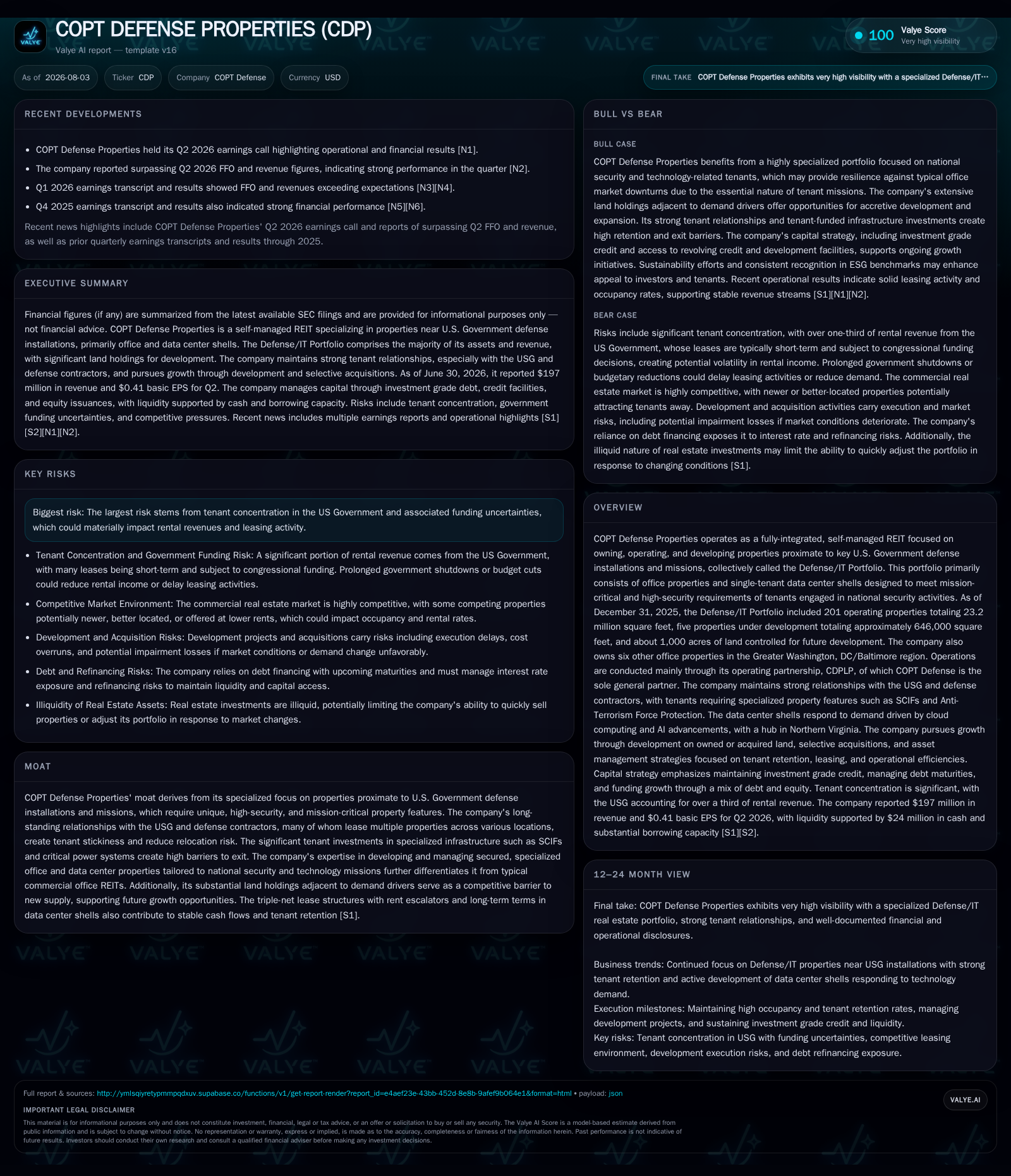
In Q2 2026, COPT Defense Properties continued to capitalize on its specialized focus on mission-critical office and data center properties near U.S. defense installations, maintaining high occupancy and tenant retention rates. The company’s substantial development pipeline, including predominantly pre-leased projects, supports steady revenue visibility amid external government budget uncertainties. Its financial position remains stable with ample liquidity and manageable debt maturities supporting ongoing growth initiatives. Risks remain concentrated in tenant concentration and potential government funding fluctuations, but the strategic land holdings and specialized infrastructure investments create durable competitive advantages.
Recent Operating Update: Q2 2026 Stability Affirms Growth Thesis
COPT Defense Properties’ latest quarterly filings confirm the continuation of operational strength central to its investment proposition—a specialty REIT focused on real estate proximate to U.S. government defense installations. As of December 31, 2025, the Defense/IT Portfolio accounted for over 92% of the Company’s rentable square footage (23.2 million sq ft across 201 properties) and generated roughly 90% of annual recurring rents (ARR), underscoring its strategic importance [S1]. Occupancy for this portfolio segment stood at a robust 95.5%, nudging upward from prior year levels despite being an office-centric asset class facing broader macro risks [S1].
Tenant retention metrics bolster this positive narrative: the Defense/IT Portfolio maintained a retention rate of 79.3%—its tenth consecutive year above the critical 75% threshold—demonstrating durable tenancy given typical challenges in government-related leasing environments [S1]. This retention supports stable cash flows essential for REIT dividend distributions and signals effective management of lease expirations even in sub-markets like Fort Meade/BW Corridor where renewal challenges occurred [S1]. Leasing activity further reinforces demand with over 424,000 square feet of vacant space committed during the year alongside notable progress leasing newly developed spaces that sum to nearly half a million square feet placed into service fully leased [S1].
Business Model: Specialized Government-Adjacent Real Estate
COPT Defense Properties operates as a fully integrated, self-managed REIT targeting high-security commercial real estate tailored to the unique requirements of government agencies and defense contractors engaged in priority national security missions [S1]. Its portfolio blends office buildings optimized for mission support functions alongside single-tenant data center shells designed to accommodate sensitive classified or technology-driven operations requiring dedicated infrastructure.
Revenue is generated through long-term leased contracts where tenants pay base rent plus recoverable expenses under leases often featuring escalations tied to inflation or defined step-ups [S14]. The firm's tenancy benefits from significant switching costs; tenants invest heavily in specialized infrastructure such as Sensitive Compartmented Information Facilities (SCIFs), controlled access, specialized power redundancy, and other security features that are costly to replicate elsewhere or relocate. This creates high tenant stickiness uncommon in traditional office environments but vital in national security contexts
The company monetizes both stabilized operating properties as well as its development expertise by building properties ahead or near completion with substantial pre-leasing commitments, which mitigate speculative risk common in commercial real estate development [S1]. Its operating partnership structure facilitates direct ownership control while managing property-level services that support maintenance of requisite security standards.
Industry Structure and Competitive Position
Within the broader REIT landscape, COPT occupies a distinctive niche intersecting office-oriented specialized REITs and data center-focused landlords due to its twin emphasis on secure office and single-tenant data centers proximal to defense hubs. Compared against traditional office REITs facing secular headwinds such as remote work trends reducing demand, COPT's tenant base mitigates these pressures by virtue of mission-critical mandates that necessitate physical presence near installations.
Peers such as EastGroup (industrial focus) or Digital Realty (data centers) share some development attributes but differ materially in tenant profile and lease structures; COPT's focus on government contracting tenants ensures unique regulatory compliance burdens and infrastructure demands that erect higher entry barriers for competitors. This specialization fosters customer loyalty supported by long-term contracts exhibiting relatively low churn.
Moreover, the company's large land holdings immediately adjacent to core defense markets form a tangible moat restricting new competitive supply that would otherwise dilute rentals or occupancy; zoning constraints and need for certifications heighten these barriers further. The nature of governmental ecosystem tenants also limits direct competition from non-specialized landlords who lack requisite facility security clearances or experience managing highly regulated environments.
Growth Drivers: Pre-Leased Pipeline & Tenant Expansion Demand
The company’s five active developments, aggregating approximately 646,000 square feet slated for delivery shortly, underpin near-term revenue growth with three out of four properties pre-leased before construction concluded—a testament to robust forward demand visibility among defense contractors expanding mission capabilities or renewing under updated footprint requirements [S1]. The ability to secure such pre-leases before capital deployment is crucial; it limits absorption risks endemic to commercial real estate investment while confirming end-user commitment.
Additional controlled land acreage amounting to roughly 1,000 acres offers a runway approximating over ten million square feet of potential future development—effectively securing supply-side control amid constrained market conditions prevalent near military bases where expansion faces logistical constraints [S1]. This strategic land bank positions COPT well not only for organic growth via development but also opportunistic acquisitions leveraging its market expertise.
Increasing government spending on defense modernization programs coupled with growing IT deployment at contractor campuses accelerates demand for facilities blending office functions with data processing capacity—precisely COPT’s product offering. Moreover, government initiatives emphasizing cybersecurity augment requirements for secure infrastructure investments within these assets, indirectly raising tenant switching costs.
Risks and Watchpoints: Tenant Concentration & Funding Uncertainty
Despite a strong operational profile, reliance on the U.S. Government (directly 35% ARR) plus prime defense contractors (more than half combined top tenants) concentrates exposure meaningfully as government budgetary decisions materially affect tenant leasing behavior [S14]. Prolonged shutdowns or budget impasses could constrain payment timeliness as well as delay renewals or expansions.
Although careful lease structuring alleviates some risk via staggered maturities and rent escalations protecting income streams partially against inflationary pressure, macroeconomic downturns influencing corporate partner budgets represent watchpoints especially if federal priorities shift fiscally or geopolitically.
Development execution risk persists albeit reduced due to pre-leasing; possible delays or cost overruns could affect timing or returns. Market competition remains moderate given scarce available supply but landlords outside core defense corridors could compete for overflow demand if government agencies recalibrate location preferences post-pandemic.
What to Watch Next: Leasing Velocity & Capital Deployment Execution
Monitoring quarterly occupancy changes—especially within key sub-segments like Fort Meade—and tenant retention outcomes remain immediate indicators of portfolio health given slight recent attrition reported earlier in certain areas [S1]. Progress on delivering committed developments on schedule while preserving or enhancing pre-leased status will shape revenue growth clarity.
Financial markers such as funds from operations (FFO), adjusted FFO per share progression relative to peer specialized REITs or broader market metrics will illuminate ongoing margin leverage trends tied to rent per square foot enhancements achieved through renewals or new leases.
Capital markets activity noting whether new equity issuance supplements conservative debt levels during upcoming maturity windows beyond currently pre-funded obligations would indicate management’s confidence navigating cyclical volatility around interest rates [F1],[S4].
Financial Profile Discussion
As of June 30, 2026, COPT Defense held $24 million in cash and equivalents against approximately $2.61 billion total debt resulting in net debt around $2.59 billion—a leverage profile consistent with sizable specialized REIT peers requiring significant upfront capital for secured developments yet balanced by stable recurring rents emerging from long-term tenancy commitments [F1]. The bulk of debt is fixed-rate following recent refinancing programs that eliminated near-term balloon maturities except an effectively prepaid senior bond due March 2026 ensuring no refinancing pressure till at least 2028 except routine amortizations [S4],[F1].
Additionally, revolving credit facilities offer approximately $746 million borrowing capacity providing ample liquidity flexibility supporting ongoing property capital expenditures estimated near $100 million annually including tenant improvements integral to maintaining high-quality mission-critical accommodations [S5],[S8].
Operating performance continues generating net operating income growth supported by rent escalations averaging around mid-single digit percentages on renewals despite modest market-wide office headwinds demonstrating pricing power due to asset specialization and location exclusivity [S11],[S1]. Dividends remain sustainable given cash flow consistency aligning with REIT distribution requirements.
In summary, COPT Defense Properties’ stable financial footing complements its business model well suited for capital-intensive but resilient government-aligned commercial real estate positioning it favorably against both traditional office landlords battling secular obsolescence risks and pure data center landlords focused only on cloud-scale payloads.
Disclaimer: This is research-only, informational analysis and not investment advice. It may include AI-generated interpretation and general industry context. Always verify important details using primary sources.

Comments