
Deep Fission Advances Deep Borehole SMR Development Amid Early-Stage Capital Challenges
Deep Fission pursues phased commercialization of its novel deep borehole small modular reactor amid technical validation and regulatory complexity.
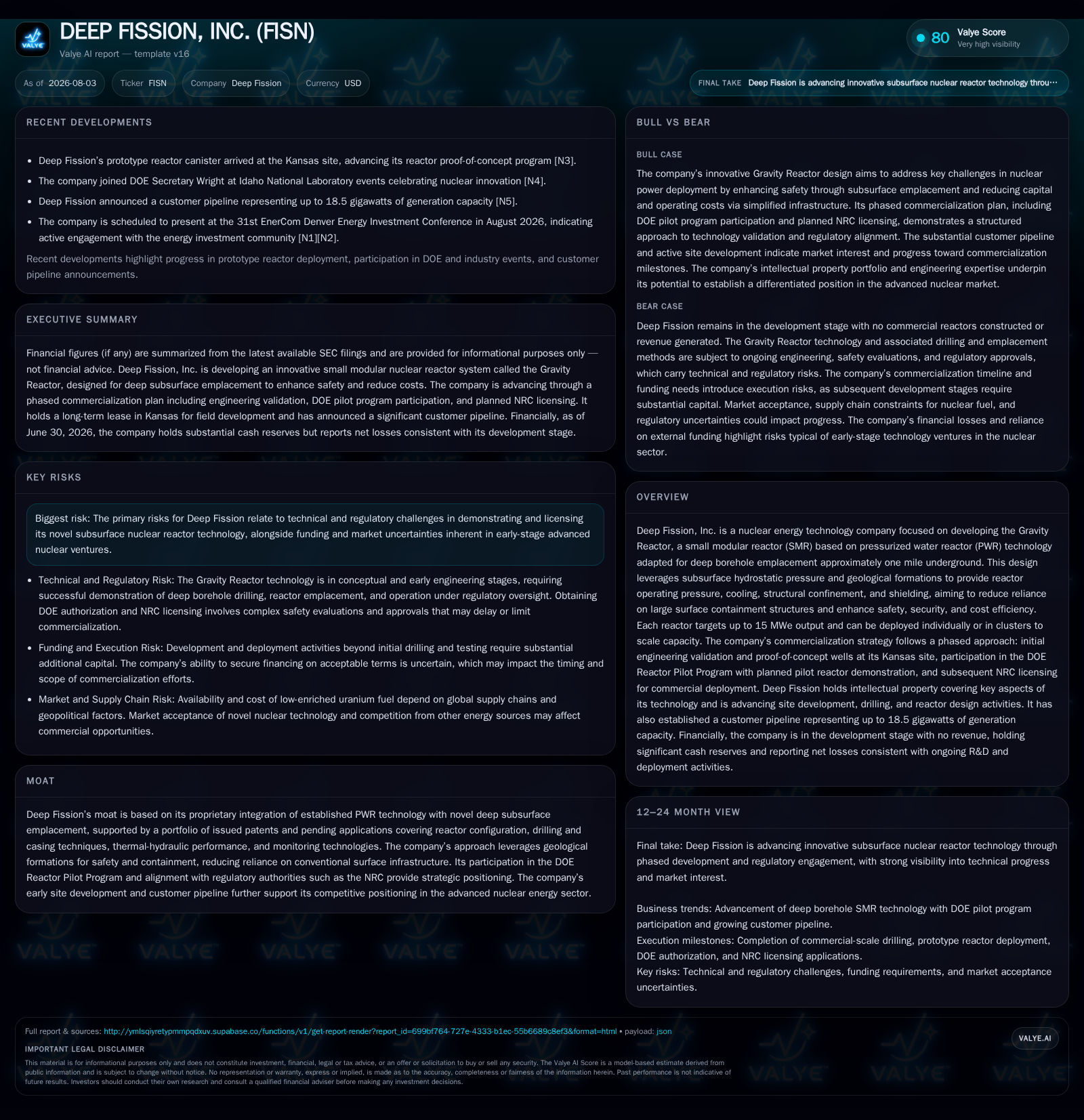
Deep Fission, Inc. is developing the Gravity Reactor, a small modular nuclear reactor (SMR) utilizing pressurized water reactor (PWR) technology adapted for emplacement in deep boreholes approximately one mile underground. The company focuses on leveraging geological formations for enhanced safety and cost efficiencies while targeting initial pilot deployment within three years. Recent filings reveal ongoing engineering validation, prototype drilling at its Kansas site, and active participation in the DOE Reactor Pilot Program. Despite technological promise, Deep Fission faces typical early-stage risks including capital needs, regulatory uncertainty, and operational scale-up hurdles. Its financial position shows solid liquidity but continued losses reflective of pre-commercial development.
Recent Operating Update
Deep Fission’s latest quarterly filing from August 3, 2026 [S2] confirms continued progress executing its phased commercialization plan focused on validating core engineering components central to the Gravity Reactor concept. The company has drilled data acquisition wells reaching depths up to 6,000 feet at its Kansas site within the Great Plains Industrial Park [S1], marking critical steps toward demonstrating commercial-scale vertical borehole drilling capability—a foundational technical risk for its novel underground reactor emplacement approach.
Parallel efforts include fabrication and delivery planning for key system components such as well casing, reactor canisters, heat exchangers, and loading of low-enriched uranium fuel [S1]. These activities collectively prepare for the imminent installation of a full pilot system targeted over the coming months.
Strategically, Deep Fission’s involvement in the U.S. Department of Energy (DOE) Reactor Pilot Program provides an institutional framework for technical oversight and authorization that precedes Nuclear Regulatory Commission (NRC) commercial licensing [S1][S19]. This engagement is crucial for generating commissioning data to inform future regulatory submissions. While timelines remain contingent on funding availability and regulatory approvals, management emphasizes early risk mitigation focusing on drilling execution and integration of nuclear systems underground.
Additional developments include recent corporate governance updates enhancing board compensation policies to align with market standards [S3], alongside a June 2026 public equity offering raising gross proceeds of $40 million [S7]. These capital infusions strengthen liquidity during ongoing pre-commercial development expenditures.
Business Model Overview
Deep Fission’s business model revolves around developing the Gravity Reactor: a small modular reactor (SMR) leveraging established pressurized water reactor (PWR) technology uniquely adapted for emplacement roughly one mile below surface via deep boreholes [S1]. The design exploits natural hydrostatic pressure within boreholes to maintain reactor operating pressure and cooling functions while relying on surrounding geological formations for structural confinement and radiation shielding.
This underground containment strategy aims to reduce reliance on large engineered surface structures common in conventional nuclear plants, thereby lowering capital costs, accelerating deployment timelines, enhancing security against physical threats or environmental hazards, and reducing operating expenses.
Each Gravity Reactor is designed to produce approximately 15 megawatts electric (MWe), with flexibility to deploy reactors individually or cluster them at a single site. Clustering supports operational efficiencies through shared infrastructure and coordinated fuel management such as staggered refueling cycles [S1].
Revenue generation is expected from multiple streams: upfront project development fees associated with Gravity Reactor deployments; recurring technology licensing fees governing use of proprietary designs; operations and maintenance services sustaining deployed units; and potential equity stakes in projects providing indirect cash flow exposure from electricity sales [S15]
Site control is established through long-term leases such as the Kansas site where initial engineering validation activities are underway [S1]. Non-binding letters of intent with prospective partners indicate cumulative generation capacity opportunities potentially reaching tens of gigawatts over future multi-year horizons—contingent on successful pilot demonstrations and regulatory progress [S24]. Strategic collaborations targeting high-demand sectors like data centers aim to align offerings with emerging energy consumption patterns driven by artificial intelligence growth.
Industry Structure and Competitive Position
Deep Fission operates within the advanced nuclear energy sector characterized by intensive regulation, high capital intensity, long development cycles, and complex technology integration. It occupies a specialized niche focused on innovative SMRs deployed via deep borehole emplacement rather than conventional surface-based modular reactors.
This approach differentiates Deep Fission from peers such as NuScale Power or Rolls-Royce SMR which develop above-ground modular units presenting different engineering trade-offs. The company’s competitive advantage derives from proprietary integration of mature PWR cores with novel geological confinement techniques supported by patents covering drilling methods, thermal-hydraulic optimization, subsurface monitoring technologies, among others [S1].
Participation in the DOE Reactor Pilot Program aligns Deep Fission with federal initiatives driving regulatory modernization under legislation like the Nuclear Energy Innovation and Modernization Act (NEIMA). This engagement facilitates early commissioning data generation informing subsequent NRC licensing applications under evolving frameworks better suited for advanced reactors [S19].
The hydrostatic pressure-driven containment strategy reduces dependence on extensive engineered surface facilities—a major cost driver in traditional nuclear plants—offering potential savings if pilot outcomes validate assumptions. Subterranean siting also confers enhanced operational security against physical threats or sabotage concerns increasingly relevant in today’s geopolitical climate.
However, this pioneering methodology introduces execution risks including precision deep vertical drilling at commercial scale coupled with new regulatory classification challenges highlighted by ongoing litigation contesting NRC licensing criteria applicability to such advanced designs [S14][S26][S27]. Market competition extends beyond SMR vendors to mature renewable energy sources which may constrain adoption depending on comparative cost-effectiveness.
Growth Drivers
Growth catalysts include rising global demand for reliable low-carbon baseload power amplified by surging electricity needs from AI data centers requiring stable energy inputs [S1]. Government incentives such as DOE funding programs underpin capital availability critical for advancing nascent nuclear technologies.
Technological innovations embodied in Deep Fission’s Gravity Reactor promise cost curve disruption through scalable modularity enabled by clustered installations allowing incremental capacity expansions tailored to customer requirements [N5][S24]. Successful pilot demonstrations under DOE oversight represent pivotal proof points likely unlocking further strategic partnerships vital given current pre-revenue status
Power purchase agreements (PPAs) with utilities or large industrial users could establish revenue visibility post-regulatory approval phases. Early-stage MOUs offer foundational frameworks but remain non-binding reflecting exploratory status currently [S24]. International expansion depends on export controls compliance and international cooperation agreements representing medium-term opportunities.
Risks and Watchpoints
Key risks center on technical feasibility of reliably drilling deep vertical boreholes exceeding several thousand feet combined with safely installing nuclear systems underground—a novel integration blending nuclear physics with geotechnical engineering demands [S10][S14]. Regulatory uncertainty persists amid incomplete NRC framework modernization originally designed for large conventional reactors potentially prolonging approval timelines exacerbated by ongoing litigation challenging agency interpretations affecting advanced reactor classification [S14][S26][S27].
Financial sustainability hinges on continued access to substantial capital given persistent operating losses typical of R&D-intensive stages. The company reported a net loss exceeding $61 million in fiscal 2025 despite recent equity inflows totaling $40 million gross proceeds mid-2026 supplementing cash reserves near $93 million at Q2-end 2026—comfortably covering current liabilities but necessitating further fundraising ahead of commercialization [F1][S7]
Supply chain vulnerabilities involve sourcing specialized nuclear components subject to stringent safety requirements amid global geopolitical uncertainties impacting logistics [S10][N5]. Market adoption faces competition from increasingly cost-competitive renewables alongside public apprehension regarding nuclear safety influencing political support levels [S10][N4].
Previous internal control weaknesses disclosed relating to financial reporting increase operational risk profiles potentially affecting investor confidence pending remediation completion [S10][S22].
What To Watch Next
Near-term milestones include successful completion of commercial-scale borehole drilling demonstrating safe emplacement consistent with design parameters coupled with full integration testing culminating in prototype reactor commissioning authorized under DOE oversight enabling subsequent NRC licensing stages [S1][S19]. Progress updates will be critical indicators of schedule adherence and technical feasibility.
Capital markets will monitor funding environment evolution especially institutional or strategic investor interest reflecting confidence beyond validation phases—particularly as initial PPAs or definitive commercial arrangements materialize beyond existing LOIs [N5][S24]. Regulatory developments including NRC rulemaking outcomes under Part 53 modernization efforts alongside resolution progress in litigation challenging licensing frameworks will materially influence timeline certainty and valuation prospects.[S14]
Competitive dynamics versus peers such as TerraPower or NuScale Power progressing alternate advanced designs will shape relative franchise viability depending on speed-to-market and cost competitiveness.
Financial Profile Discussion
Deep Fission’s financial snapshot typifies an early-stage advanced nuclear developer transitioning from R&D toward commercialization. As of June 30, 2026, cash and equivalents stood at approximately $93 million supported by recent equity raises including a $40 million gross public offering completed in June 2026 [F1][S7]. Current assets totaled nearly $97.8 million against modest current liabilities around $8.5 million yielding a robust current ratio near 11.5x indicative of strong short-term liquidity management despite ongoing developmental cash burn.[F1] Total debt remains negligible relative to cash reserves implying minimal leverage exposure.[F1]
Capital expenditures focus primarily on wellfield development activities including reservoir data acquisition plus procurement or manufacture of critical components such as fuel assemblies and heat exchangers required for upcoming pilot installation phases.[S11][S16] Prudent liquidity stewardship combined with successful funding rounds will be essential given extended timelines typical in nuclear project commercialization.
Disclaimer: This is research-only, informational analysis and not investment advice. It may include AI-generated interpretation and general industry context. Always verify important details using primary sources.

Comments