
Enovis Advances Patient Care with Integrated Surgical Innovation and Broad Market Reach
Enovis’s Q2 2026 results highlight integration progress across diverse musculoskeletal care segments, leveraging proprietary surgical techniques and a multi-channel global footprint.
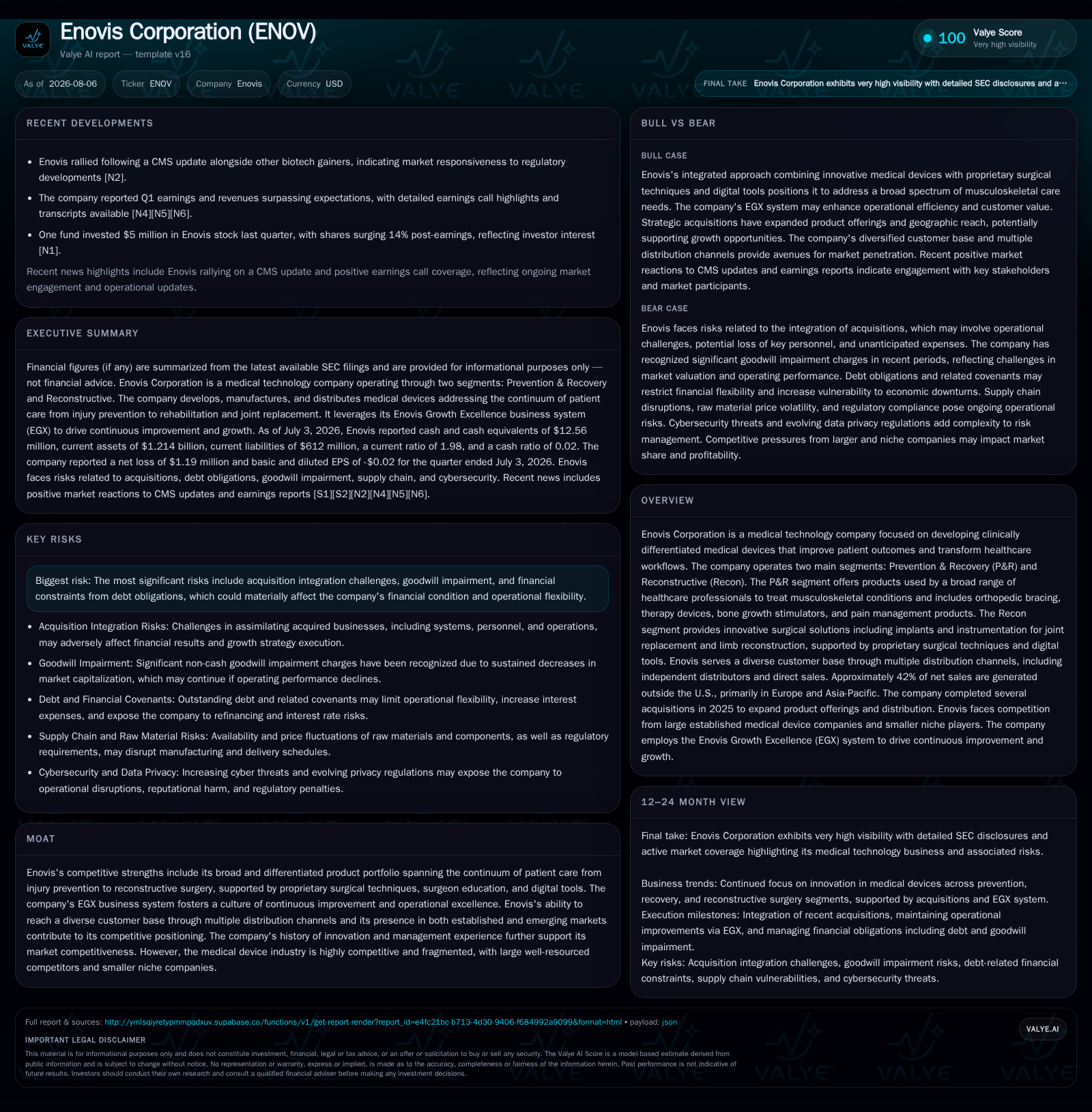
In its second quarter ended July 3, 2026, Enovis demonstrated solid operational momentum driven by growth in both Prevention & Recovery and Reconstructive segments, supported by recent acquisitions and sustained product adoption. The company’s strategy to span the musculoskeletal care continuum—from bracing to implants—combined with surgeon education and innovative digital tools, reinforces its clinical differentiation against peers. Multi-channel distribution and geographic diversification, including approximately 42% international sales, provide resilience amidst competitive and regulatory pressures. While acquisition integration remains an execution risk, Enovis’s Enovis Growth Excellence system underpins operational discipline as it navigates leverage constraints amid ongoing investments in R&D and global market expansion.
Second Quarter Operational Highlights Signal Solid Momentum in Multi-Segment Growth Strategy
Enovis’s Q2 2026 filings reveal continued progress integrating seven acquisitions completed during 2025—a combination of four within the Reconstructive segment and three within Prevention & Recovery [S1]. This diversified acquisition activity has expanded complementary product offerings spanning bracing to advanced surgical implants and broadened European distribution partnerships. While the company does not disclose detailed segment revenues for Q2 explicitly, the dual-segment strategy manifests in delivering products across a broad musculoskeletal care continuum, supporting orthopedists, surgeons, therapists, and retail consumers worldwide [S1]. Approximately 42% of net sales are generated internationally, underscoring geographic diversification that mitigates reliance on any single region [S1].
The latest quarterly [S2] and event filings [S3] emphasize operational execution amid active integration efforts. Steady adoption gains in both Prevention & Recovery (P&R)—which includes orthopedic bracing, therapy devices, bone growth stimulators—and Reconstructive products highlight active engagement with a wide customer base comprising hospitals, healthcare professionals, and distributors. This breadth provides revenue stability while enabling cross-selling across channels. Any growth pressures observed have not derailed the company’s medium-term growth trajectory supported by these multiple streams.
Leveraging Clinical Differentiation: How Proprietary Techniques Support Market Penetration
Enovis stakes its competitive positioning on clinical differentiation through proprietary surgical techniques integrated into its reconstructive offerings alongside broad surgeon education initiatives [S1]. These techniques enhance preoperative planning precision via digital surgical tools complemented by intra- and post-operative support technologies that can improve patient outcomes markedly. This end-to-end approach promotes higher surgeon adoption rates—a crucial driver given strong industry competition from major orthopedic implant peers such as Stryker Corporation or Zimmer Biomet Holdings.
R&D investment underpins this strategy by continuously refreshing product portfolios with both incremental innovations and breakthrough devices targeting unmet clinical needs [S1]. The company’s Enovis Growth Excellence (EGX) system reinforces operational excellence by embedding continuous improvement culture in manufacturing quality and cost efficiency—an advantage that supports sustainable margin expansion despite pricing pressures common in device markets.
Distribution Channel Dynamics Across Core Geographies Elevate Customer Reach and Resilience
Enovis employs a multi-channel distribution model combining direct sales forces with independent distributors tailored to regional market requirements [S1]. This hybrid approach facilitates deep penetration in developed markets while enabling scalable entry into emerging geographies with complex regulatory landscapes or varying payer structures.
The approximately 42% international sales exposure spreads risk but also subjects Enovis to foreign exchange volatility, regulatory heterogeneity including data privacy compliance complexities (e.g., HIPAA in the U.S., GDPR in Europe), and anti-bribery laws that require diligent oversight [S13]. Compared to firms like Smith & Nephew known for extensive global dealer networks, Enovis focuses on maintaining targeted channel mixes that balance operational control with market reach.
Acquisition Integration: Opportunities Realized Versus Execution Risks Underway
The accelerated acquisition pace pursuing portfolio breadth poses integration management challenges highlighted repeatedly in risk disclosures [S1][S5]. Assimilation tasks include IT systems harmonization, internal control compliance as mandated by Sarbanes-Oxley Act sections for new entities acquired—including Lima—and retention of critical personnel who facilitate product continuity.
Synergy realization timelines remain subject to execution risk; management acknowledges potential delays or unanticipated costs such as facility consolidations or legal compliance outlays impacting short-term profitability [S1]. However, these strategic moves are essential for expanding Enovis's technological capabilities and reinforcing footprint especially in Europe where recent deals added surgical implant distribution partners [S1].
Unlocking Growth: Innovation Pipeline and Expansion into Emerging Markets
Demand drivers supporting growth beyond core U.S. markets include demographic shifts such as an aging population raising musculoskeletal disease prevalence globally coupled with greater adoption of outpatient ambulatory surgical procedures [S1]. Enovis pursues emerging market entries where musculoskeletal care is underpenetrated compared to mature economies.
New product development focuses on bringing innovative pain management devices, improved bracing materials offering enhanced patient comfort, and reconstructive implants employing novel biomaterials. Regulatory approvals received or pending fortify this pipeline although no precise launch dates are disclosed [S1]. These innovations maintain competitive relevancy vis-à-vis peers who similarly advance their surgical instrumentation technologies.
Risk Factors: Navigating Integration Challenges, Regulatory Dynamics, and Leverage Constraints
Enovis faces material risks intertwined with its aggressive acquisition-driven growth strategy including potential goodwill impairments if operating performance falls short or if competitors' innovations erode market share unexpectedly [S1][S7]. Regulatory scrutiny intensifies especially relating to collaborations with surgeons whose involvement is regulated under health fraud statutes like the Anti-Kickback Statute or transparency mandates under federal Physician Payments Sunshine Act [S21][S22]. Compliance failures could trigger costly investigations or settlements.
Financially, the company maintains significant leverage with net debt estimated at approximately $1.3 billion as of year-end 2025 against cash balances just over $12 million reported mid-2026 [F1]. Substantial debt service obligations constrain financial flexibility for opportunistic investments or buffering against market volatility [F1][S4]. Capital structure amendments extending revolving credit maturity through end-2030 reflect proactive risk management but also underscore continuing leverage sensitivities [S14].
"Eyes On" Enovis: Key Milestones And Metrics To Monitor Ahead
Investors should track forthcoming quarterly disclosures focusing on organic revenue growth within each segment to gauge underlying demand beyond acquisition shocks [S2][S3]. Progress updates on synergy capture—especially cost savings realized from IT consolidation or overhead streamlining—serve as early indicators of integration success.
Monitoring new product launches aligned with regulatory clearance announcements will elucidate innovation pipeline health while changes in geographic revenue mix highlight penetration effectiveness into emerging regions. Additionally, surgeon engagement metrics through participation in educational programs may preface broader adoption of newer reconstructive devices.
Financial Profile Discussion: Leverage Supports Ambitious Growth but Demands Vigilance
As of July 3, 2026, the latest balance sheet data indicate cash and equivalents at $12.56 million juxtaposed with total debt near $1.31 billion measured at December-end 2025 resulting in substantive net debt burden above $1.29 billion [F1]. Operating margins have been pressured partly by acquisition-related costs including amortization of intangibles coupled with investments in R&D vital for sustaining clinical differentiation [F1][S2]. The company’s ability to expand EBITDA margins hinges on successful synergies realization balanced against reinvesting sufficiently in innovation pipeline maturation.
Prudent capital allocation choices will be critical amid rising interest expense potentially limiting free cash flow availability for debt reduction while sustaining growth capex or marketing spend essential to deepen market penetration.
This analysis incorporates insights primarily from Enovis’ August 2026 quarterly financial filing supplemented by its February 2026 annual disclosure highlighting integrative strategic moves accompanied by broad medical device industry context focused on orthopedic implants and rehabilitation sectors. The company’s progressive clinical differentiation combined with expansive distribution capabilities support its competitive stance though tempered by notable risk factors related to acquisition execution complexity and capital structure leverage demands. Future performance milestones stressed herein will be determinative for validating Enovis’ medium-term growth outlook.
Disclaimer: This report is for informational purposes only and does not constitute investment advice or research view.
Disclaimer: This is research-only, informational analysis and not investment advice. It may include AI-generated interpretation and general industry context. Always verify important details using primary sources.

Comments