
United States 12 Month Natural Gas Fund Balances Futures Exposure and Regulatory Constraints in Q2 2026
UNL’s Q2 2026 update underscores the challenges of tracking natural gas prices via rolling 12-month futures amid regulatory limits and market volatility.
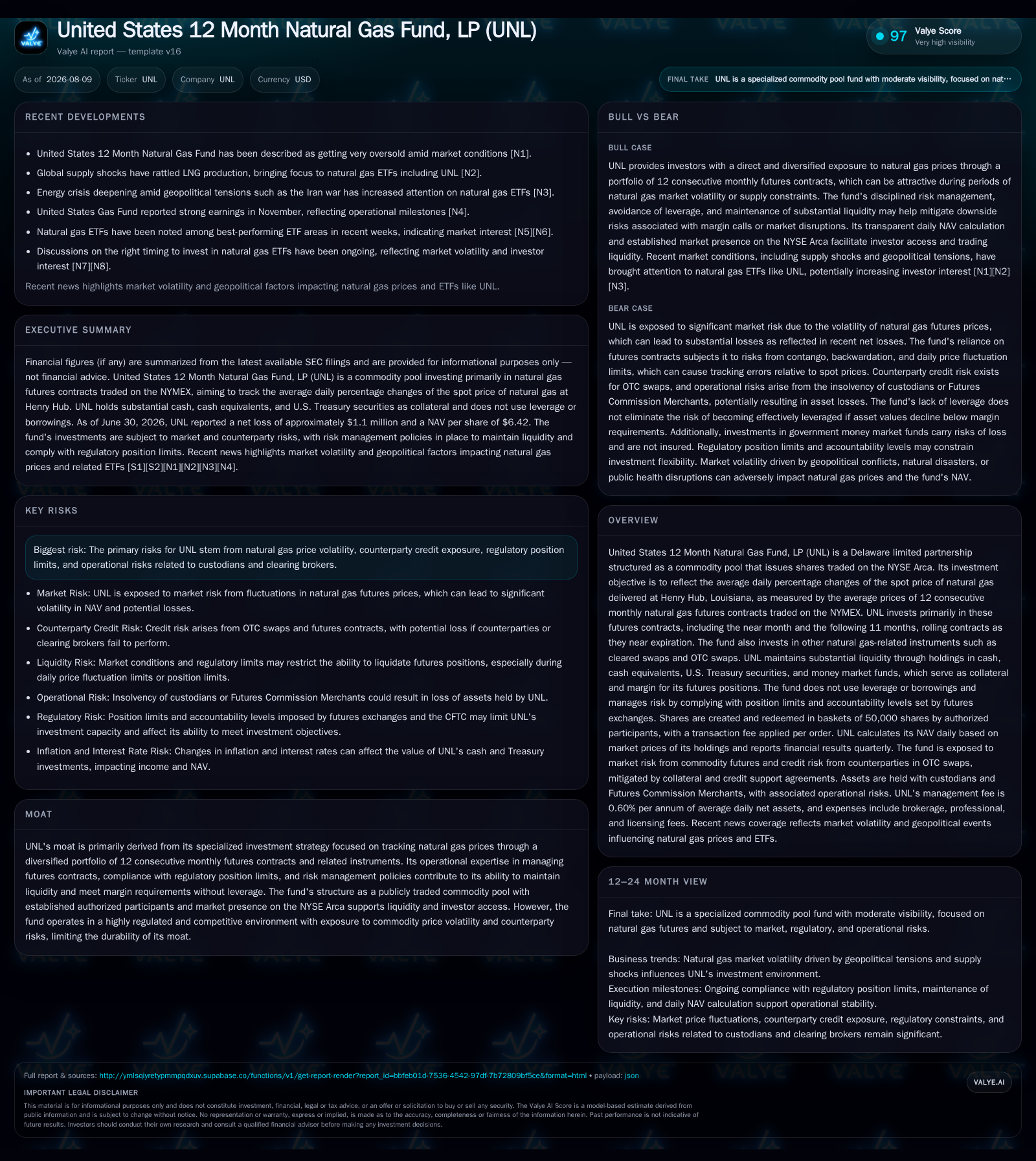
The United States 12 Month Natural Gas Fund, LP (UNL) reported its latest quarterly results on August 7, 2026, reaffirming its strategy to track natural gas spot price movements through a portfolio of 12 consecutive monthly NYMEX futures contracts. UNL’s investment approach involves rolling near-month contracts while managing margin requirements and regulatory position limits without leverage. Despite the fund’s objective to mirror daily percentage changes in the natural gas price curve, its net asset value (NAV) and share market price do not aim to replicate spot prices dollar-for-dollar, reflecting inherent tracking challenges. Liquidity management remains a key operational focus with substantial cash and equivalents held to meet collateral needs. UNL operates in a competitive commodity futures investment space alongside peers such as USO and DBC but differentiates via its specific natural gas futures exposure and no-leverage policy.
Recent Operating Update
United States 12 Month Natural Gas Fund, LP (UNL) filed its latest quarterly report on August 7, 2026. The update clarifies that the fund's investment objective is designed not to replicate exactly the net asset value (NAV) or share price relative to the spot price of natural gas delivered at Henry Hub on a dollar basis but rather to reflect the average daily percentage change in spot prices measured through a specific basket of twelve consecutive monthly natural gas futures contracts traded on the NYMEX [S2]. This approach acknowledges that tracking futures-based indices inherently diverges from spot prices over longer time horizons due to factors like roll costs.
The report also confirms that UNL continues to operate without leverage or borrowings. The fund maintains substantial liquidity through holdings in cash equivalents—approximately $15.66 million as of June 30, 2026 [F1]. These provisions help ensure that UNL can meet all margin calls promptly while adhering strictly to regulatory frameworks governing derivatives trading.
Business Model Details
UNL is structured as a Delaware limited partnership operating as a commodity pool issuing shares traded on the NYSE Arca exchange [S1], [S3]. Its core business model centers on providing investors with liquid exposure to natural gas price movements without requiring direct ownership of physical commodities or taking delivery obligations. The fund achieves this by holding a portfolio of twelve consecutive monthly NYMEX natural gas futures contracts—the "Benchmark Futures Contracts"—rolling these positions forward as near-month contracts approach expiration [S2].
Revenue for UNL arises primarily from management fees calculated as a fixed percentage of average daily total net assets; currently this rate is 0.60% per annum following a fee reduction from 0.75% in May 2024 [S8]. The fund's expenses are relatively low due to its passive nature and absence of leverage-related financing costs.
Creation and redemption mechanisms are central to UNL's liquidity framework: Authorized participants can create "Creation Baskets" of shares by delivering cash equivalent to underlying assets or redeem shares in "Redemption Baskets" typically consisting of blocks of 50,000 shares.
Importantly, UNL does not seek nor expect its NAV or market price changes over periods exceeding one day to perfectly track any single futures contract or spot prices—a realistic concession given complex roll yields driven by the shape of the futures curve (contango or backwardation), implied cost structures, and daily trading restrictions inherent in commodity markets [S2].
Industry Structure and Competitive Landscape
Commodity futures investment funds like UNL function as intermediaries channeling investor capital into speculative yet regulated markets for energy commodities without direct physical handling. They rely heavily on well-established derivative exchanges (NYMEX for natural gas), clearinghouses ensuring settlement integrity, custodians safeguarding assets (currently BNY Mellon for UNL), and transfer agents administering shareholder transactions [S2]
UNL competes within a peer set that includes other specialized commodity ETFs such as the United States Oil Fund (USO), which provides crude oil exposure via similar futures contract strategies; Invesco DB Commodity Index Tracking Fund (DBC), which offers diversification across multiple commodity sectors; and energy sector ETFs like Energy Select Sector SPDR Fund (XLE), which provides equity-based energy industry exposure rather than direct commodity instruments. UNL differentiates itself through focused management of rolling twelve-month natural gas futures without leverage—appealing to investors seeking targeted energy commodity exposure with controlled risk profiles.
Regulatory oversight plays an outsized role in shaping competitive dynamics. Position limits imposed by exchanges such as NYMEX restrict how large any participant—including UNL—can be in particular contracts or aggregate exposures across months. For example, accountability levels threshold for one-month benchmark contracts is approximately 6,000 net contracts while an aggregate ceiling exists at around 12,000 net contracts across months for natural gas [S1]. Such constraints force strategic balancing between desired exposure magnitude and maintaining compliance—further influencing the fund’s portfolio construction and risk management.
Growth Drivers
Growth catalysts for funds like UNL hinge largely on increasing investor demand for liquid commodity exposure driven by macroeconomic factors such as inflation concerns prompting allocations into hard asset proxies like natural gas; rising volatility in energy markets increasing interest in tactical positioning; and broader ETF adoption trends enhancing retail investor participation.
Innovations in commodity derivatives markets also aid growth by continuously improving trading infrastructure efficiency and allowing more precise rolling strategies that reduce tracking error.
Moreover, regulatory clarity around permissible commodity pool structures helps lower uncertainty around operational continuity appealing to institutional buyers who require transparency regarding position limits compliance and counterparty risk mitigation.
Lastly, expansion of authorized participant networks enhances secondary market liquidity facilitating smoother creation/redemption cycles—which supports stable pricing dynamics required for sustained inflows.
Risks and Constraints
Significant risks confronting UNL stem first from inherent commodity price volatility impacting NAV swings which can be sudden and extreme given geopolitical events or supply-demand shocks affecting natural gas markets directly [S18].
Counterparty credit risk arises from OTC swaps counterparties used to complement primary futures holdings; although mitigated by collateral posting policies and counterparties’ creditworthiness assessments, residual exposures remain possible especially under extraordinary market stress scenarios [S7], [S18].
Operational risks include failures at custodians or clearing brokers disrupting trade execution or settlement activities—risks managed through contractual safeguards but never fully eliminable.
Another key limitation relates to regulatory position limits potentially forcing forced reductions if aggregate positions exceed thresholds—implying possible unplanned transaction costs or rebalancing frictions impacting performance consistency [S1]. Daily price fluctuation limits imposed by exchanges cap how much futures contract prices can move per session which may freeze liquidation opportunities during rapid moves causing illiquidity periods challenging efficient NAV maintenance.
Tracking error is an intrinsic risk when using futures contracts instead of physical commodities due to roll yield effects caused by contango where longer-dated contracts trade higher than near-dated ones leading some systematic drag; backwardation offers opposite but less common dynamics. Finally, cybersecurity remains an ongoing concern given reliance on third-party IT providers despite robust controls overseen by USCF management teams [S18].
What To Watch Next
Key milestones include monitoring monthly account statements published regularly providing insight into performance attribution vis-à-vis spot natural gas movements alongside tracking roll yield impact metrics when disclosed explicitly.
Regulatory environment changes especially any revisions around position limits or new reporting requirements could materially influence portfolio sizing capabilities.
Liquidity markers such as creation/redemption volumes or changes in cash/collateral cushions indicate how well UNL manages inflows/outflows under volatile conditions.
Investor appetite indicators measured by overall assets under management growth within this specialized ETF segment would signal demand sustainability.
Continued monitoring of expense ratio trends post-fee reduction will reveal whether cost efficiencies are passed on effectively preserving investor returns.
Finally, developments regarding macroeconomic drivers like shifts in energy policy impacting natural gas production/consumption fundamentals will inevitably ripple through UNL’s performance trajectory.
Financial Profile Discussion
UNL reported cash and cash equivalents totaling approximately $15.66 million as of June 30, 2026 providing robust liquidity buffers for margin calls on its futures portfolio amidst volatile markets [F1]. Consistent with prior disclosures, UNL does not employ leverage thereby limiting balance sheet complexity but also precluding return enhancement via borrowing strategies seen in some commodity funds [S5].
Management fees have been reduced recently to a lower annual rate of 0.60%, representing a modest improvement in cost structure aimed at enhancing attractiveness relative to peers who may charge marginally higher fees for diversified strategies [S8]. Expense levels remain low consistent with passive commodity pools’ profiles.
Income generation aligns closely with realized/unrealized gains or losses driven primarily by fluctuations in natural gas futures prices rather than traditional operating revenues; hence net income variation inherently correlates with underlying commodity price cycles rather than operational growth dynamics directly observable in traditional industries [F1], [S25].
Liquidity management practices emphasize maintaining Treasuries and money market fund positions sufficient both for investor redemptions executed via Redemption Baskets typically sized at blocks of 50,000 shares plus meeting day-to-day margin calls ensuring smooth operation without resorting to forced asset sales even during rapid market moves [S4], [S11].
Overall financial discipline reflected in conservative capital stewardship linked tightly with regulatory compliance supports operational resilience but constrains potential upside during bullish markets beyond what baseline asset appreciation yields.
Disclaimer: This analysis is intended solely for informational purposes reflecting recent public filings about United States 12 Month Natural Gas Fund, LP (UNL). It does not constitute investment advice or research views. Readers should consult financial advisors before making investment decisions.
Disclaimer: This is research-only, informational analysis and not investment advice. It may include AI-generated interpretation and general industry context. Always verify important details using primary sources.

Comments