
Tootsie Roll Industries Manages Tariff and Regulatory Pressures While Leveraging North American Manufacturing
The company’s latest quarterly results underline stable operations amid evolving regulatory risks and supply chain cost challenges.
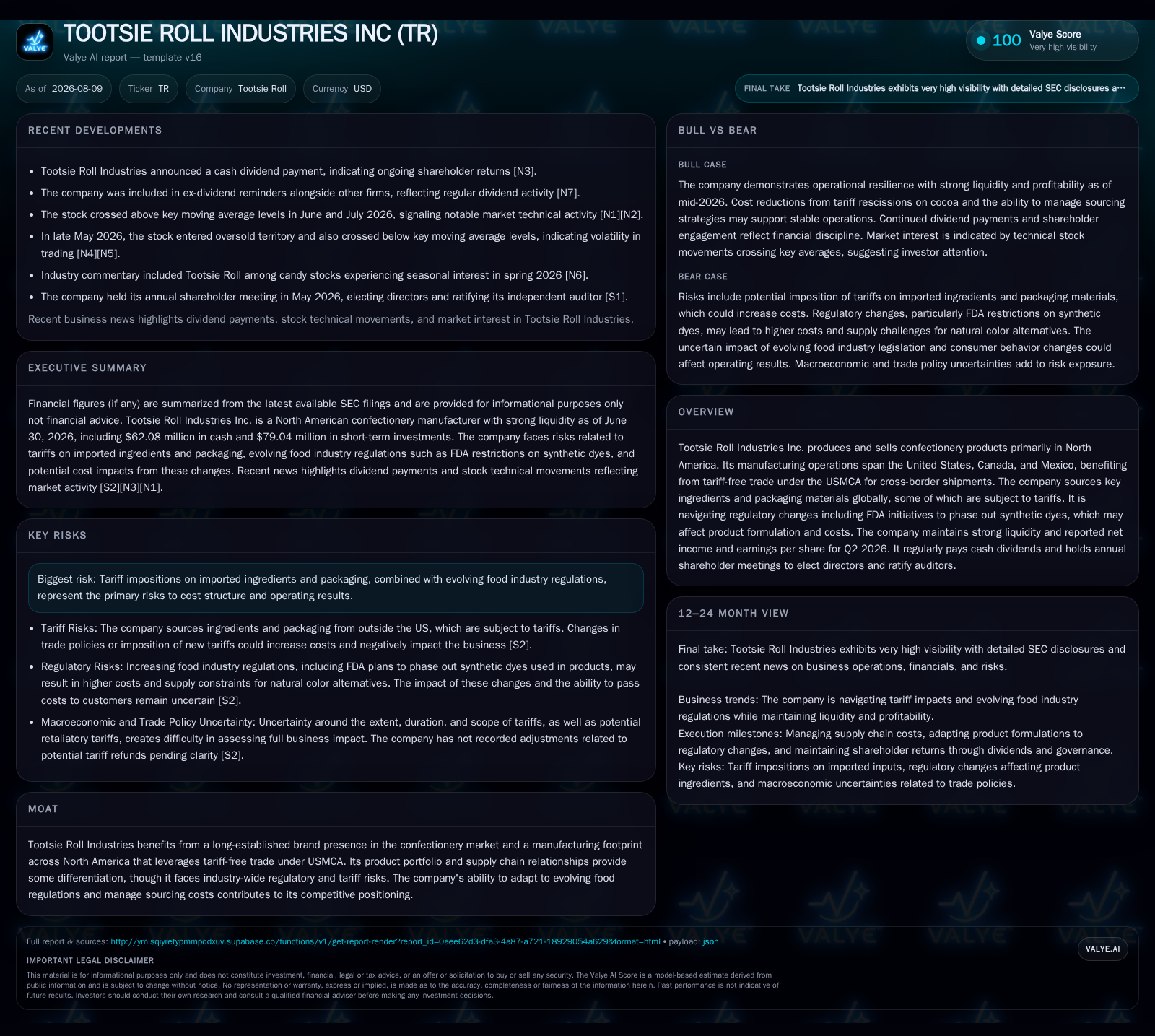
Tootsie Roll Industries reported second-quarter 2026 results showing continued stable operating performance supported by its North American manufacturing footprint. The company benefits from tariff-free cross-border shipments under USMCA but faces potential cost pressures from ingredient and packaging tariffs and the FDA’s move to phase out synthetic dyes. Its ability to mitigate tariff exposures through sourcing strategies and reformulate products with natural colorants will be critical for maintaining margins. Strong liquidity and consistent dividend payments reflect a stable financial foundation in a mature confectionery market.
Recent Operating Update: Q2 2026 Results Reflect Steady Performance Amid Cost Challenges
Tootsie Roll Industries’ Q2 2026 filing dated August 7 reports ongoing operational stability with no material changes in risk factors from prior disclosures [S2]. The company holds $62.1 million in cash equivalents and $335 million in current assets against $116 million in current liabilities, yielding a strong current ratio of approximately 2.9 as of June 30, 2026 [F1]. These liquidity metrics reinforce Tootsie Roll’s capacity to manage working capital amid supply chain cost pressures.
Although tariff-related economic policies have had only nominal impact through mid-2026, the company flags ongoing uncertainty regarding potential tariffs or surcharges imposed on goods previously covered under the U.S.-Mexico-Canada Agreement (USMCA) [S2]. Manufacturing plants located in the U.S., Canada, and Mexico allow Tootsie Roll to benefit significantly from tariff-free shipment of finished products across borders under USMCA terms [S2][S1]. However, many key raw materials—including edible oils—and certain packaging elements are sourced globally outside USMCA territories subject to tariffs, exposing input costs to potential hikes if trade policy tightens. Recent rescission of cocoa tariffs has delivered limited cost relief starting late 2025 [S2], yet the impact of new tariff regimes such as the reported U.S. global 10% tariff remains unpredictable.
Complementing these supply-side concerns are escalating regulatory challenges. FDA initiatives announced in early 2025 signal a phased elimination of petroleum-based synthetic dyes commonly used in food products [S9][S15]. Given Tootsie Roll's reliance on synthetic dyes in numerous products, reformulation efforts to transition towards natural colorants are underway but expected to increase costs while constrained supply of natural colors may limit flexibility [S9]. State-level legislative actions banning or restricting synthetic dye-containing products further complicate compliance landscape.
Business Model Specifics: Branded Confectionery Focus with Integrated North American Manufacturing
Tootsie Roll operates primarily as a branded confectionery manufacturer producing candies, gums, and related sweets distributed through retail channels across North America [S1]. Revenue is generated by selling finished packaged goods directly to wholesalers and retailers who then sell to end consumers. Production volume and product mix drive top-line variability alongside pricing factors influenced by commodity costs such as sugar, cocoa, edible oils, and packaging materials.
The company’s value chain position centers on the manufacturing stage supplemented by strong brand equity developed over decades. The diversified product portfolio includes iconic items that command consumer loyalty even amid shifting preferences [S1]. Seasonal demand spikes around holidays require efficient inventory turnover management to optimize working capital without excess stock tying up funds.
Tariff-free intra-North American shipments enabled by USMCA production footprint enhance competitiveness by minimizing customs costs and delivery delays compared with peers solely reliant on imports or domestic plants alone. However, raw material sourcing exposes Tootsie Roll to global commodity price volatility and regulatory shifts impacting input availability or quality standards.
Industry Structure and Competitive Positioning
The confectionery sector is defined by entrenched brand loyalty coupled with sensitivity to ingredient prices and tightening food safety regulations. Players compete on product innovation—including cleaner labels with natural ingredients—pricing discipline amid volatile input costs, distribution reach across retail formats, and marketing engagement.
While large multinational peers such as Mars or Hershey possess scale advantages in R&D breadth and global distribution networks, Tootsie Roll’s regional manufacturing integration within North America under USMCA affords it logistical efficiencies vital for shelf presence in the U.S., Canada, and Mexico markets. This localized manufacturing strategy aligns with industry trends favoring shorter supply chains post-pandemic disruptions.
Margins can be squeezed by rising ingredient tariffs or commodity inflation given fixed pricing contracts with major retailers that slow immediate pass-through capability. Keeping product formulations compliant with evolving FDA rules while preserving flavor profiles adds another layer of complexity relative to certain peers more diversified into snacks beyond confectionery.
Growth Drivers: Innovation Amid Regulatory and Market Shifts
Key growth pathways involve expanding healthier product variants using natural ingredients aligned with growing consumer preferences for clean-label sweets. Developing novel flavors or formats can capture incremental market share leveraging established brand trust.
Expanding retail distribution footprint including e-commerce channels offers additional volume growth vectors by reaching consumers increasingly shopping online for convenience [S1]. Seasonality around holidays also creates predictable revenue uplifts enabling inventory planning.
Cost optimization initiatives focused on supply chain efficiency—including alternate ingredient sourcing strategies—seek to mitigate tariff exposure impacts. Regulatory adaptation programs targeting timely dye reformulations aim to preserve both compliance readiness and margin integrity.
Strategic partnerships or acquisitions remain possible but unconfirmed avenues for scaling product offering breadth or geographic reach based on historical filings.
Risks and Growth Constraints: Tariffs, Ingredients Regulation, Consumer Trends
Principal risks reside in escalating costs driven by imported ingredient tariffs combined with potential retaliatory trade actions affecting cross-border logistics under USMCA terms [S9][S22]. Should material tariffs disrupt supply continuity or amplify procurement costs substantially without contractual price adjustments from customers, gross margin contraction would likely follow.
Evolving food industry legislation banning synthetic dyes necessitates costly reformulation efforts faced industry-wide yet pose execution risks related to supply constraints for natural replacements impacting product availability or pricing structures [S15][S22]. Consumer shifts away from traditional confectionery towards health-conscious snacking represent market risks requiring portfolio nimbleness.
Seasonal demand variation compels precise production scheduling; inventory mismanagement could lead either to missed sales opportunities or elevated holding costs reducing cash flow efficiency. Competitive pressures from private label brands leveraging lower pricing intensify marketplace rivalry particularly in commodity candy segments.
Economic downturns could dampen discretionary spending reducing unit sales volumes though staple confectionery items tend to exhibit some resilience given their relatively low price points.
What To Watch Next: Milestones And Demand Markers Into Late 2026
Market participants should monitor developments related to potential changes in USMCA provisions or imposition of tariffs by Canada/Mexico that might nullify existing cross-border exemptions impacting logistics cost base. Clarification around refunds related to invalidated IEEPA tariffs remain uncertain but could support cost recovery depending on government outcomes [S22].
Progress on FDA’s phased synthetic dye bans including timing of approvals for natural color formulations will materially influence product pipeline execution risk while supply availability will affect mix economics.
Commodity price movements for cocoa, edible oils, sugar, and packaging materials will continue dictating raw material cost per unit measures essential for margin monitoring.
Seasonal Q3 sales trends provide signals regarding inventory turnover health heading into Halloween/holiday season peak demand periods influential for full-year financial outcomes.
Lastly, management commentary during upcoming earnings releases will be crucial for refining views around tactical responses to input inflation pressures and effectiveness of sourcing diversification initiatives [S3][N1][N2].
Financial Profile Discussion
Tootsie Roll’s financial standing entering Q3 remains solid with cash balances surpassing $62 million complemented by a favorable current ratio of nearly 2.9 reflecting strong short-term liquidity available at quarter end June 30, 2026 [F1]
Capital expenditure appears prudently managed focusing on maintenance rather than aggressive expansion consistent with incremental innovation emphasis alongside manufacturing footprint optimization rather than greenfield growth reported historically.
While macroeconomic uncertainties including tariffs place upward pressure on cost of goods sold metrics requiring close monitoring of gross margin percentages going forward especially if pass-through pricing remains constrained by retailer contracts.
This analysis synthesizes official SEC filings through August 7, 2026 ([S1]-[S3]) combined with company facts data snapshot ([F1]) supported by industry context foundationally accessed via an LLM-powered analytical framework relevant to the confectionery sector. All numeric claims are directly cited; forward-looking interpretations are grounded solely within disclosed information without speculating future guidance or outcomes.
Disclaimer: This is research-only, informational analysis and not investment advice. It may include AI-generated interpretation and general industry context. Always verify important details using primary sources.

Comments