
Ameris Bancorp's Diversified Loan Portfolio Supports Solid Credit Quality Amid Mixed Earnings in Q2 2026
Recent quarterly disclosures show Ameris Bancorp navigating earnings pressures with steady portfolio management and capital preservation.
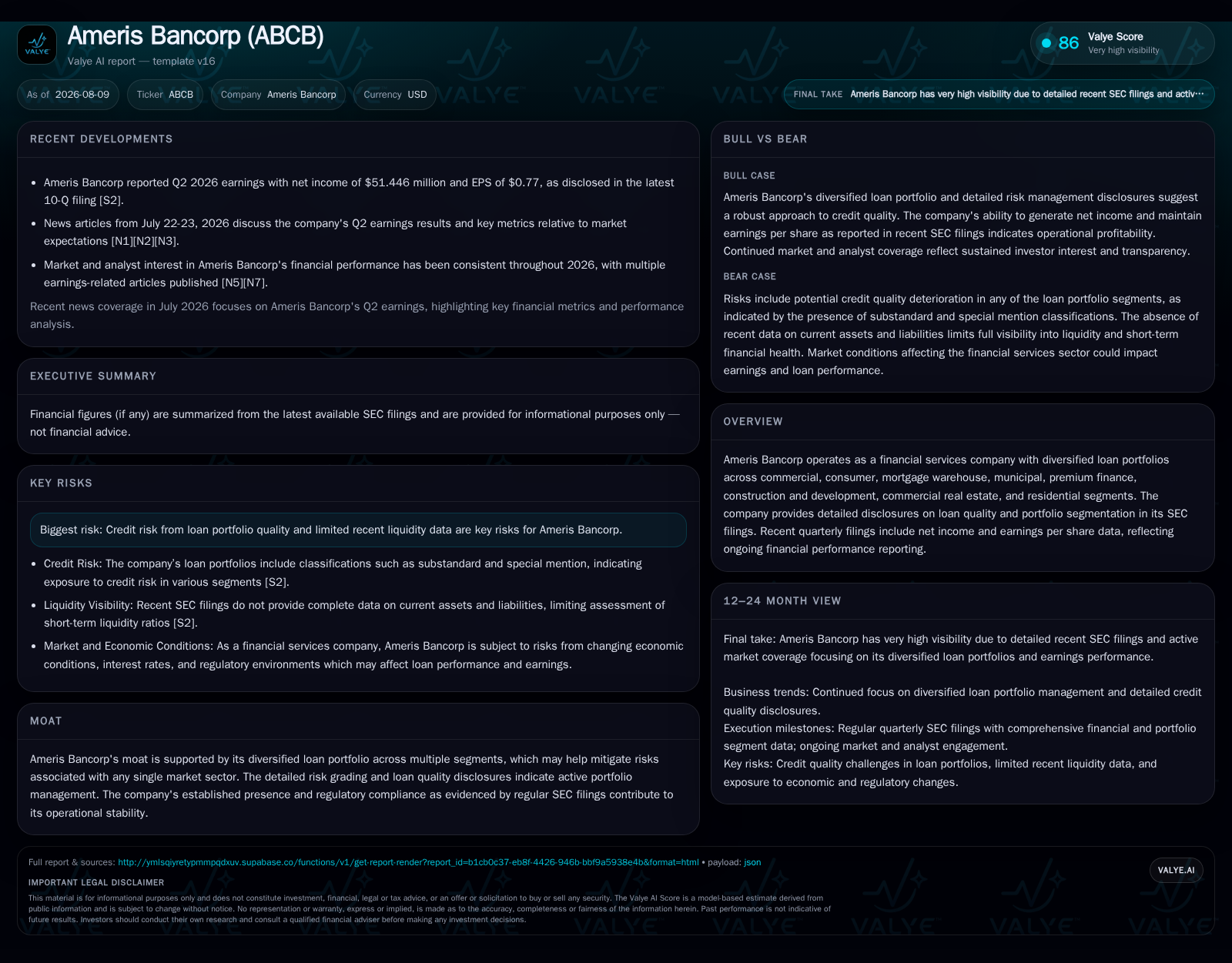
Ameris Bancorp reported net income of $161.9 million for the first half of 2026, reflecting a decline compared to last year amid rising provision for credit losses. The company maintains a broadly diversified loan portfolio across commercial, consumer, mortgage warehouse, municipal, premium finance, construction, and real estate segments that supports its credit risk management and operational stability. Ameris’s deposit base grew modestly alongside controlled borrowings. However, earnings softness relative to estimates highlights margin compression and credit quality vigilance as ongoing challenges. Monitoring the net interest margin trajectory and asset quality on upcoming filings will be key to assessing the sustainability of recent trends.
Recent Operating Update: Q2 2026 Earnings and Portfolio Trends
Balance sheet movements indicate strategic funding management with borrowings increasing substantially to nearly $7 billion offset by repayments close to $6.3 billion within the half year span [S2]. Cash and cash equivalents rose to around $1.2 billion as of June-end compared to just over $1.08 billion at the start of the year.
Management has adopted Accounting Standards Update (ASU) 2025-08 early related to recognition of credit losses on purchased loans without day-one expense impact [S5]. Additionally, implementation planning is underway for another forthcoming standard addressing internal-use software costs (ASU 2025-06), which may affect capitalized assets reporting beyond fiscal year 2027.
Market commentary around this earnings announcement highlighted a mismatch with analyst expectations underpinning shares’ muted reaction [N1][N2]. The miss is attributed in part to compressed net interest margins during competitive lending markets alongside rising credit loss provisioning.
Business Model: Diverse Regional Banking with Multi-Segment Lending Focus
Ameris Bancorp operates primarily through its wholly owned subsidiary Ameris Bank based in Atlanta, Georgia offering a broad suite of financial services characteristic of regional financial institutions [S1]. The bank serves a diverse customer base ranging from small to medium-sized enterprises (SMEs), municipalities, consumers, mortgage originators requiring warehouse lines, premium finance clients typically associated with insurance premium financing, construction developers, and real estate investors.
Revenue generation centers on net interest income—the spread between interest earned from loans across multiple sectors and interest paid on deposits plus borrowed funds—augmented by fee-based revenues such as loan servicing fees and deposit service charges. Effective credit risk management through rigorous underwriting and continuous portfolio monitoring underpins profitability given the diverse loan mix that can buffer against cyclical shocks within isolated segments.
The company's diversified loan portfolio promotes resilience: commercial loans address business working capital needs; consumer loans support retail customers; mortgage warehouse lending facilitates origination pipelines; municipal loans involve local government entities; premium finance caters to insurance-related loans; construction & development plus commercial real estate loans finance property projects; residential lending captures homeowner financing demand [S1].
Such diversification aids in mitigating concentration risk evident among peers who may lean heavily on one segment such as purely commercial or mortgage lending.
Industry Structure and Competitive Position
Within the regional banking landscape dominated by players such as Regions Financial Corporation (RF), Synovus Financial Corp (SNV), KeyCorp (KEY), Fulton Financial Corporation (FULT), and First Horizon National Corporation (FHN), Ameris Bancorp occupies a mid-sized role focused heavily on Southeastern US markets with specialization in specialty lending niches alongside traditional commercial banking.
Competition stems from both larger regional banks offering wider branch networks and digital capabilities plus community banks emphasizing local relationships. Ameris's product breadth allows it to cross-sell services but also necessitates balancing resource allocation across segments to sustain growth without diluting focus.
With regulatory pressures intensifying post-financial crisis era reforms—capital adequacy (Tier 1 ratio) maintenance here is implied as key though not specifically disclosed—Ameris must demonstrate strong asset quality controls backed by transparent risk grading disclosed periodically [S1]. Peer bank efficiency ratios and net interest margin trends provide benchmarks illustrating operational cost discipline importance alongside prudent credit loss provisioning.
Technology investments likely represent an avenue where Ameris can differentiate via customer experience improvements or underwriting automation though noted software accounting updates are only prospective impacts currently [S2].
Growth Drivers
Ameris’s growth prospects hinge substantially on economic performance within its core Southeastern footprint which drives demand for SME commercial loans, residential mortgages, and development financing consistent with regional population growth patterns.
Expanding the deposit base remains foundational as deposits finance low-cost lending allowing margin expansion when interest rate spreads widen; incremental deposit inflows of over $200 million signal healthy funding flow though the pace versus peers requires continued observation [S2]
Diversification into underpenetrated segments such as premium finance or municipal lending presents opportunities to capture fee revenue streams less sensitive to rate fluctuations.
Furthermore, adoption of emerging accounting standards ensures transparency while technology-enabled process improvements could enhance efficiency ratio outcomes if executed well.
Risks and Watchpoints
Credit risk continues as the predominant concern given observed increase in loan loss provisioning indicating either worsening borrower credit profiles or conservative reserve build amid uncertainty [S2]. Non-performing loan ratios broken down by segment would be critical forward indicators but remain undisclosed here.
Interest rate sensitivity poses risks particularly if funding costs escalate faster than yields achievable on legacy fixed-rate assets compressing net interest margin.
Regulatory compliance around capital buffers carries significance given industry-wide tightening trends; unexpected penalties or required raise could constrain capital returns or force asset sales.
Economic downturns leading to softer loan demand or higher defaults particularly in volatile sectors like construction or premium finance add cyclical vulnerability.
Competition from fintech lenders applying digital underwriting also threatens origination market share unless countered effectively.
Operational risks including cybersecurity threats heighten importance of IT investments hinted at through upcoming software accounting treatments [S2].
Reputational risks tied to portfolio quality perceptions underscore need for transparent disclosures especially given detailed grading classifications presented historically [S1].
What to Watch Next
Upcoming quarterly results will be scrutinized primarily around:
- Trajectory of net interest margin amid evolving interest rate environments,
- Changes in non-performing loans levels across portfolio segments,
- Provisioning rates relative to actual loan performance,
- Deposit growth sustainability vis-a-vis cost of funds,
- Efficiency ratio improvements from operational initiatives,
- Impact from adoption of ASU standards including software capitalization,
- Regulatory capital ratio updates signaling solvency health,
- Any guidance revisions addressing macroeconomic uncertainties noted by management.
Investor focus will likely hinge on whether earnings recover relative to prior year after recent misses [N1][N2], alongside visible confirmation that loan diversification continues buffering volatility amid tightening credit conditions.
Financial Profile Discussion
As per the latest Q2 filing ending June 30, 2026, Ameris Bancorp shows solid liquidity with cash and equivalents totaling approximately $1.2 billion supported through growing deposits up about $211 million during H1 2026 [S2]. The company’s borrowings surged but were largely offset by repayments maintaining relative leverage discipline.
Cash flow generation remains positive backed primarily by operating cash flow conversion reflecting ongoing earnings support despite downward pressure.
The company pays dividends regularly evidenced by ~$27 million common dividends during H1 2026 indicating confidence in distributable earnings balancing retained capital needs for growth or risk buffers [S2]. Treasury stock purchases also continue albeit at differing paces possibly reflecting opportunistic capital return policy aligned with valuation considerations.
This analysis synthesizes publicly available SEC disclosures dated through August 7, 2026 along with relevant market commentaries without inferring unsupported future forecasts or investment guidance.
Disclaimer: This is research-only, informational analysis and not investment advice. It may include AI-generated interpretation and general industry context. Always verify important details using primary sources.

Comments