
Covenant Logistics Balances Asset-Heavy Fleet Operations with Brokerage Amid Rising Costs
Q2 2026 results highlight operational pressures from driver market and regulatory risks amid capital investments in fleet renewal.
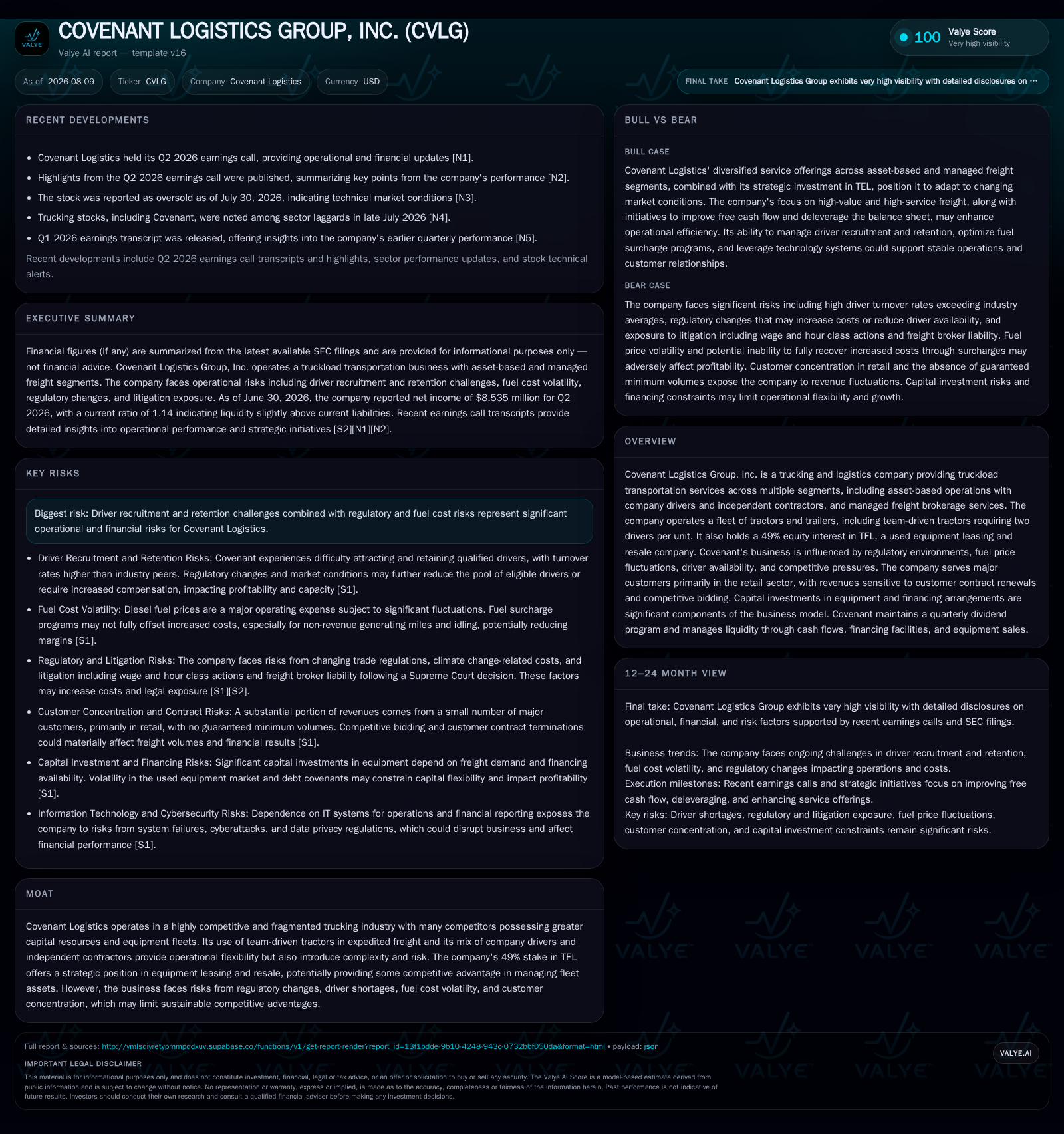
Covenant Logistics Group, Inc. reported Q2 2026 operating results that underscore ongoing challenges in the trucking and logistics sector, including driver retention, regulatory compliance costs, and fuel price volatility. The company's mixed model of asset-based truckload transportation with company drivers and independent contractors, supplemented by freight brokerage, provides flexibility but introduces operational complexity. Its strategic stake in equipment leasing/resale enhances fleet management options. However, Covenant faces industry-wide headwinds from regulatory uncertainty around driver classification, rising expenses due to environmental and safety compliance, and competitive pricing pressures from brokers and peer carriers. Capital expenditures remain a key lever for renewing the tractor-trailer fleet amid evolving regulatory demands and shifting freight patterns.
The Management Discussion notes continued exposure to class-action litigation over wage-hour regulations and ambiguous classification of independent contractors versus employees — a risk prevalent across the truckload industry due to evolving regulatory scrutiny [S2]. Fuel expense management remains critical; the company's internal decision-making receives net fuel expense data (fuel cost less surcharge revenue reimbursed to independent contractors), underscoring how fuel surcharge pass-through mechanisms only partially hedge cost volatility in practice [S2]. Additionally, recent amendments to senior executive severance agreements signal an increased emphasis on planned leadership transitions where executives must provide at least 18 months' advance notice before retirement or voluntary separation, reflecting governance adjustments possibly linked to strategic continuity [S3].
Business Model Overview
Covenant operates a hybrid freight transport business combining asset-based operations with freight brokerage services. Its mix includes standard single-driver tractors and specialized team-driven tractors that require two drivers per unit — typically employed for expedited or continuous-haul deliveries. This dual-driver model aids in meeting tight delivery windows but inherently increases labor costs per asset-utilized mile.
The asset-based segment relies heavily on both company drivers employed directly and independent contractors operating under lease-purchase arrangements. While the use of independent contractors offers flexibility in managing driver supply during labor shortages, it also intensifies risk exposure related to correct worker classification under federal and state law—a growing source of litigation as regulators scrutinize gig economy practices more intensely.
Brokered freight generally yields lower rates reflecting its asset-light nature but provides revenue diversification and fills capacity utilization gaps when owned assets are limited or temporarily idle.
Robinson.
Capital-intensive investment requirements underpin this industry landscape. Regulatory mandates—spanning DOT safety rules, EPA emissions limits, licensing fees, and evolving labor legislation—impose rising compliance costs that must be amortized across throughput volumes.
The company’s competitive differentiators hinge partly on service specialization (team-driven tractors for expedited freight) providing premium delivery capabilities leveraged particularly by retail-sector customers reliant on inventory velocity. However, such differentiation comes at the cost of elevated driver wage expenses and challenges maintaining low deadhead miles (non-revenue repositioning mileage), impacting overall operating ratios.
Growth Drivers
Freight volume growth catalyzed by macroeconomic expansion remains primary for revenue scaling across truckload operators.
Incremental gains can also emerge from optimizing load-to-truck ratios through better matching of available capacity with customer freight needs—critical given driver constraints limiting raw capacity growth.
Risks and Growth Constraints
Significant risks constrain Covenant's ability to sustainably grow:
- Tight labor markets maintain pressure on driver recruitment/retention costs; while contractor usage offers partial mitigation, heightened legal risk around reclassification threatens increased liabilities or forced employment status changes at scale.
- Increasing fuel prices elevate operating expenses despite surcharges; volatile net fuel expense remains a margin pressure point requiring active management.
- Compliance with increasingly stringent environmental regulations may introduce unanticipated capital or operating expenses impairing profitability.
- Customer concentration exacerbates renewal risks; competitive bid environments can drive down freight rates or force acceptance of broker-level pricing unfavorable for asset-heavy operations.
- Litigation uncertainties related to wage-hour laws pose volatile financial exposure impacting insurance premiums and claim reserves [S2].
- Capital availability for fleet renewal depends on cash flow adequacy plus credit facility access; constrained financing could limit replacement or expansion capability risking older asset operation penalties.
- Operational complexity of balancing company drivers, contractors, brokerage loads, and leased assets demands sophisticated management systems; failures here affect utilization rates translating directly into profitability erosion.
What to Watch Next
Upcoming milestones critical for assessing Covenant’s execution trajectory include:
- Quarterly updates on driver turnover rates and net fuel expense trends provide leading indicators on margin sustainability.
- Progress in reducing class-action litigation exposure or settling major claims will be pivotal turning points.
- Fleet capital expenditure deployments vis-à-vis regulatory requirements highlight ability to maintain compliant modern equipment bases without excessive leverage increase.
- Freight rate trends especially within retail sector customer renewals offer crucial insight into pricing power amidst competitor bids.
- Integration outcomes from TEL partnership reflecting used equipment resale market conditions signal potential impact on capital recycling efficiency.
- Management commentary on contract renewals or expansions within brokerage service offerings shows progress diversifying revenue mix away from pure asset-dependence.
Financial Profile Discussion
As of June 30, 2026, Covenant Logistics Group's balance sheet shows total debt of approximately $246 million and cash and equivalents of about $2.6 million, resulting in net debt near $244 million [F1]. Current assets stand at roughly $220 million against current liabilities of about $193 million, yielding a current ratio of approximately 1.14 [F1]. This reflects significant leverage typical for capital-intensive trucking operators reliant on borrowing for fleet capitalization. The firm’s modest reported net income reflects narrow profitability margins common within mid-scale truckload carriers facing high fixed overheads combined with cost pressures related to labor and fuel volatility. Sustained free cash flow generation alongside careful working capital management will be essential to fund ongoing fleet renewal without excessive incremental borrowing costs undermining return on invested capital.
This analysis incorporates publicly filed SEC disclosures through Q2 2026 supported by industry-standard indicators framing trucking sector dynamics without any direct investment advice or valuation conclusions.
Disclaimer: This is research-only, informational analysis and not investment advice. It may include AI-generated interpretation and general industry context. Always verify important details using primary sources.

Comments