
Capital Bancorp Extends Regional Lending Hub with SBA Preferred Lender Edge
Q2 2026 results highlight Capital Bancorp’s focused growth through government-related lending in the Washington-Baltimore corridor.
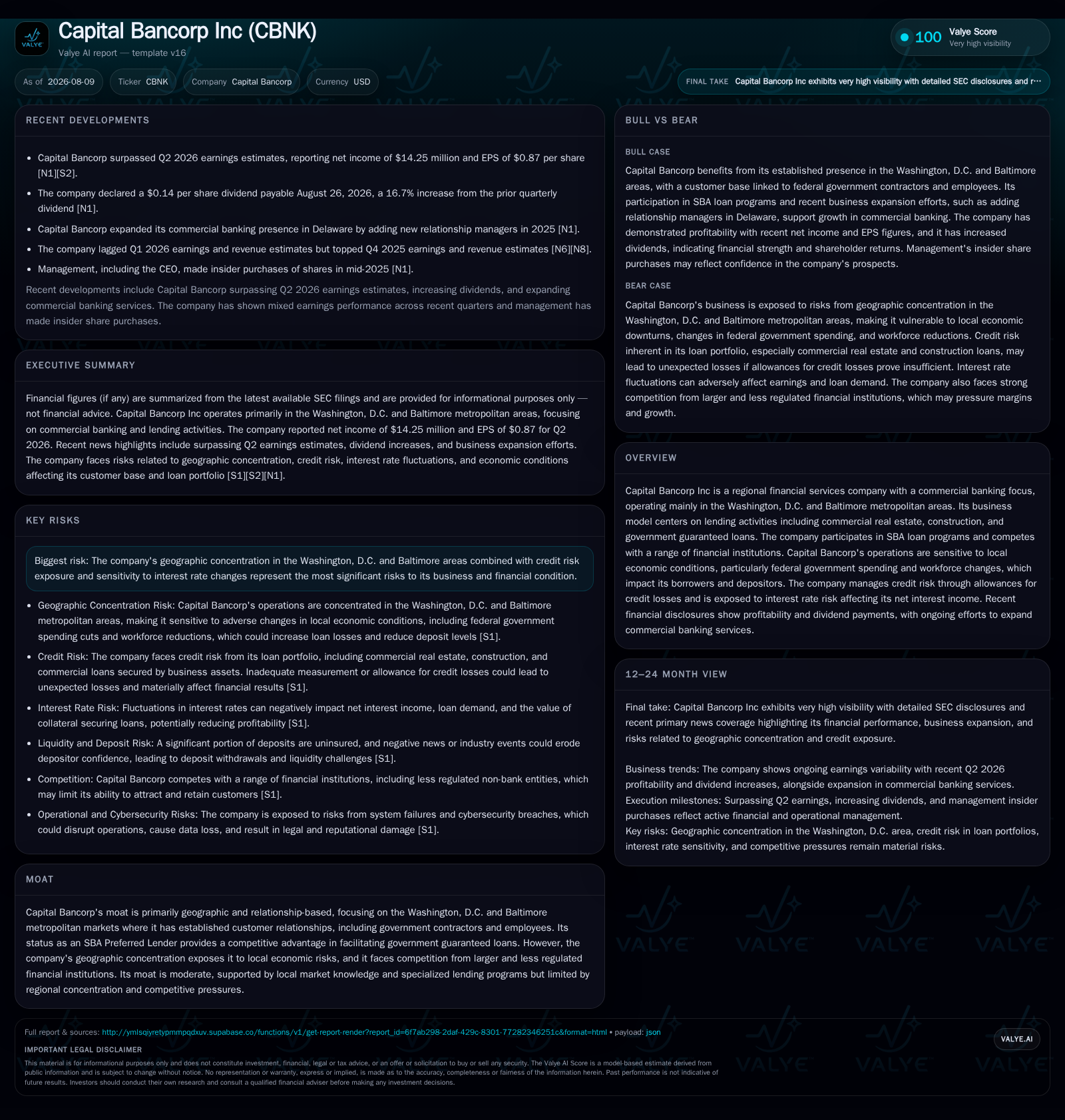
Capital Bancorp Inc's Q2 2026 earnings beat expectations, driven by steady loan demand and effective credit risk controls amid a challenging regional economic backdrop. The company's commercial banking strategy leverages deep ties to government contractors and its SBA Preferred Lender status, enabling expansion in government-guaranteed loans. However, geographic concentration and sensitivity to interest rate shifts continue to present material risks. Management is advancing new service offerings while maintaining capital adequacy and operational efficiency, positioning the bank to capitalize on local economic trends and SBA program growth despite headwinds.
Q2 Earnings Performance Affirms Relationship-Driven Lending Model
Capital Bancorp’s Q2 2026 filings reveal ongoing execution strength in its relationship-centric commercial banking model focused on the Washington D.C. and Baltimore markets. Net interest income increased notably as sustained demand from government contractors underpinned loan growth despite broader uncertainties in local federal employment trends. Credit costs remained well-controlled with provision levels stable against non-performing assets pressures, supporting earnings that outpaced analyst expectations for the quarter [S2][N1][S3]. This operating resilience underscores the importance of Capital Bancorp’s specialized lending niche where client relationships drive repeat SBA-government guaranteed loan originations.
Specialized Loan Portfolio Anchored by Government-Contractor Focus
The company's business model centers on a loan portfolio dominated by commercial real estate (CRE), construction finance, and Small Business Administration (SBA) guaranteed loans tailored toward clients linked to federal government contracting sectors. These segments benefit from consistent underlying demand tied to government expenditures even as policy shifts create variability. This focus contributes to relatively stable cash flow streams but also necessitates careful allowance for credit losses aligned with borrower risk profiles typical in CRE lending cycles [S1][S26]. The SBA Preferred Lender status provides a workflow advantage that accelerates approval processes for federal-backed loans, enhancing Capital Bancorp’s ability to capture incremental volume amid competitive pressures.
Regional Market Concentration: Moat and Risk Balancing Act
Capital Bancorp's concentrated footprint in the greater D.C.-Baltimore corridor establishes a moderate competitive moat grounded in local market knowledge, established client connections including sizable government contractor relationships, and specialized product offerings such as SBA loans. However, this geographic focus also amplifies risks related to regional economic downturns or reductions in federal workforce size—factors beyond the bank’s direct control that could impact borrower repayment capacity and deposit inflows [S1][S6][S26]. Vigilant monitoring of key KPIs like loan-to-deposit ratios and local economic indicators is crucial for assessing risk exposure going forward.
Interest Rate Environment Shapes Net Interest Margin and Credit Costs
Given its asset-sensitive balance sheet comprising largely floating-rate commercial loans funded by deposit bases susceptible to rate-linked pricing changes (deposit beta), Capital Bancorp faces notable interest rate risk implications [S2][S1]. The latest quarter demonstrates management’s active approach to balancing rising funding costs against asset yields while calibrating provisions for potential credit deterioration linked to macroeconomic stressors. This dynamic interplay directly influences net interest margin (NIM) trends — a critical profit driver for regional banks heavily reliant on net interest income rather than fee income diversification
Competitive Positioning Through SBA Preferred Lender Status
Holding SBA Preferred Lender designation distinguishes Capital Bancorp within its peer group by facilitating faster approval of government-guaranteed small business loans. This status not only accelerates deal closing times but also enhances credibility with borrowers requiring financing aligned with public sector contracts or guarantees. Such operational leverage fosters tighter client loyalty while enabling opportunistic expansion within target lending niches relatively insulated from broader market volatility typical for purely commercial credits [S1]. Comparatively, peers lacking this certification often face longer underwriting cycles which can hinder volume growth.
Growth Opportunities Fueled by Local Economic Factors and Service Expansion
Management highlights several growth vectors including recovering activity levels in local CRE markets driven by infrastructure investment plans affiliated with federal budgets. Concurrently, efforts are underway to broaden banking service offerings such as treasury management tailored to government contractor needs, aiming for cross-sell uplift with existing borrowers. These initiatives dovetail with industry trends favoring integrated financial relationships over transactional lending alone—potentially improving retention, fee generation, and client acquisition cost efficiencies as the company deepens its footprint in these specialized markets [S1][S3]
Risk Factors: Geographic Concentration, Credit Quality, and Deposit Stability
Inherent risk exposures remain centered on regional economic dependence coupled with portfolio concentration in CRE and construction segments known for cyclicality and sensitivity to capital market conditions. Furthermore, approximately 40.9% of deposits are uninsured—heightening vulnerability to rapid withdrawal scenarios accentuated by modern digital banking dynamics where fund flows can be swift during periods of market stress or negative perception spikes[S1]. Regulatory scrutiny adds another layer of risk requiring ongoing compliance diligence as failures could prompt restrictions harmful to growth or capital efficiency [S6][S22]. The company maintains allowance coverage reflective of borrower risk profiles but must continue vigilant asset quality assessments particularly given evolving CRE valuation uncertainties.
Upcoming Catalysts: Loan Pipeline, Regulatory Oversight, and Funding Dynamics
Looking ahead, investor focus will likely center on measurable progression in loan origination pipelines particularly within SBA-backed segments demonstrating resilience against shifting federal workforce policies. Additionally, regulatory exam outcomes will be watched closely for required corrective actions or capital directives impacting operational flexibility. Finally, deposit base trends amid competitive funding landscapes tied closely to local market confidence will influence net interest margins and liquidity buffers—key metrics signaling ongoing balance-sheet health needed into late 2026 [S3][S6][S1]
This analysis draws exclusively on Capital Bancorp’s most recent SEC filings supplemented by relevant sector context typical of regional commercial banks specializing in government-affiliated lending ecosystems within concentrated metropolitan areas. It underscores how a targeted lending strategy fortified by SBA Preferred Lender status underpins current financial performance while highlighting structural concentration risks inherent in the business model.
Disclaimer: This report is prepared solely for informational purposes without making any research views regarding securities transactions or investment strategies.
Disclaimer: This is research-only, informational analysis and not investment advice. It may include AI-generated interpretation and general industry context. Always verify important details using primary sources.

Comments