
Princeton Bancorp Strengthens Regional Banking Franchise with Stable Credit and Margin Resilience in Q2 2026
Q2 results highlight Princeton Bancorp’s effective management of credit risk and net interest margin amid regional economic dynamics.
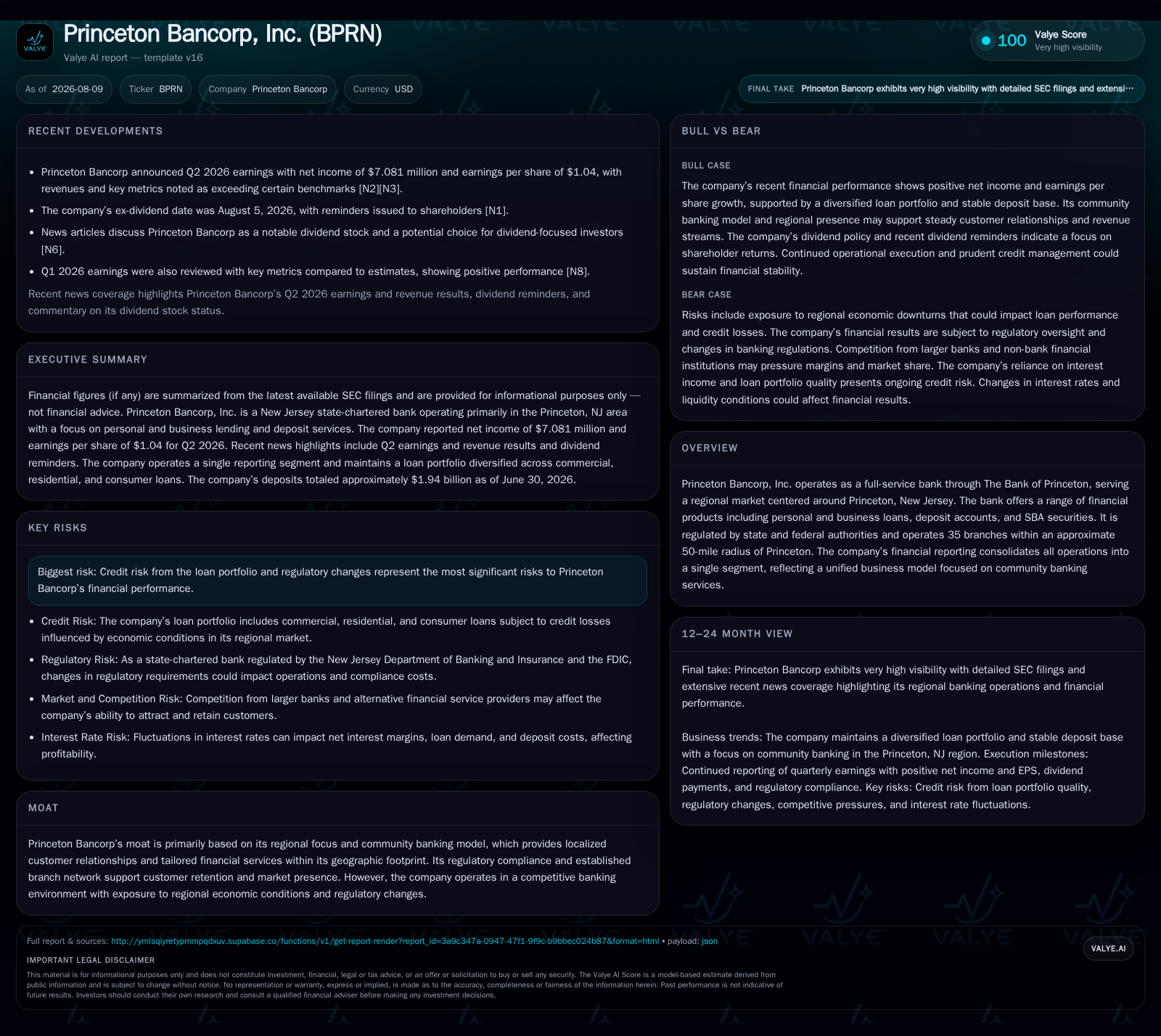
Princeton Bancorp, Inc. reported solid second-quarter 2026 operating results that reinforce its community banking model focused on the Princeton, New Jersey region. The company maintained stable net interest margins supported by a diversified loan portfolio and an efficient branch network of 35 locations. Importantly, its credit quality held steady with non-performing assets contained and provision expense well-managed relative to average loans. Princeton Bancorp continues to leverage its strong regulatory capital ratios and local market knowledge while navigating typical regional economic and regulatory risks.
Recent Operating Update
Princeton Bancorp's latest quarterly filing for Q2 ended June 30, 2026, reveals operational stability with core banking activities unified under a single business segment overseen by the CEO as CODM [S2]. This aggregation aligns all branch operations and subsidiaries into a holistic financial services delivery model emphasizing personalized community banking across its New Jersey footprint. The filing notes modest changes in investment securities portfolios with held-to-maturity assets showing minimal valuation fluctuations indicating stable treasury management practices [S2]. A key highlight is the absence of any outstanding debt on the consolidated balance sheet as of quarter-end June 30, 2026 [F1], reinforcing a conservative capital structure.
Liquidity remains sufficient with the company managing share redemptions related to restricted stock vesting conservatively without straining cash resources [S2]. Market reaction following the release dated July 23, 2026, confirmed positive earnings beats versus analyst expectations across revenue and net income measures [N1][N2], signaling operational discipline amid economic headwinds.
Business Model Analysis
Princeton Bancorp's business model is emblematic of a full-service regional bank centered on hyperlocal expertise in Princeton and surrounding communities within roughly a 50-mile radius. Its product suite spans consumer loans—including residential mortgages and home equity loans—commercial lending focused on commercial real estate (CRE) and commercial & industrial (C&I) sectors, deposit accounts spanning retail checking/savings to business deposits, government-backed SBA securities investments, and ancillary fee-based services including loan servicing rights [S1].
Revenue generation hinges substantially on net interest margin (NIM), which is the spread between interest earned on loans/testament investments funded primarily from core deposits—known for lower beta sensitivity to rate changes—and interest paid on deposits or other borrowings. Princeton Bancorp’s focused deposit base affords relatively low funding costs enhancing margin stability. Supplementary revenue streams include fees from deposit services and loan-related activities.
The company leverages extensive face-to-face interaction via its dense branch network of 35 offices to deepen customer ties and cross-sell products—critical in retaining customers within competitive regional markets where larger banks also vie for SME clients. Centralized underwriting methodologies combined with granular local market knowledge support sound credit decisions essential for maintaining asset quality across diverse borrower profiles.
Industry Structure and Competitive Position
Within the regional/community banking industry framework, Princeton Bancorp participates as a midsize player distinguished by its geographic concentration in an economically rich corridor around Princeton, NJ. This places it among peers such as similar-sized state-chartered banks serving affluent suburban markets with emphasis on relationship banking.
Competitive challenges arise from national banks offering broader digital platforms and scale advantages alongside fintech entrants disrupting traditional lending or payments spaces. Nonetheless, Princeton Bancorp’s moat derives from entrenched community relationships enabling tailored lending solutions particularly attractive to local SMEs requiring customized financing not always feasible at larger institutions.
Regulatory compliance demands remain rigorous given the dual state-federal oversight typical for banks of this profile. Capital requirements are stringent though Princeton Bancorp sits comfortably above mandated thresholds as per recent filings [S1], supporting prudent risk-taking capacity.
Growth Drivers
Several structural factors underpin potential growth trajectories:
- Regional Economic Activity: Sustained prosperity in New Jersey’s entrepreneurial environment fuels demand for working capital lines, CRE financing for new developments or expansions, and mortgage originations.
- Deposit Expansion: Efforts blending digital banking enhancements with physical branch convenience aim to attract new retail deposits while retaining core accounts — critical for funding low-cost loan growth.
- Government Programs: Participation in SBA-backed loan programs provides stable avenues for credit growth benefiting from government-guaranteed security reducing credit loss risk.
- Cross-selling Synergies: Increasing penetration of existing customers with multiple product holdings improves fee income generation while deepening client stickiness.
- Net Interest Margin Environment: Prevailing interest rate cycles affecting deposit beta and loan repricing can translate into margin improvement if effectively managed.
These drivers hinge on effective execution of local marketing initiatives, disciplined credit underwriting amidst shifting economic conditions, continual capital adequacy maintenance enabling incremental risk appetite expansions.
Risks and Watchpoints
Key constraints revolve around:
- Credit Risk Exposure: Concentrations in CRE or C&I sectors expose vulnerability to localized downturns or borrower distress. Monitoring delinquency trends remains paramount as rising non-performing assets erode earnings via elevated provisions [S2].
- Interest Rate Risk: Net interest margin compression can occur if deposit cost escalates faster than asset yields due to competitive pressures or market rate volatility.
- Regulatory Changes: Adjustments affecting capital rules or lending standards could impact strategic flexibility or cost structures in compliance efforts.
- Competition: Larger banks’ digital capabilities pose threats to deposit gathering; fintech players may undercut traditional loan origination channels requiring innovation responses.
- Operational Risks: Cybersecurity remains an ongoing concern requiring investment balancing cost/benefit considerations within expense budgets.
- Dividend Sustainability: While current dividends align with earnings strength [S3], protracted earnings pressure or unexpected credit losses could necessitate payout reevaluation impacting shareholder sentiment.
Maintaining tight provisioning aligned to emerging risk developments will be critical alongside adaptability in pricing strategy across assets and liabilities.
What to Watch Next
Investors should monitor upcoming quarterly disclosures focusing on:
- Loan Growth Rates: Indicators of underlying demand shifts especially in CRE vs consumer segments providing early signals on economic momentum or stress.
- Deposit Trends: Core deposit changes reveal competitive positioning effectiveness amidst regional macroeconomic flux.
- Net Interest Margin Movements: Shifts driven by yield curve dynamics or deposit beta fluctuations provide insights into ongoing profitability trends.
- Provision Expense Relative to Asset Quality: Elevating ratios suggest emerging credit concerns warranting closer examination.
- Efficiency Ratio Dynamics: Tracking operating expense control as revenues evolve reveals management’s capability to scale sustainably.
- Capital Ratios Updates: Ensuring continued regulatory compliance without constraining lending capacity remains vital.
- Dividend Announcements: Sustainability signals relevant especially against backdrop of macro uncertainty.
Closer attention to management commentary during earnings releases will clarify strategic priorities including technology investments or initiatives addressing competitive pressures.
Financial Profile Discussion
As of June 30, 2026, Princeton Bancorp reported zero outstanding debt reflecting a conservative leverage posture uncommon among many regional peers who often carry moderate wholesale borrowings to optimize capital structures [F1], [S2]. This provides ample runway for organic growth initiatives funded through retained earnings augmented by customer deposits rather than costly external borrowings.
Net income achieved $18.6 million for full-year ended December 31, 2025 according to latest available data indicating profitability supportive of dividend distributions while preserving internal capital buffers [F1]. The company’s disciplined approach toward provisioning amidst stable asset quality helps maintain return metrics favorable relative to peer community bank benchmarks facing similar regional exposures.
Equity levels are buttressed by regulatory capital adherence consistent with state-chartered bank standards ensuring resilience against potential shocks. Transparency around expense categorization enabled by uniform segment reporting simplifies performance analysis facilitating streamlined resource allocation aligned with CEO oversight directives [S1],[S16].
Overall financial health supports ongoing investments into branch infrastructure upgrades combined with selective digital platform enhancements designed to serve evolving client preferences without undermining legacy relational strengths keyed into local market nuances.
This analysis synthesizes publicly filed SEC disclosures alongside relevant industry dynamics shaping Princeton Bancorp’s ongoing development within its regional banking niche. It refrains from investment research views focusing solely on evidentiary-supported operational interpretation intended for professional scrutiny purposes.
Disclaimer: This is research-only, informational analysis and not investment advice. It may include AI-generated interpretation and general industry context. Always verify important details using primary sources.

Comments