
Atmus Filtration Technologies Leverages OEM Partnerships to Outperform Tariff Challenges in Q2 2026
Atmus's Q2 results reveal resilience through strong OEM contracts and adaptive pricing amid complex tariff headwinds.
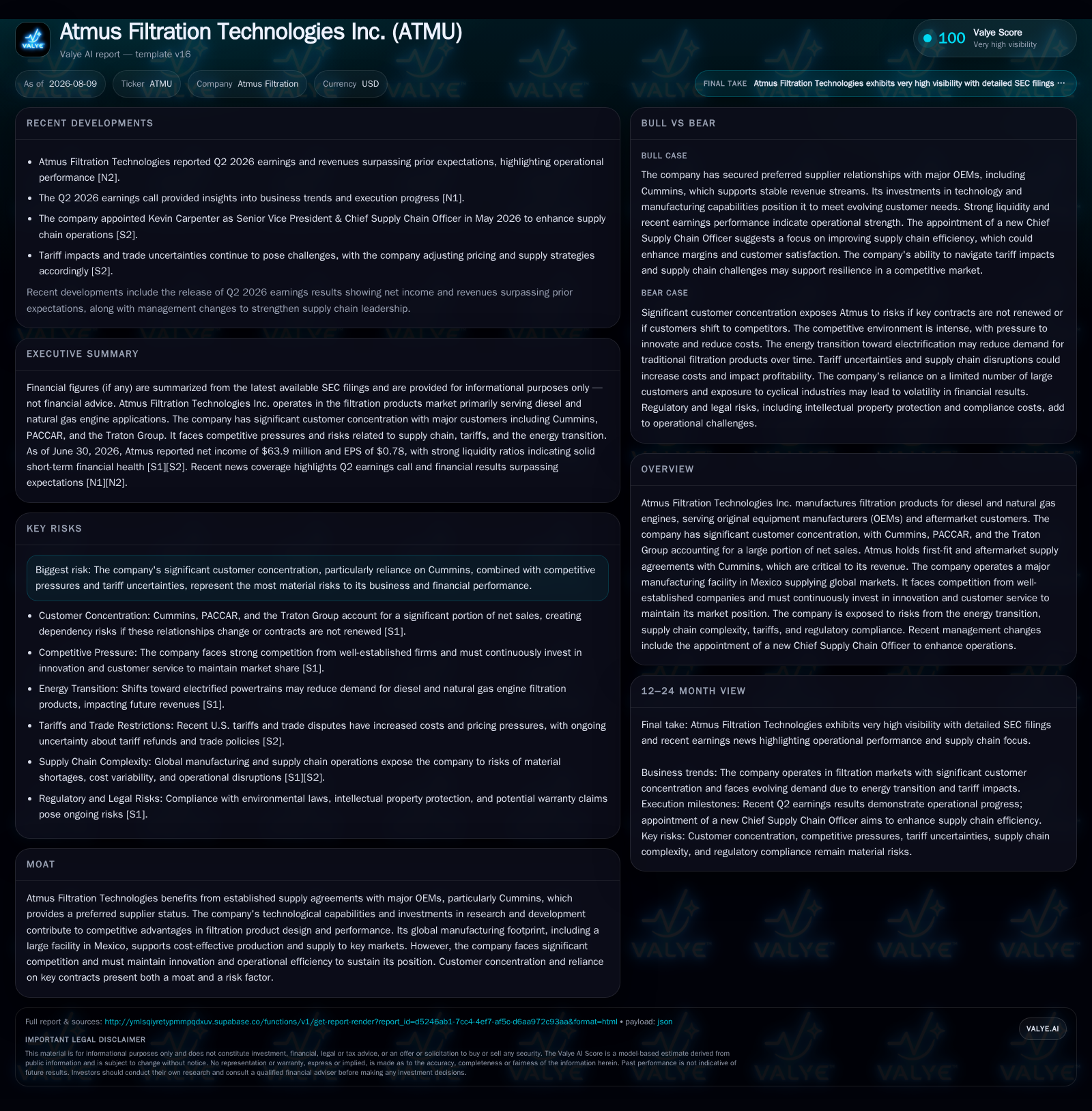
In its latest quarterly filing, Atmus Filtration Technologies showcased operational strength driven by sustained supply agreements with major OEMs, notably Cummins, which helped offset rising costs from increased tariffs. The company’s manufacturing scale in Mexico and significant R&D investments underpin its ability to manage supply chain complexities and maintain competitive filtration technology. However, substantial customer concentration and ongoing trade policy uncertainties remain pivotal risk factors influencing future performance.
Q2 2026 Results Highlight Supply Agreement Strength Amid Tariff Pressures
Atmus Filtration Technologies’ Q2 2026 Form 10-Q filing reveals the company’s adept response to recent tariff escalations affecting imports from key manufacturing regions including Mexico and China. Management acknowledged that tariff-driven cost increases pressured the cost of goods sold (COGS), particularly on finished goods, purchased components, and raw materials [S2]. In response, Atmus raised prices on select products, a tactical move that largely mitigated margin compression despite ongoing uncertainty about the duration and scope of trade restrictions [S25],[S17]. The manufacturing site in San Luis Potosí benefits from United States-Mexico-Canada Agreement (USMCA) tariff exemptions for qualifying goods supplying the U.S. market; however, these exemptions face potential reduction or elimination in future trade negotiations [S2],[S25]. This geographical production footprint is critical for optimizing cost structures amid such regulatory flux.
Earnings for the quarter exceeded market estimates [N3], signaling operational resilience through strong customer relationships anchored by firm supply agreements.
Concentrated OEM Exposure Shapes Revenue Stability and Risk
Atmus’s revenue profile is heavily weighted toward a small group of major original equipment manufacturers (OEMs). Cummins Inc., PacCar Inc., and the Traton Group collectively accounted for approximately 46.6% of net sales in fiscal year 2025 — with Cummins representing nearly 18.8% alone [S23],[F1]. These relationships provide a stable foundation given Atmus’s first-fit supply agreement coupled with aftermarket provisions securing recurring revenue streams [S1]. However, heavy customer concentration introduces material risk: any disruption or termination of these contracts could materially impair financial performance [S14],[S26].
Cummins notably exercises considerable bargaining power due to its size and strategic importance. While Atmus holds preferred supplier status backed by well-established agreements executed in mid-2023 [S27], renewal negotiations will be critical KPIs to monitor. Failure to renew or adverse contract terms could manifest as revenue volatility or margin pressure.
Innovation Investments Sustain Technology Leadership in Emissions Filtration
Atmus sustains a competitive edge through substantial investments in research and development (R&D), focused on filtration media technology essential for meeting increasingly stringent emissions regulations associated with diesel particulate filters (DPF) and engine air filters used across diesel and natural gas powertrains [S1]. R&D expenditure as a percentage of sales remains significant, signaling a commitment to advancing product performance critical for emissions compliance—an industry imperative given regulatory trends.
This innovation-centric approach aligns Atmus alongside industry leaders such as Donaldson Company Inc. and Mann+Hummel, which similarly emphasize technological differentiation to maintain OEM partnerships. Such investments help mitigate commoditization risks inherent in the filtration component sector.
Manufacturing Scale in Mexico Enables Cost Management Under Trade Uncertainty
The company’s large-scale manufacturing operations centered in San Luis Potosí deliver a vital cost advantage while serving global markets. This facility is certified compliant under USMCA rules allowing tariff-free import into the U.S., directly countering recent import duty hikes that challenge suppliers relying on other jurisdictions [S24],[S25].
This strategic site not only lowers unit production costs but also reduces lead times for order fulfillment—a crucial factor under heightened supply chain complexity. Nonetheless, escalating tariffs beyond USMCA coverage or shifts in geopolitical dynamics could erode this advantage [S2]. Maintaining capacity utilization and operational efficiency at this plant will continue to be an important operational KPI.
Balancing Aftermarket Growth Against First-Fit Dynamics
Atmus’s business model derives revenue primarily from first-fit OEM contracts complemented by aftermarket sales. The former offers predictable volume linked to new engine assembly production schedules under long-term purchase agreements with companies like Cummins [S1],.
Aftermarket revenues are influenced by fleet size and age since replacement filter sales correlate with maintenance cycles. This segment provides growth upside given aging commercial vehicle populations worldwide but introduces greater demand volatility than first-fit channels. Balancing investments tailored toward both segments influences revenue mix stability: sustained aftermarket growth can soften cyclical downturns impacting new engine installations.
Risks from Global Trade Policies, Customer Concentration, and Competitive Pressures
Key risks outlined remain tightly integrated with macro-geopolitical factors. Tariff volatility has introduced cost unpredictability despite temporary USMCA-related relief [S25],[S17]. The legal uncertainty following the U.S. Supreme Court ruling invalidating some tariffs under IEEPA further clouds prospects around refunds and future trade measures [S25],[S16]. Moreover, reliance on a concentrated set of OEM customers amplifies vulnerability should purchasing preferences shift or contract renewals fail [S22],[S14].
Competition is intense from global filtration component suppliers seeking share via technological innovation and pricing pressures—all while managing escalating raw material costs amid supply chain constraints,[S1]. The company must sustain innovation cadence and operational excellence to defend its market position.
Growth Trajectory Fueled by Regulatory Trends and Fleet Expansion
Long-term demand drivers favor Atmus as commercial vehicles powered by diesel and natural gas engines occupy critical roles globally. Increasingly strict emissions standards promote adoption of advanced filtration technologies integral to compliance strategies adopted by OEMs. Urbanization trends supporting expanded freight infrastructure contribute to commercial fleet growth sustaining replacement part demand.
Technological improvements enhancing fuel efficiency simultaneously drive product upgrades boosting average selling price per unit—an important margin lever for Atmus,. These structural factors underpin a framework supportive of medium-to-long term revenue growth presuming the company continues securing key supply contracts.
What To Watch: Contract Renewals, Tariff Developments, and Innovation Milestones
Critical upcoming milestones for observers include negotiations around expiring supply agreements—especially those with Cummins—given their disproportionate impact on overall sales volume [S27],[N2]. Additionally, monitoring changes in U.S., Mexican, Canadian trade policies that may redefine tariff frameworks or reduce USMCA benefits will be pivotal [S25],[N2].
Innovation output measured via new product launches or patent filings aligned with emissions regulation cycles will signal management’s ability to maintain technological relevance against peers like Donaldson and Mann+Hummel.[N2] Improving throughput or reducing lead times at the Mexico plant might also indicate better cost control.
Financial Profile Discussion: Liquidity, Leverage, and Margin Trends
Atmus closes Q2 2026 with a healthy liquidity position reflected by a current ratio of approximately 2.65 based on current assets of $965 million against current liabilities of $364 million [F1]. Cash & equivalents stood at $259 million at quarter-end aiding operational flexibility amid sector cyclicality concerns. Although total debt balances roughly $1 billion resulting in net debt near $741 million after cash offsets [F1], the company manages this leverage through consistent operating income generation supported by robust supply arrangements.
This analysis is based solely on publicly available regulatory filings and documented news items provided up to August 2026. It does not constitute investment advice or research views.
Disclaimer: This is research-only, informational analysis and not investment advice. It may include AI-generated interpretation and general industry context. Always verify important details using primary sources.

Comments