
XCel Brands Faces Liquidity Pressures After Judith Ripka Asset Sale and Debt Amendments
XCel Brands navigates financial strain amid brand portfolio shifts and licensing revenue challenges in early 2026.
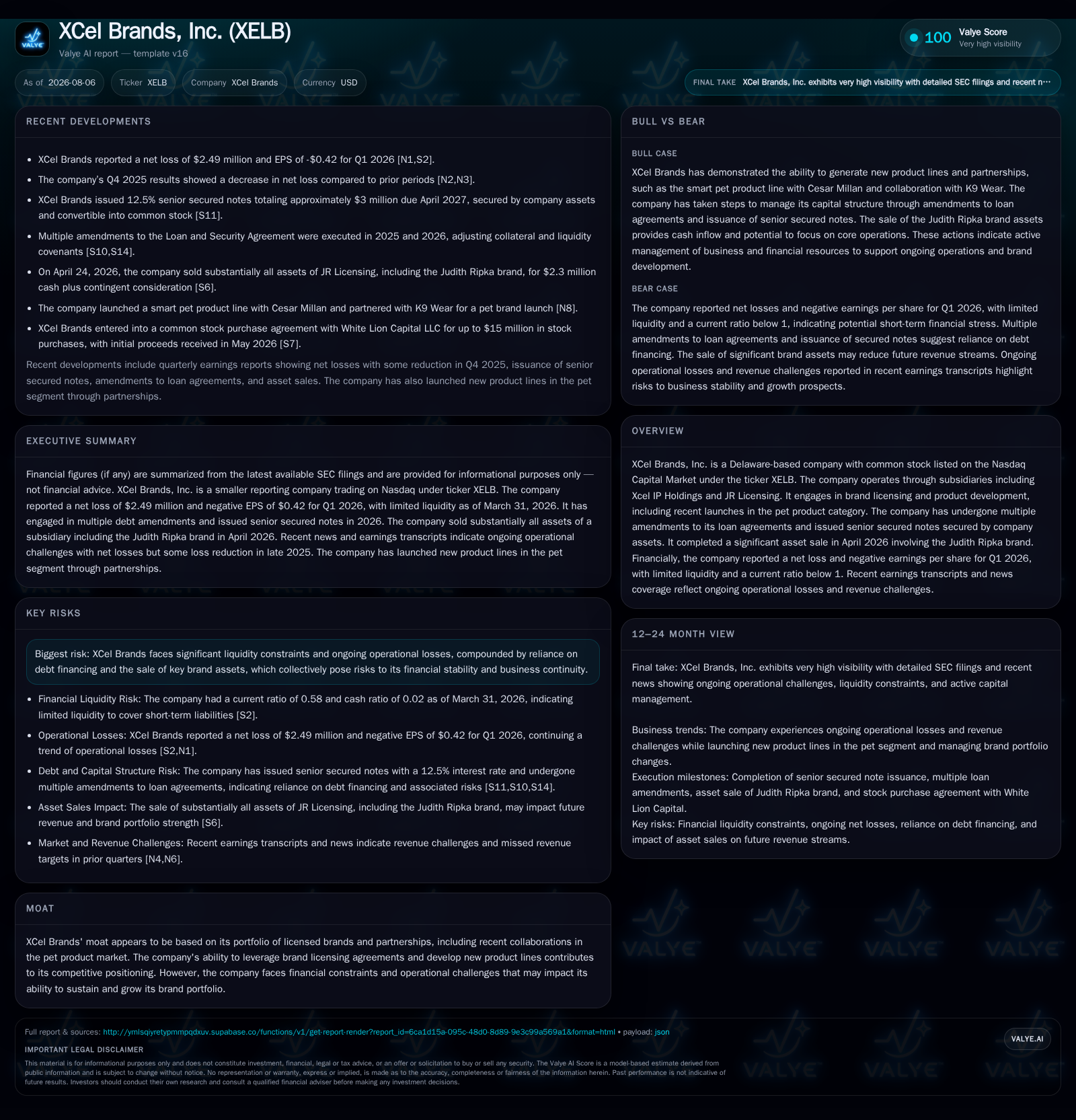
In Q1 2026, XCel Brands reported ongoing net losses and liquidity constraints, underscored by a current ratio of 0.58 and $13.3 million in total debt. The April 2026 sale of the Judith Ripka brand marked a significant portfolio realignment amid operational difficulties. The company’s business model hinges on licensing intellectual property and developing consumer product lines, including recent expansions into pet products. However, financial pressures from amended loan agreements and secured notes raise concerns about sustaining growth and brand equity monetization in a capital-light but cash-constrained industry.
Recent Operating Update
XCel Brands’ latest quarterly filing for Q1 2026 reveals sustained operational difficulties marked by a net loss that continues to pressure earnings per share negatively [S2][F1]. This period also exposed liquidity strains with a current ratio of just 0.58 and total debt exceeding $13 million as of March 31, 2026 [F1], signaling tight working capital conditions that could constrain day-to-day operations.
The company undertook a significant strategic move in April 2026 by selling substantially all assets related to the Judith Ripka brand for an upfront cash payment of $2.3 million plus contingent proceeds potentially adding $0.75 million [S15]. This transaction reflects a notable reshaping of the company’s brand portfolio amid ongoing financial pressures.
Furthermore, the issuance of senior secured notes in April, backed by company assets as collateral, underscores rising leverage risk amid restrictive capital market access [S25]
Business Model
Operating primarily as a licensor of intellectual property rights through subsidiaries such as Xcel IP Holdings and JR Licensing, XCel Brands generates revenue mainly via licensing fees and royalties earned from third-party manufacturers and retailers who produce and distribute branded products [S1]. This upstream position in the value chain enables capital-light operations with relatively low fixed costs; however, revenue is volatile based on licensee performance and the relevance of licensed brands.
Recently, the company expanded into consumer product categories including pet products—an area showing promise for incremental growth owing to increasing market demand—but evidence on product launch success rate or licensee traction remains limited [S1]. Brand portfolio management is central to sustaining royalty revenue; hence divestitures like Judith Ripka reduce brand breadth but can inject immediate liquidity.
Revenue mechanics depend on maintaining active licensing agreements with quality licensees who can deliver market penetration while ensuring brand equity remains intact through controlled product development and marketing support. Pricing power manifests through negotiated royalty rates which can vary by product category and exclusivity terms.
Industry Structure and Competitive Position
XCel Brands operates within the brand licensing and consumer products industry characterized by firms such as Iconix Brand Group and Sequential Brands Group that similarly monetize portfolios of intellectual property via third-party licensees. This sector's value hinges on effective brand equity management alongside navigating the ebbs of consumer demand across product categories.
Unlike direct manufacturers or retailers, licensors must balance licensee recruitment and retention with contractual rigor to protect intellectual property usage while maximizing royalty income streams over long durations. Financial health assessment often revolves around liquidity ratios due to reliance on recurring royalties rather than asset-heavy inventories or direct sales.
Within this landscape, XCel’s recent asset sale positions it smaller but potentially more focused; however, its operating losses coupled with high leverage place it at some disadvantage relative to peers with deeper balance sheets or broader diversified portfolios.
Growth Drivers
Future growth conspicuously depends on how well XCel can expand its licensing agreements both in number and in scope—particularly by penetrating new consumer product segments like pet care where it has begun product launches [S1]. Effective co-branding initiatives can amplify market reach by pairing known brands with emerging ones or complementary products.
Another key driver includes enhancement of brand renewal rates through sustained licensee performance monitoring—critical given that royalty income growth is contingent upon active agreement renewals without steep attrition. Geographic expansion or digital channel development may offer additional avenues; however, evidence for these strategies was not detailed.
Successful monetization will also require cautious management of marketing spend effectiveness to boost sell-through while controlling promotion-related margin erosion—a known challenge among consumer-focused licensors aiming to maintain gross margins.
Risks and Watchpoints
XCel faces acute liquidity constraints highlighted by its sub-1 current ratio (0.58) which presages short-term risk in meeting obligations without additional financing or asset sales [F1]. Dependency on debt financing exposes it to refinancing risks especially given tightened covenants observed through multiple loan amendments in early 2026 [S16][S17].
Operational losses remain a persistent concern dampening cash flow conversion despite the traditionally capital-light nature of licensing models. Divesting valuable brands like Judith Ripka could impair future royalty revenue streams unless offset by successful new licensing acquisitions or product introductions.
The competitive pressure within brand licensing also elevates the need to sustain brand equity against private label encroachment or competing licensors capturing market share. Additionally, contractual risks exist if licensees underperform or default, exacerbating top-line volatility.
Regulatory risks surrounding intellectual property rights or changes affecting licensing contract enforceability are potential external threats although not specifically cited recently for XCel.
What to Watch Next
Investors should monitor upcoming disclosures for details on new licensing agreements signed post-Judith Ripka divestiture since they will signal the company's ability to replenish royal income inflows [S1]. Quarterly updates measuring changes in active license agreements count or product line expansions into pet products will be critical KPIs.
Liquidity developments remain paramount; any announcements on further debt restructuring or capital raises will provide insight into financial agility under stress scenarios noted earlier this year [S2][S3]. Equity issuance activity under the Purchase Agreement initiated in January 2026 may partially alleviate cash shortages but requires scrutiny for dilution impacts [S26][S20].
Operationally, signs of narrowing net losses or stabilizing earnings per share would indicate improving cost control or efficiency gains. Also important are metrics describing licensee performance outcomes and renewal rates as proxies for long-term royalty sustainability.
Financial Profile Discussion
As of March 31, 2026, XCel’s financial position reflects constrained liquidity with cash reserves at only $179,000 against current liabilities near $7.7 million—translating to a current ratio of approximately 0.58 [F1]. Total debt stands over $13 million, largely linked to recently issued senior secured notes collateralized by company assets following amended financing arrangements executed earlier this year [F1][S25].
The firm recorded steep operating losses totaling approximately $13.2 million for fiscal year-end December 31, 2025, culminating in a net loss nearing $17.5 million—a continuation from previous years’ challenges consistent with industry peers facing monetization hurdles amidst competitive pressures [F1][S1]
Capital structure transformations via secured notes have increased leverage but provided much needed immediate funding relief albeit at the cost of higher interest obligations and enhanced creditor control over assets [S25]. This reflects typical trade-offs faced by licensors with limited intangible collateral seeking survival amid cash flow deficits.
Disclaimer: This analysis is based solely on publicly available filings and reflects no investment advice or research view regarding XCel Brands stock.
Disclaimer: This is research-only, informational analysis and not investment advice. It may include AI-generated interpretation and general industry context. Always verify important details using primary sources.

Comments