
FS KKR Capital Navigates Middle-Market Credit Challenges with Defensive Portfolio and Leveraged Structure
FS KKR Capital Corp’s recent quarterly report highlights credit valuation pressure amid a defensive investment posture targeting senior secured loans in private U.S. middle-market companies.
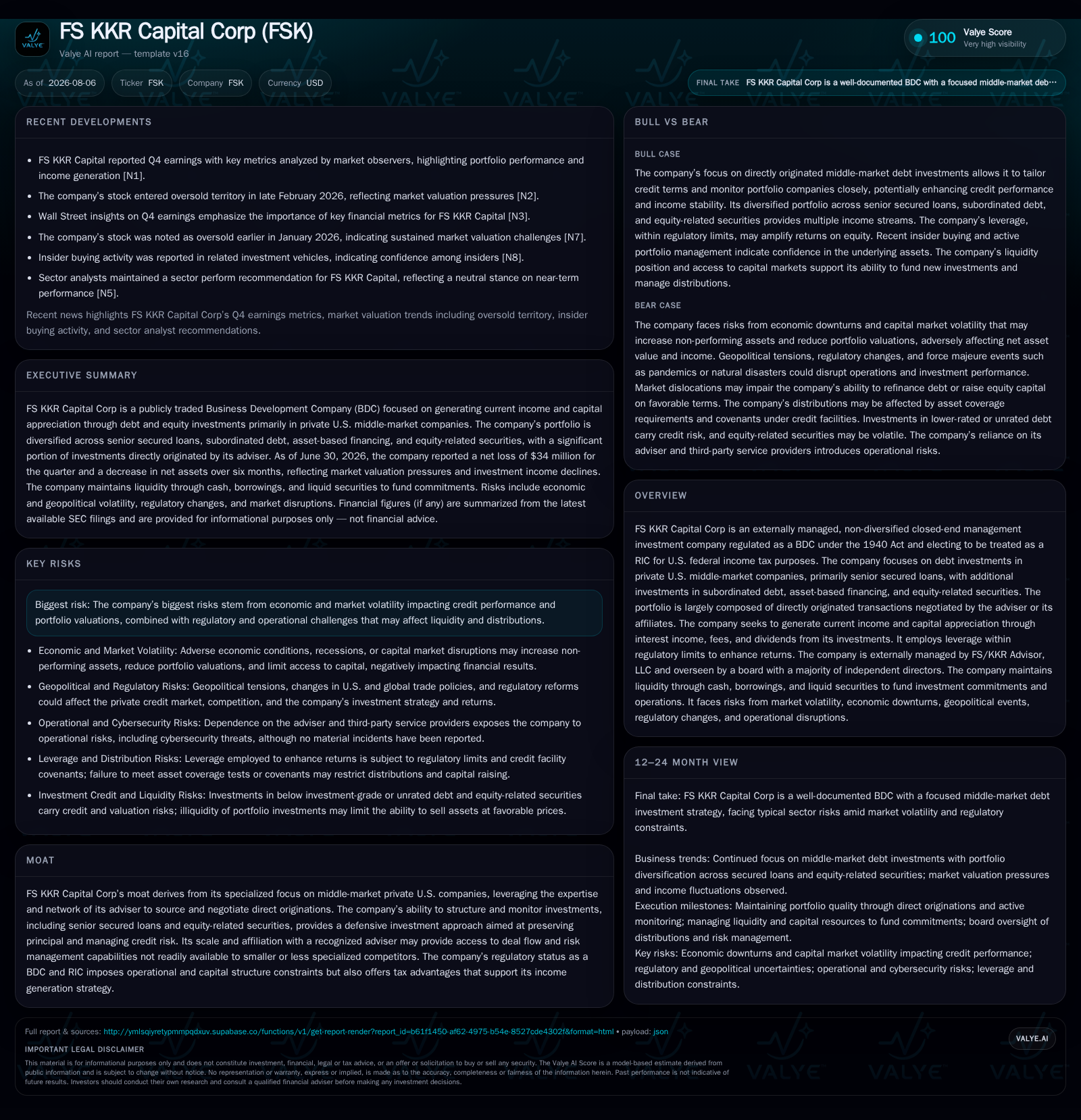
In its latest quarter, FS KKR Capital Corp (NYSE: FSK) reported net asset value pressure driven primarily by lower valuations of select portfolio companies, consistent with industry-wide market volatility impacting middle-market credit. The company's business model centers on generating current income through an externally managed, closed-end BDC framework that invests predominantly in senior secured loans to private U.S. middle-market firms. Leverage remains a key driver of returns within regulatory limits, though asset coverage ratios remain above required minimums. FS KKR’s competitive moat depends heavily on its adviser’s origination capabilities and portfolio monitoring expertise amid cyclical credit risks. Looking ahead, challenges include navigating macroeconomic uncertainty and capital market conditions that could affect refinancing and distribution capacity.
Recent Operating Update
FS KKR Capital Corp’s (FSK) second quarter 2026 results reveal the tangible effects of ongoing volatility in the private middle-market credit ecosystem. The company reported a net decrease in net assets from operations of $34 million (or $(0.13) per share) for the quarter ended June 30, 2026, contrasting with a net increase during the same period last year [S2][S24]. This decline was primarily driven by reduced valuations of select portfolio holdings, including notable assets such as COPJV and Production Resources Group. These markdowns underscore persistent valuation pressures within less liquid private investments amid uncertain macroeconomic conditions.
Business Model and Strategic Position
FSK operates as an externally managed, non-diversified closed-end business development company overseen by a majority independent board. Its core investment objective remains generating current income with secondary capital appreciation by focusing primarily on debt instruments issued to private U.S. middle-market companies—defined here as firms with annual EBITDA between $50 million and $150 million at origination [S1][S2]
The Adviser leverages its direct origination capabilities to negotiate comprehensive deal terms beyond price alone—covering covenant packages, maturity profiles, and interest structures—thus aiming to embed prudent credit terms while achieving competitive yields [S1]. This direct origination focus contrasts with BDC peers who may rely more heavily on secondary market purchases, potentially offering better downside protection through substantive structural control.
Within the portfolio composition, senior secured loans dominate, supplemented by second lien loans and asset-based finance products tailored for companies requiring specialized capital solutions [S1]. This specialized sourcing capability paired with active portfolio monitoring affords FS KKR potential structural advantages over pure secondary buyers or less focused specialty lenders.
Peer groups encompass other large BDCs like Ares Capital Corporation (ARCC), Owl Rock Capital Corporation which shares a similar direct lending emphasis, Golub Capital BDC known for its concentration on direct origination strategies, along with diversified entities such as Main Street Capital Corporation. Traditional commercial banks continue serving overlapping client profiles but face regulatory headwinds limiting their middle-market exposure, positioning FSK within an expanding private credit niche.
Growth Drivers
The expanding demand for private credit among middle-market companies serves as a primary engine behind FSK’s growth opportunity set. This demand is fueled by persistent bank regulatory constraints limiting traditional lending volumes while these companies seek flexible financing solutions beyond public markets.
Rising interest rates globally have broadened yield spreads in floating-rate senior secured loans—the portfolio’s mainstay—providing upside potential for investment income streams amid modest increases in borrowing costs under floating-rate debt arrangements [S1][S15]. Incremental diversification into subordinated debt or asset-based finance sectors can also unlock additional revenue pools.
Capital raising flexibility fortified by recent shareholder-approved authorizations to issue warrants or convertible instruments enhances strategic optionality for growth funding without immediate dilution risks [S6]. Additionally, evolving portfolio mix optimization focused on higher-quality credits combined with vigilant covenant enforcement could improve credit outcomes especially if economic volatility stabilizes.
Risks and Watchpoints
Key risks prominently include economic cyclical downturns negatively impacting borrower repayment capacity that could elevate non-performing assets ratios beyond current levels—a critical KPI given FSK’s defensive mandate on principal preservation [S1][S2]. Continued downward pressure on valuation multiples for illiquid assets could also weigh on net asset value per share metrics.
Market liquidity risk is intrinsic given many investments are privately negotiated loans not traded broadly; this illiquidity complicates timely monetization during stress periods potentially forcing realizations below recorded fair values [S1][S14]. Investor behavior around share price volatility relative to NAV remains another watchpoint given external factors can drive discount/premium swings unrelated directly to underlying fundamentals.
Lastly, the discretionary nature of share repurchase programs means that despite existence no assured support exists for share price or narrowing discounts absent explicit repurchase volumes or targeted pricing intervals [S2][S21]
What to Watch Next
Upcoming milestones include monitoring Q3 earnings releases for trajectory shifts in net investment income and realized credit losses, which collectively signal portfolio health sustainability amidst continued economic uncertainty.
Attention should be paid to leverage ratio adjustments through debt issuance or repayments as part of yield optimization against asset coverage buffers.
Portfolio non-accrual trends alongside shifts in loan-to-value metrics could serve as early markers of emerging credit stress.
Fee income growth derived from both origination activities and asset management operations will be important indicators reflecting adviser effectiveness in leveraging scale.
Finally, guidance or commentary updates around dividend policies will clarify distribution sustainability aligned with underlying cash flows.
Financial Profile Discussion
The company maintains a revolving credit facility with available borrowing capacity exceeding $3 billion combined across multiple arrangements providing considerable liquidity flexibility for new investments or refinancing needs [S8][S15]
Leverage usage is tactically managed within regulatory mandates; the reduction of required asset coverage from 200% to 150% post-2019 improves capital efficiency but simultaneously elevates sensitivity to asset valuation shifts – warranting close tracking going forward [S8][S9]
Overall expense ratios inclusive of management fees are tightly monitored given their direct impact on net investment income retention supporting shareholder returns alongside incentive fee structures aligning interests between advisers and investors [S1][S21]
Disclaimer: This is research-only, informational analysis and not investment advice. It may include AI-generated interpretation and general industry context. Always verify important details using primary sources.

Comments